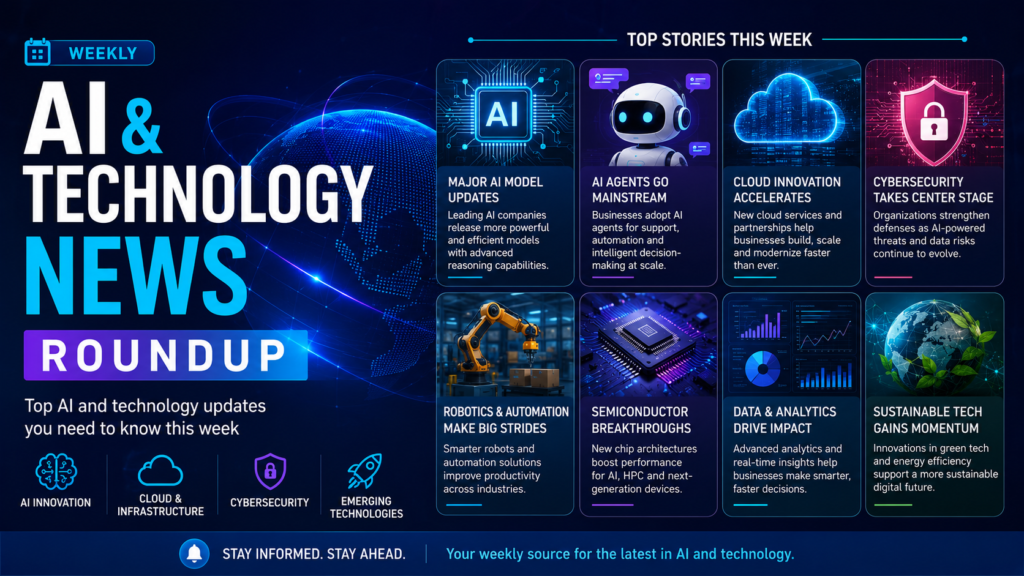
Weekly AI & Technology News Roundup
Introduction
Artificial Intelligence (AI) and emerging technologies continue to reshape industries at an unprecedented pace. Every week brings new breakthroughs in generative AI, cloud computing, cybersecurity, robotics, semiconductors, enterprise software, and digital transformation. Businesses are adopting AI-powered solutions to improve productivity, streamline operations, enhance customer experiences, and make smarter decisions. At the same time, governments, researchers, and technology leaders are introducing new regulations, security frameworks, and innovations that influence how organizations use technology responsibly.
Keeping up with these rapid developments is essential for business leaders, IT professionals, developers, entrepreneurs, and technology enthusiasts. Understanding the latest trends helps organizations identify new opportunities, prepare for emerging risks, and make informed technology investments.
This weekly roundup highlights the biggest developments across AI and technology, explores their business impact, and provides insights into where the industry is heading.
-
Artificial Intelligence Continues to Transform Business Operations
Artificial intelligence remains the biggest driver of digital transformation worldwide. Organizations are integrating AI into customer service, software development, finance, marketing, healthcare, manufacturing, and supply chain management.
Modern AI platforms can automate repetitive tasks, generate content, analyze complex datasets, assist developers with coding, and provide intelligent recommendations in real time.
Businesses are increasingly adopting AI because it helps:
- Improve productivity
- Reduce operational costs
- Enhance customer experiences
- Support data-driven decisions
- Automate repetitive workflows
- Accelerate innovation
As AI capabilities continue to evolve, organizations are focusing on implementing responsible AI practices while maintaining security, privacy, and regulatory compliance.
-
Enterprise AI Adoption Accelerates
Large enterprises are investing heavily in AI-powered business applications.
Common enterprise use cases include:
- Intelligent customer support
- AI-powered document processing
- Predictive analytics
- Sales forecasting
- Fraud detection
- HR recruitment assistance
- Marketing automation
- Software development support
Rather than replacing employees, enterprise AI is increasingly being used to augment human capabilities, allowing teams to focus on strategic and creative work.
Organizations that successfully integrate AI into daily operations are improving efficiency while creating better customer experiences.
-
Cybersecurity Remains a Top Technology Priority
As businesses become increasingly digital, cybersecurity continues to dominate technology discussions.
Growing concerns include:
- AI-powered phishing
- Ransomware attacks
- Identity theft
- Cloud vulnerabilities
- Insider threats
- API security
- Supply chain attacks
Organizations are investing in Zero Trust architectures, Multi-Factor Authentication (MFA), Endpoint Detection and Response (EDR), and AI-powered threat detection to strengthen security.
Cybersecurity is now considered a core business investment rather than simply an IT expense.
-
Cloud Computing Continues to Expand
Cloud platforms remain the foundation of modern digital infrastructure.
Businesses continue migrating workloads to the cloud because it provides:
- Greater scalability
- Lower infrastructure costs
- Better disaster recovery
- Global accessibility
- Improved collaboration
- Faster software deployment
Hybrid cloud and multi-cloud strategies are becoming increasingly common as organizations seek greater flexibility and resilience.
Cloud-native development also enables businesses to deploy AI applications more efficiently.
-
Generative AI Becomes More Practical
Generative AI is moving beyond experimentation into real business applications.
Organizations are using AI to:
- Generate marketing content
- Draft emails
- Create software code
- Produce documentation
- Analyze contracts
- Summarize meetings
- Assist customer service teams
- Build knowledge bases
Rather than replacing professionals, generative AI is improving productivity by reducing repetitive work and accelerating content creation.
Businesses are also implementing governance policies to ensure responsible AI usage.
-
AI Agents Gain Momentum
One of the fastest-growing trends is the rise of AI agents.
Unlike traditional chatbots, AI agents can:
- Understand context
- Perform multi-step tasks
- Make decisions
- Interact with multiple business systems
- Learn from previous interactions
- Automate complex workflows
Organizations are deploying AI agents across customer support, IT operations, finance, sales, and human resources.
Many experts believe AI agents will become standard business tools over the next few years.
-
Software Development Is Becoming AI-Assisted
Developers increasingly rely on AI coding assistants to improve productivity.
AI now helps with:
- Code generation
- Debugging
- Documentation
- Unit testing
- Refactoring
- Code reviews
This allows software engineers to spend more time designing systems and solving complex problems rather than writing repetitive code.
Human expertise remains essential, particularly for architecture, security, and quality assurance.
-
Robotics and Intelligent Automation Continue to Grow
Artificial intelligence is also transforming robotics.
Industries including manufacturing, logistics, healthcare, agriculture, and retail are deploying intelligent robots capable of:
- Autonomous navigation
- Visual inspection
- Inventory management
- Warehouse automation
- Predictive maintenance
- Medical assistance
AI-powered robotics improves operational efficiency while reducing repetitive manual work.
-
Data Privacy and Responsible AI Receive Greater Attention
Organizations are recognizing that AI success depends on trust.
Responsible AI initiatives focus on:
- Data privacy
- Transparency
- Fairness
- Bias reduction
- Explainability
- Security
- Regulatory compliance
Businesses increasingly establish AI governance frameworks to ensure ethical and responsible deployment.
Responsible AI strengthens customer confidence while reducing legal and reputational risks.
-
Digital Transformation Continues Across Every Industry
Digital transformation is no longer limited to technology companies.
Industries embracing AI include:
- Healthcare
- Banking
- Manufacturing
- Education
- Retail
- Transportation
- Insurance
- Government
- Telecommunications
Organizations continue modernizing legacy systems while integrating cloud computing, automation, AI, analytics, and cybersecurity into everyday operations.
Digital transformation has become a long-term business strategy rather than a temporary technology initiative.
Emerging Technology Trends to Watch
Several technologies continue gaining momentum alongside AI.
Edge Computing
Processing data closer to devices reduces latency and supports real-time applications.
Quantum Computing
Although still developing, quantum computing promises breakthroughs in scientific research, optimization, and cryptography.
Extended Reality (XR)
Virtual Reality (VR), Augmented Reality (AR), and Mixed Reality (MR) continue expanding into education, healthcare, training, and industrial operations.
Internet of Things (IoT)
Connected devices generate valuable business insights while enabling smarter operations across manufacturing, logistics, healthcare, and smart cities.
Green Technology
Organizations increasingly invest in sustainable technology solutions that improve energy efficiency and reduce environmental impact.
What Businesses Should Focus On This Week
Business leaders should evaluate how current technology trends align with organizational goals.
Priority actions include:
- Review AI implementation opportunities.
- Strengthen cybersecurity defenses.
- Improve cloud security.
- Train employees on AI and cybersecurity awareness.
- Evaluate automation opportunities.
- Monitor emerging regulations.
- Protect customer data.
- Invest in continuous innovation.
- Develop responsible AI policies.
- Measure technology return on investment.
Organizations that remain proactive are better positioned to compete in a rapidly evolving digital economy.
Looking Ahead
Technology innovation shows no signs of slowing. AI models continue becoming more capable, cloud platforms are expanding rapidly, cybersecurity remains a top concern, and intelligent automation is reshaping business operations.
Future developments will likely include:
- More autonomous AI agents
- Smarter enterprise automation
- Stronger AI governance
- Enhanced cybersecurity powered by AI
- Greater integration between AI and cloud platforms
- Increased adoption of predictive analytics
- More personalized digital experiences
Businesses that embrace continuous learning and technology modernization will be best positioned for long-term growth.
Conclusion
This week’s AI and technology landscape highlights one clear trend: innovation continues to accelerate across every industry. Artificial intelligence, cloud computing, cybersecurity, intelligent automation, and digital transformation are becoming essential components of modern business strategy.
Organizations that stay informed about emerging technologies can make better investment decisions, improve operational efficiency, strengthen security, and deliver greater value to customers. While technology evolves rapidly, success depends on adopting solutions strategically, maintaining strong governance, and continuously investing in skills and innovation.
By following the latest AI and technology developments, businesses can remain competitive, adapt to changing market conditions, and confidently prepare for the future of digital transformation.
Learn more about AI, cloud, cybersecurity, and digital transformation solutions at: