Your CCTV Sent an Alert. Who Took Responsibility?
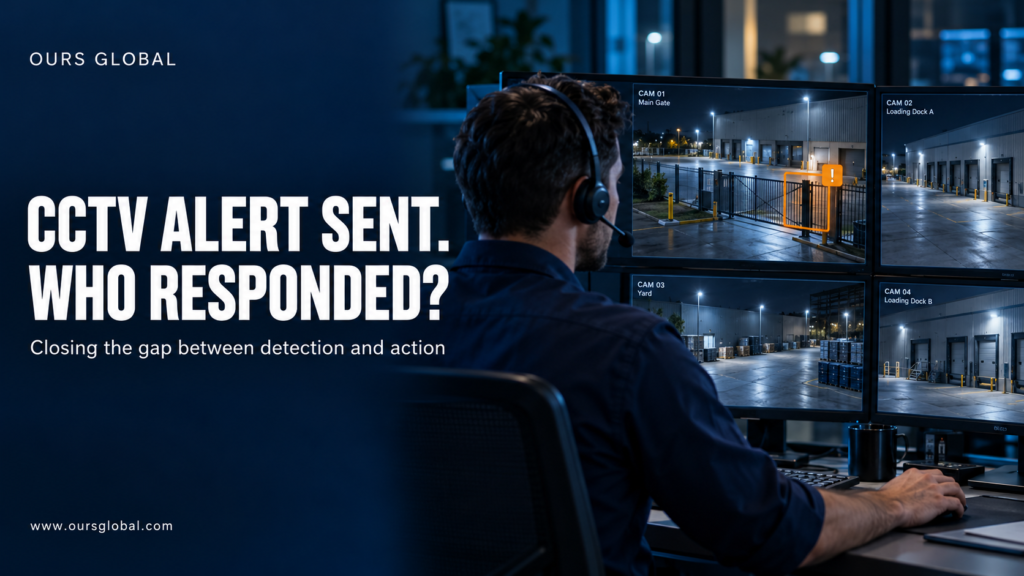
At 2:17 a.m., a camera captures movement near a warehouse entrance.
An alert reaches a phone. An email lands in an inbox. A notification appears on a dashboard.
But the person responsible is unavailable. The backup contact is outdated. Nobody has clearly agreed on what happens next.
This is an illustrative scenario, but it raises a practical question for every business using CCTV:
When your system identifies a possible problem, who takes responsibility for the next step?
Businesses spend considerable time comparing cameras, image quality, storage capacity, and monitoring prices. The process that connects an alert to an accountable response deserves the same attention.
An alert can start a security response. It cannot complete one by itself.
What Is the CCTV Alert-to-Response Gap?
The CCTV alert-to-response gap is the period between identifying a potential incident and having an authorised person take the appropriate next action.
That action might involve checking additional footage, contacting on-site security, notifying a designated manager, or following an agreed emergency procedure.
The gap can widen when:
- Operators do not have enough site information.
- Nobody acknowledges the notification.
- The first contact is unavailable.
- Responsibility is unclear across teams.
- An incident is marked complete before its outcome is confirmed.
Professional CCTV monitoring should be evaluated partly on how these handovers are managed.
The useful question is not simply, “Will you send us an alert?”
It is, “What happens if nobody responds?”
1. “Alert Sent” and “Incident Resolved” Are Different Events
Consider a monitoring report containing this entry:
“Unusual activity detected. Customer notified.”
That may accurately describe the operator’s action. However, it leaves several questions unanswered.
Did the customer receive the notification? Did anyone acknowledge it? Was a responder assigned? Was the activity checked? Is further action still needed?
A useful incident record distinguishes between stages such as:
- Detected: Activity or an alert has been identified.
- Reviewed: Available footage and context have been assessed.
- Escalated: The appropriate contact has been notified.
- Acknowledged: A responsible person has accepted the handover.
- Closed: The outcome has been recorded under agreed closure criteria.
These are suggested workflow stages, not a universal industry standard. Businesses and providers should agree on terminology that fits their operations.
The important point is that sending a message should not silently become proof that the situation was resolved.
2. Every Site Needs Context, Not Just Camera Access
A monitoring operator may see someone entering a loading area after normal working hours.
Is this an unauthorised visitor, an approved maintenance contractor, or a scheduled delivery?
Video alone may not answer the question.
Useful site information can include operating hours, authorised access arrangements, scheduled work, restricted areas, and the correct names for entrances and buildings.
Without that context, operators may spend valuable time trying to establish basic facts.
For a business with multiple locations, vague descriptions create additional problems. “Rear entrance” may mean something different to the monitoring team, the facilities manager, and the responding guard.
Use consistent site and camera labels that match the information responders receive.
A clear location description makes an alert easier to act on.
Keep this information current when layouts, access arrangements, tenants, or operating schedules change.
3. A Contact List Is Not an Escalation Plan
A spreadsheet containing several phone numbers is a starting point. It does not explain how an incident should be handled.
An escalation plan should answer:
- Who is contacted first for each type of event?
- Which communication channel should be used?
- What counts as acknowledgement?
- What happens if the first person does not respond?
- Who has authority to approve further action?
- Which events require a different or immediate escalation route?
Set time limits according to incident priority, site risk, and the agreed service scope. A single waiting period may be unsuitable for every situation.
Separate responsibilities clearly. A facilities contact may handle an equipment issue, while a security contact handles suspected unauthorised access.
The monitoring team also needs a defined route when the customer’s contacts remain unreachable.
These decisions are easier to make during onboarding than during a live incident.
4. Verification Should Reduce Uncertainty Without Creating Unnecessary Delay
Reviewing an alert helps operators communicate what is actually visible.
However, verification should not become an open-ended search for certainty.
A useful procedure tells operators what to check, what information to communicate, and when the available evidence is sufficient to follow the escalation process.
Reports should separate observations from assumptions.
For example:
“A person is visible beside the restricted loading entrance” describes an observation.
“A thief is attempting a break-in” makes a conclusion that the footage may not support.
Clear, factual reporting helps the recipient assess the situation without overstating what is known.
Urgent events should follow the agreed priority procedure. Routine verification steps should not become a reason to delay appropriate emergency action.
5. What Happens When the Camera Feed Disappears?
A monitoring arrangement depends on usable information reaching the monitoring team.
If a feed becomes unavailable, the next question is operational: who notices, who is informed, and who arranges restoration?
When evaluating outsourced CCTV monitoring services, clarify whether camera-health checks and connectivity alerts are included. Do not assume that every monitoring package covers technical faults.
Agree on:
- How a loss of visibility is identified.
- Who receives the fault notification.
- Who owns troubleshooting and repair.
- What temporary measures may be required.
- How restored service is confirmed.
Loss of visibility should have its own documented handling process. It should not be mistaken for an uneventful period.
6. Shift Changes Should Preserve Incident Ownership
A monitoring shift may end while an incident remains unresolved.
An on-site manager may leave before a technical fault is repaired. A new operator may inherit an event that has already been escalated several times.
A clear handover records what happened, what was checked, who was contacted, and what still needs attention.
It should also identify the current owner and next action.
Otherwise, the next person may repeat earlier work or assume someone else is dealing with the issue.
The principle is simple: an unresolved incident needs an owner even when the people working on it change.
7. Measure the Response Process, Not Just Alert Volume
A report showing hundreds of alerts tells you how much activity was logged. It does not establish whether those alerts were handled effectively.
Consider reviewing:
Time to operator review: How long it takes for an alert to receive attention.
Time to escalation: How long it takes to notify the appropriate contact after the escalation criteria are met.
Time to acknowledgement: How long it takes for a responsible recipient to accept the handover.
Unacknowledged events: Incidents that did not receive a confirmed response.
Closure completeness: Whether records contain an outcome and any outstanding follow-up.
Review these measures by priority and event type. Combining routine technical issues with urgent security events can hide important differences.
Also distinguish what the monitoring provider controls from what depends on customer staff, connectivity, on-site responders, or emergency services.
A useful service review makes those dependencies visible.
Run a Planned “Nobody Answers” Exercise
One practical way to evaluate an escalation process is an authorised tabletop exercise.
Choose a fictional after-hours event. Ask the monitoring provider and internal team to explain what would happen if the primary contact did not answer.
Work through the backup route, responsibility handover, and documentation.
Look for unanswered questions:
Does the backup contact know they are listed? Can the operator identify the correct site? Who remains responsible while waiting? What would justify closing the incident?
Keep the exercise clearly labelled and coordinated. Do not trigger a real emergency dispatch or create confusion for operational staff.
The objective is to find unclear responsibilities before an actual incident exposes them.
Questions to Ask Before Outsourcing CCTV Monitoring
Before selecting a provider, request clear answers to these questions:
- What monitoring method and coverage hours are included?
- How are site-specific instructions maintained?
- How are alerts prioritised and reviewed?
- What happens when our primary contact is unreachable?
- How are unresolved incidents handed between shifts?
- Are camera-health and connectivity checks included?
- What evidence is required before an incident is closed?
- Which response commitments are documented in the agreement?
These questions move the discussion beyond camera counts and monthly pricing towards the work the service will actually perform.
Frequently Asked Questions
Does a CCTV alert mean someone has responded?
No. An alert confirms that a notification or event was generated. Acknowledgement and subsequent action need to be recorded separately.
Can remote CCTV monitoring replace on-site security?
It depends on the site and its requirements. Remote monitoring can support observation, verification, and communication, while physical tasks may still require authorised on-site personnel.
What if nobody answers a monitoring alert?
The provider should follow the agreed escalation procedure, including backup contacts and priority-specific instructions. That procedure should be established before monitoring begins.
What should a CCTV incident report contain?
Useful details include the site, time, camera reference, observed activity, review findings, contact attempts, acknowledgement, actions taken, and the recorded outcome.
Strengthen Your Monitoring Process with OURS GLOBAL
If you are reviewing your surveillance arrangements, start by examining what happens after an alert—not only how the alert is generated.
OURS GLOBAL offers outsourced CCTV monitoring services, including 24/7 monitoring, live video monitoring, incident detection and alerting, and remote monitoring for multiple locations. Its service page also describes customisable solutions for different business requirements.
Whether you manage a warehouse, retail business, office, or surveillance company, use an initial discussion to define your coverage needs, existing systems, escalation contacts, and reporting expectations.
Ask the team to confirm the proposed workflow, technical compatibility, responsibilities, and service commitments for your sites.
Explore OURS GLOBAL’s outsourced CCTV monitoring services and request a tailored quote.
Your next security review should answer one question clearly:
When an alert arrives, who owns the next action?