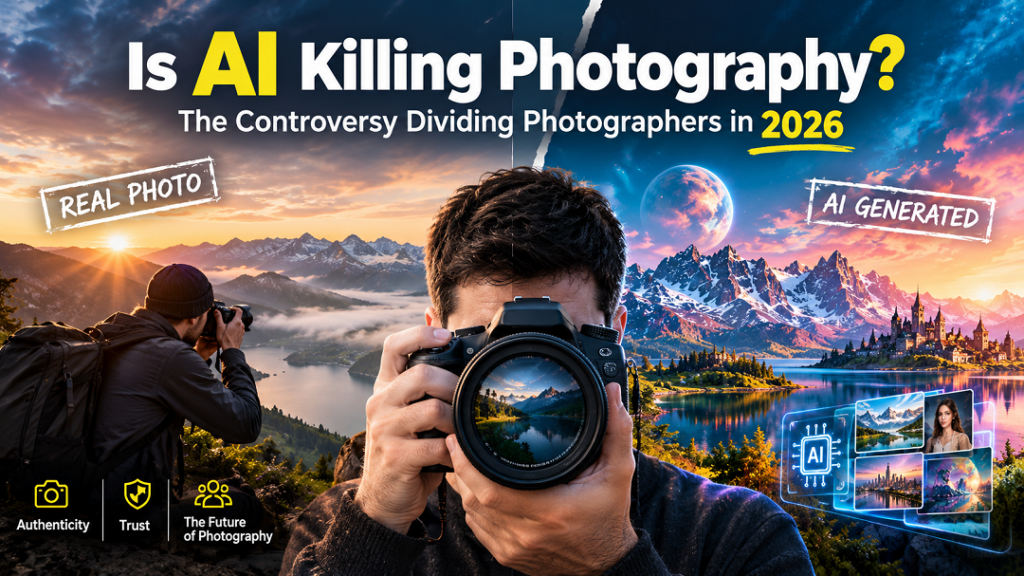
Is AI Killing Photography? The Controversy Dividing Photographers in 2026
Introduction: Is Artificial Intelligence Destroying the Art of Photography?
Photography is experiencing one of the biggest transformations in its history. In 2026, artificial intelligence can generate realistic portraits, dramatic landscapes, commercial product scenes, fashion visuals, and cinematic compositions without requiring a traditional camera shoot.
What once required professional equipment, lighting setups, models, locations, and hours of post-production can sometimes be created using a simple text prompt and an AI image generator.
This technological shift has sparked a controversial question across the photography industry: Is AI killing photography, or is it creating an entirely new era of visual creativity?
For professional photographers, the answer is complicated. Some see AI as a powerful creative assistant that saves time and expands artistic possibilities. Others worry that AI-generated images could reduce demand for traditional photography, put pressure on pricing, and make it harder for audiences to trust what they see online.
Businesses are also reconsidering how they create visual content. E-commerce brands want attractive product images. Advertising agencies need fresh campaign concepts. Photographers must deliver high-quality images efficiently. At the same time, audiences increasingly want to know whether the images they encounter are genuine photographs, heavily edited pictures, or entirely AI-generated creations.
The debate goes beyond technology. It involves authenticity, copyright, professional identity, creative ownership, commercial value, and the future of visual storytelling.
In this article, we explore how AI is changing photography in 2026, whether artificial intelligence can replace professional photographers, how to identify AI-generated images, and why professional photo editing remains important in an increasingly automated world.
1. What Is AI Photography, and Why Is Everyone Talking About It?
AI photography is a broad term used to describe the creation, modification, or enhancement of images using artificial intelligence.
It includes several different processes, from generating an entirely synthetic scene to improving an authentic photograph through automated editing tools.
Understanding these differences is essential because not every image involving AI is fake, and not every digitally edited photograph is misleading.
The Main Types of AI Photography
AI-generated images
These images are synthesized by AI models rather than captured as a complete scene using a physical camera. They can depict realistic people, imaginary locations, fictional products, or events that never happened.
AI-assisted photo editing
Artificial intelligence can help improve real photographs through tasks such as noise reduction, object removal, background extension, masking, and selected retouching operations.
AI-enhanced photography
A genuine photograph may be improved with AI-powered sharpening, resolution enhancement, lighting adjustments, or other corrections.
AI compositing and image manipulation
Photographers and designers can combine real photographs with generated elements to produce advertising visuals, artistic compositions, and creative scenes.
Traditional photography with professional editing
This workflow begins with a camera-captured image and uses conventional post-processing techniques such as exposure correction, color grading, retouching, and background refinement. AI may or may not be involved.
The important distinction is how an image was created and how it is presented to its audience.
A clearly labeled AI illustration can be a legitimate creative work. A professionally edited photograph can still represent a real subject accurately. Problems arise when an image is presented in a way that gives viewers a false impression of reality.
2. Why AI Is Creating a Major Controversy in Photography
AI image-generation tools have made sophisticated visual creation accessible to a much wider audience.
People who have never operated a DSLR camera can now generate convincing-looking images. Small businesses can experiment with campaign concepts without organizing a full production shoot. Designers can explore multiple creative directions quickly.
These advantages are significant, but they also create challenges for established photography businesses.
The Fear of Losing Photography Jobs
Professional photography requires investment in cameras, lenses, lighting equipment, studio space, education, software, and practical experience.
AI-generated imagery offers an alternative for certain assignments, particularly conceptual illustrations and fictional scenes. As a result, some clients may question whether they still need to commission traditional photography for every project.
The greatest pressure may fall on work where clients prioritize speed, low cost, and visual appearance over documenting a real subject.
However, AI does not automatically eliminate the need for photographers. Real weddings, live events, corporate portraits, property documentation, physical product photography, and photojournalism often require genuine subjects and real-world access.
The commercial impact depends on the photography niche, client expectations, quality requirements, and how effectively professionals adapt.
The Problem of Trust
A photograph has traditionally carried an implicit suggestion that something existed in front of a camera.
That assumption is becoming less reliable.
An AI-generated image can depict a convincing natural disaster, an imaginary celebrity encounter, a fictional product, or a fabricated news event. If viewers believe the image documents reality, the consequences can extend beyond photography into journalism, politics, business, and public safety.
The issue is not that every AI image is deceptive. It is that realistic visual content can be used to mislead when its origin and context are hidden.
The Battle Over Creative Ownership
AI systems can produce images in styles resembling established visual traditions, raising difficult questions about training data, copyright, attribution, and the economic interests of artists and photographers.
Photographers may worry about how their work is used to train AI systems. AI creators may argue that the technology enables new forms of expression and makes creative tools more accessible.
These debates involve technical, ethical, contractual, and legal questions that vary by jurisdiction. They cannot be reduced to a simple claim that every AI-generated image is either lawful or unlawful.
3. Real Photo vs AI-Generated Image: Can You Tell the Difference?
One of the most compelling parts of the AI photography controversy is how difficult it can be to distinguish a genuine photograph from a synthetic image.
Modern image-generation systems can create realistic-looking skin, lighting, reflections, landscapes, and architectural details. At the same time, traditional photographs can be heavily retouched or altered.
Here are some clues worth examining when evaluating an image.
Check Hands, Faces, and Fine Details
AI systems have historically struggled with complex hands, overlapping fingers, and certain anatomical details. Newer systems have improved, so correct anatomy does not prove that an image is authentic.
Inspect jewelry, hair strands, glasses, clothing seams, and small background objects for unusual inconsistencies.
Examine Lighting and Shadows
Check whether the apparent light sources agree with the direction and intensity of the shadows.
Unnatural reflections or inconsistent lighting can indicate manipulation or synthetic generation, but complicated real-world lighting can also produce unusual results.
Inspect Text and Product Details
Look closely at signs, logos, packaging, labels, and written information.
Distorted lettering or inconsistent product details may be a warning sign. However, image compression, motion blur, and ordinary editing can also make text difficult to read.
Check Background Geometry
Pay attention to building lines, windows, railings, repeated objects, and transitions between foreground and background.
Unusual geometry may suggest image generation or manipulation, although wide-angle distortion and lens effects can also affect the appearance of a genuine photograph.
Verify the Original Source
The most useful evidence often comes from outside the image itself.
Check who published it, whether the photographer or organization has confirmed its origin, whether other independent photographs exist, and whether the claimed event is supported by reliable reporting.
Important: No single visual clue can reliably prove that an image is real or AI-generated. Authenticity assessments should combine visual inspection with source verification and other available evidence.
4. Is AI Replacing Professional Photographers in 2026?
AI is changing how images are produced, but replacing a photograph’s appearance is not the same as replacing the complete service a professional photographer provides.
Photography involves planning, communication, lighting, timing, subject direction, technical control, creative interpretation, and delivery.
The extent to which AI can replace a particular assignment depends on what the client actually needs.
Commercial Photography
AI can help businesses develop advertising concepts, fictional environments, mood boards, and imaginative campaign visuals.
However, a company selling a physical product may need accurate images of its actual materials, shape, color, finish, and features.
For example, an AI-generated image of a luxury watch might look beautiful while showing an incorrect dial, inaccurate logo, or nonexistent design feature. If customers rely on that image to make a purchase, the discrepancy can create problems.
Real product photography remains valuable when accuracy and customer confidence matter.
Wedding Photography
Wedding photography documents unique events and relationships.
AI can assist with selected editing tasks, but it cannot independently attend a wedding and document genuine moments as they unfold.
Couples typically want authentic expressions, family interactions, ceremony details, and memories of an event that actually happened.
For wedding photographers, the opportunity is to combine efficient post-production with storytelling, reliable service, and consistent image quality.
Fashion and Portrait Photography
AI can help explore creative concepts, generate backgrounds, and speed up some retouching operations.
Nevertheless, real portrait photography involves human expression, collaboration, and personal representation. Fashion assignments may also require actual garments, models, designers, and products.
AI-generated people and synthetic fashion scenes can be useful in appropriate creative contexts, but they are not interchangeable with every real-world photography requirement.
Real Estate Photography
Property buyers and renters need images that represent the actual property.
AI can assist with sky replacement, image enhancement, and selected visual corrections. However, adding nonexistent rooms, hiding significant defects, or substantially misrepresenting a property’s condition can mislead prospective customers.
The goal should be to present a property attractively while maintaining an accurate representation of what is being offered.
Photojournalism and Documentary Photography
In journalism, authenticity is fundamental.
News organizations need photographs that accurately communicate events. Alterations that change the meaning of a scene can undermine public trust, particularly when images are presented as documentary evidence.
AI-generated illustrations may be appropriate in clearly labeled explanatory contexts, but they should not be confused with authentic photographs of real events.
5. Is Photo Editing Cheating? The Debate Behind AI Photography
Photo manipulation existed long before modern AI image generators.
Photographers have historically adjusted exposure, retouched film, combined images, modified colors, and removed distractions. Digital editing made these processes faster and more accessible.
The ethical question is not simply whether a photograph has been edited. It is whether the changes are appropriate for its intended use.
Editing That Improves Image Quality
Professional photo editing commonly includes:
- Exposure and white balance correction.
- Color grading and tone adjustments.
- Natural skin retouching.
- Dust and sensor-spot removal.
- Sharpening and noise reduction.
- Background cleanup.
- Perspective correction.
- Product color and detail refinement.
- Cropping and composition adjustments.
These techniques can improve an image while preserving its intended meaning.
For example, an e-commerce photographer may remove dust from a product surface, correct the white balance, and make the background consistent across a product catalog.
Editing That Can Mislead Viewers
More serious concerns arise when editing changes facts that matter.
Examples include removing important objects from a news photograph, adding people to a documentary scene, changing the appearance of a product beyond what customers should expect, or presenting a generated event as a genuine photograph.
In beauty and fashion imagery, heavy retouching can also create unrealistic expectations if the extent of the transformation is inconsistent with the context.
A fantasy campaign and a news photograph have different standards. The appropriate editing process depends on the purpose of the image and the expectations of the audience.
6. The Hidden Impact of AI on the Photo Editing Industry
While much of the public debate focuses on AI-generated pictures, artificial intelligence is also changing what happens after a photographer presses the shutter.
Photo editing and post-production are essential parts of commercial photography. They help transform raw captures into consistent, polished images suitable for websites, advertising, print, social media, and e-commerce platforms.
AI tools can automate selected operations, but professional workflows still require judgment and quality control.
Faster Image Processing
AI-assisted tools can help identify subjects, create masks, reduce noise, and remove certain unwanted elements.
These features can save time, especially when photographers need to process hundreds or thousands of images.
However, automated edits may introduce artifacts, damage fine details, or produce inconsistent results across a large collection.
The Growing Importance of Human Quality Control
A product image may look acceptable at thumbnail size but reveal unnatural edges, altered textures, or inaccurate colors when inspected closely.
Portrait retouching may remove important natural details. Background replacement may produce incorrect shadows. AI enhancement may invent texture that was not present in the original image.
Professional review helps identify these issues before images are delivered to a client.
A Hybrid Editing Workflow
For many photography businesses, the most practical approach is a combination of automation and skilled editing.
AI can handle suitable repetitive tasks, while experienced editors review complex images, refine details, maintain consistency, and apply client-specific requirements.
This approach can improve workflow efficiency without treating automated output as automatically perfect.
7. Why Professional Photo Editing Services Still Matter in the AI Era
The availability of automated editing software does not eliminate the need for professional post-production.
Photographers and businesses often manage demanding deadlines, large image collections, strict brand guidelines, and different technical requirements for each client.
A reliable editing process can help maintain consistency across an entire project.
Consistent Image Quality
Images captured under different lighting conditions may require individual corrections before they can be presented as a cohesive collection.
Professional editors can balance color, exposure, contrast, and overall appearance across multiple photographs.
Natural Retouching
Portraits, fashion images, and beauty photographs often require careful retouching that improves presentation while preserving natural details.
The objective is not always to create a flawless or artificial appearance. It is to deliver an image that meets the client’s brief.
Accurate Product Images
E-commerce businesses need images that present products clearly and consistently.
Editing may include background removal, dust cleanup, color correction, shadow refinement, and edge cleanup. Product details should remain faithful to the actual item whenever accuracy matters to customers.
Better Production Efficiency
Outsourcing appropriate post-production tasks can allow photographers to focus on shooting, client communication, creative direction, and business development.
It can also help studios manage fluctuations in image volume without handling every editing task internally.
Scalable Workflows
Businesses with large catalogs or recurring photography requirements may benefit from a consistent process for image preparation, review, revisions, and delivery.
The best workflow depends on the type of images, required quality, turnaround time, budget, and technical specifications.
8. How Photographers Can Stay Competitive as AI Evolves
The growth of AI does not mean photographers should abandon their craft. It means they may need to reconsider which skills differentiate their services.
Master the Fundamentals
Lighting, composition, timing, visual storytelling, color management, and subject direction remain important skills.
Technical knowledge helps photographers recognize when an automated tool produces a poor result and how to correct it.
Learn AI-Assisted Tools
Understanding AI editing tools can improve efficiency and help photographers choose the right workflow for different assignments.
However, adopting a tool should be based on its usefulness, not simply because it is new.
Develop a Specialized Niche
Photographers can build expertise in areas where authenticity, technical knowledge, or access matters.
Examples include weddings, corporate portraits, industrial photography, food photography, real estate, product photography, and documentary work.
Offer Complete Client Solutions
Clients may value more than a collection of attractive images.
Planning, professional execution, consistent editing, file management, delivery standards, and clear communication can all contribute to a strong service offering.
Build Trust Through Transparency
Photographers can explain their editing practices, clarify when AI tools are used, and maintain suitable original files and project records.
Being transparent about the workflow can help clients understand what they are buying and what they can expect from the final images.
9. Copyright, Consent, and Ethical Questions in AI Photography
AI photography also raises important legal and ethical questions.
The rules differ across countries, and the answer to a particular legal question may depend on the facts, applicable laws, and the terms of the services involved.
Who Owns an AI-Generated Image?
Copyright protection for AI-generated content varies by jurisdiction and may depend on the degree of human creative contribution and other relevant factors.
Photographers and businesses should review the terms of the tools they use and avoid assuming that every generated image is automatically free of restrictions.
Can AI Use a Photographer’s Work Without Permission?
The use of copyrighted material in AI training and image generation has been the subject of ongoing legal and policy debates.
The legal treatment depends on the jurisdiction, the particular use, applicable exceptions, licensing arrangements, and relevant court decisions or regulations.
Photographers should understand the licensing conditions that apply to their work and seek professional advice when necessary.
What About Real People’s Faces?
Creating or manipulating an identifiable person’s likeness can raise privacy, consent, publicity, or reputational concerns.
This is especially important in advertising, sensitive contexts, and situations where an image could falsely suggest that someone participated in an event or endorsed a product.
How Should Businesses Disclose AI Images?
Disclosure may be important when viewers could otherwise mistake a synthetic image for a real event, actual product photograph, genuine testimonial, or documentary record.
Businesses should review relevant laws, platform rules, industry standards, and customer expectations before publishing AI-generated content.
These considerations are not merely technical details. They are part of responsible image production.
10. How to Identify AI-Generated Images: A Practical Checklist
If you encounter a suspicious image online, do not rely solely on its appearance.
Use this checklist to assess its origin more carefully.
Step 1: Check the original source.
Find the earliest available publication or the original creator. A reputable source can provide important context.
Step 2: Inspect the full-resolution image.
Look for inconsistencies in hands, text, reflections, shadows, repeated patterns, and background geometry.
Step 3: Search for other versions.
Reverse image search may reveal an earlier photograph, an altered version, or other images from the same event.
Step 4: Review available metadata.
Camera information, timestamps, and software details may provide clues. However, metadata can be incomplete, modified, or removed.
Step 5: Look for provenance information.
Content Credentials based on the C2PA standard can record supported information about an image’s origin and editing history.
The absence of credentials does not prove that an image is fake, and credentials should be verified rather than treated as unquestionable proof.
Step 6: Compare independent evidence.
For an alleged news event, look for credible reporting, official statements, and independently published photographs or videos.
Step 7: Use AI detection tools cautiously.
Detection systems can provide useful signals, but their performance varies across image types, editing methods, and generation systems.
Step 8: Avoid making unsupported claims.
If the available evidence is inconclusive, describe the uncertainty rather than labeling the image definitively real or fake.
11. Will AI Make Photography Less Valuable or More Creative?
The answer depends on how photography is defined and what people value about it.
If the only requirement is to produce an attractive visual, AI may replace some assignments that previously required a conventional shoot.
But photography is not solely about producing a visually pleasing result.
It can document a real event, capture an unpredictable moment, represent a physical product, preserve a family memory, or communicate the personality of a real person.
AI can create an imagined version of these things, but an image that looks real does not establish that the depicted event actually happened.
At the same time, AI can expand creative possibilities. Artists can explore imaginary environments, designers can develop concepts quickly, and photographers can experiment with visual ideas that would be difficult or expensive to produce physically.
The future is likely to include both authentic photography and synthetic imagery, with different expectations for each.
The Biggest Opportunity for Photographers
Photographers who combine strong creative skills with technical expertise, effective client service, and thoughtful editing practices may be well positioned to adapt.
Rather than competing solely on the number of images they can produce, they can emphasize authenticity, specialized knowledge, consistency, and the quality of the complete customer experience.
12. Frequently Asked Questions About AI and Photography
Is AI killing photography in 2026?
AI is changing photography by automating some editing tasks and offering alternatives for certain types of visual content. However, it has not eliminated the need for authentic event photography, physical product photography, portraits, photojournalism, and other work requiring real-world subjects.
Can AI completely replace professional photographers?
AI can generate images and assist with selected production tasks, but it cannot independently provide every aspect of a professional photography service. Real-world access, human interaction, creative direction, authentic documentation, and client-specific execution remain important.
What is the difference between AI photography and traditional photography?
Traditional photography captures light from a physical scene using a camera or photographic medium. AI-generated photography-style images are synthesized by an AI model. Some workflows combine camera-captured photographs with AI-generated elements or AI-assisted editing.
How can I tell if a photo is AI-generated?
Check visual details, verify the original source, review available metadata and provenance information, and compare independent evidence. Detection tools may help, but no single method guarantees a correct answer in every situation.
Is AI photo editing considered cheating?
No. AI-assisted editing is not inherently dishonest. Its appropriateness depends on the purpose of the image and how the result is presented. Editing that materially misrepresents an event, person, or product can raise ethical or legal concerns.
Will AI reduce the demand for photo editing services?
AI may automate some repetitive tasks, but businesses still need consistent quality, accurate product representation, natural retouching, detailed review, and reliable delivery. The impact varies by service type and client requirements.
Why do photographers outsource photo editing?
Outsourcing can help photographers manage large image volumes, maintain consistent output, meet deadlines, and spend more time on photography and client relationships. The suitability of outsourcing depends on the provider’s quality, workflow, security practices, and ability to meet the project’s requirements.
Can AI and human photo editors work together?
Yes. AI can assist with suitable repetitive tasks, while human editors review results, correct errors, refine details, and ensure the final images meet the client’s requirements.
Is AI-generated photography legal for commercial use?
Commercial use depends on applicable laws, tool licensing terms, source material, consent, and other circumstances. Businesses should review the relevant requirements before using generated images in advertising or commercial projects.
What is the future of photography?
The future will likely involve a combination of traditional photography, AI-generated imagery, and AI-assisted post-production. Authenticity, technical quality, creative judgment, and transparency will continue to influence how images are produced and trusted.
Conclusion: AI May Change Photography, but Quality Still Matters
Is AI killing photography? The more accurate answer is that AI is changing the photography industry, challenging established business models, and creating new opportunities for visual creativity.
Some image-production tasks will become faster and more automated. Some commercial assignments will shift toward synthetic imagery. Other areas will continue to depend on genuine photographs, professional expertise, and accurate visual representation.
For photographers and businesses, the goal should not simply be to choose between AI and traditional methods. It should be to understand which approach best meets the requirements of each project.
Authentic photography, responsible AI use, professional retouching, and reliable quality control can all play important roles in a modern visual workflow.
As the industry evolves, the ability to produce consistent, polished, and commercially suitable images remains valuable.
Need Reliable Outsourced Photo Editing Services?
At Ours Global, professional photo post-production can be an important part of delivering consistent visual content for photography businesses and commercial clients.
If you are a professional photographer, studio, e-commerce business, or creative agency looking to manage editing workloads more efficiently, explore our outsourcing photo editing services.
Visit: https://www.oursglobal.com/outsource-photo-editing-services
Explore whether outsourcing photo editing fits your workflow, image volume, quality expectations, and turnaround requirements. A well-planned post-production process can help your team focus more on photography, creativity, and customer relationships while maintaining the standards your clients expect.
Looking to streamline your photo editing workflow? Visit Ours Global to learn more about outsourced photo editing services for your business.