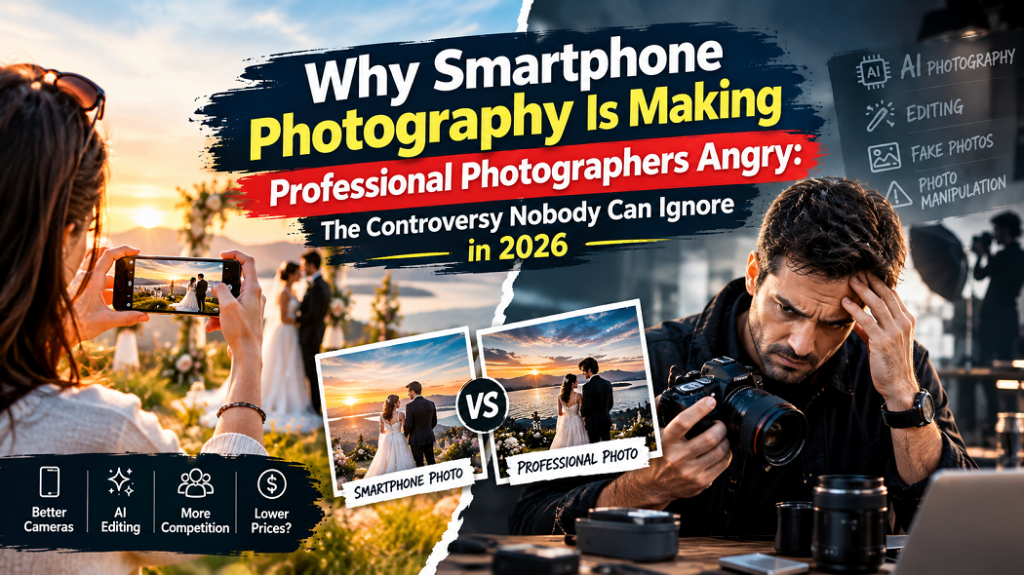
Why Smartphone Photography Is Making Professional Photographers Angry: The Controversy Nobody Can Ignore in 2026
Introduction: Why Is Smartphone Photography Making Professional Photographers Angry?
You no longer need an expensive camera to capture a photograph that looks professional. A modern smartphone can produce sharp portraits, detailed landscapes, attractive product images, and impressive low-light photographs with just a few taps.
For everyday users, this is exciting. For some professional photographers, however, it raises an uncomfortable question: If a smartphone can take beautiful pictures, why should anyone pay for professional photography?
The debate has become more complicated in 2026 as smartphone cameras, computational photography, AI-powered editing, and image-generation technology continue to evolve. Ordinary users can capture and enhance images quickly, while businesses can produce social media content without always hiring a professional photographer.
But does that mean professional photography is becoming unnecessary?
Not necessarily.
A smartphone can deliver excellent results in many situations, but professional photography involves much more than camera hardware. Lighting, composition, creative direction, consistency, subject knowledge, color management, and post-production all influence the final image.
At the same time, professional photographers face genuine business challenges. Clients may expect premium results at lower prices, compare professional work with heavily processed smartphone images, or assume that automated editing makes professional services unnecessary.
The controversy also extends to authenticity. When smartphones automatically combine exposures, enhance faces, remove distractions, or generate image details, people may wonder how much of a photograph represents the original scene.
In this article, we explore why smartphone photography is challenging professional photographers, how smartphones compare with professional cameras, whether AI is changing the value of photography, and why professional photo editing remains important in the modern visual industry.
1. The Smartphone Photography Revolution: Everyone Is a Photographer Now
Smartphones have transformed photography by making cameras accessible to billions of people.
Instead of carrying a separate camera, users can capture, edit, and publish images using a device they already own.
This accessibility has changed how people document their lives, promote businesses, create content, and communicate online.
Why Smartphone Photos Look So Good
Modern smartphones combine compact camera hardware with sophisticated software.
Depending on the device, features may include:
- Multiple camera lenses and focal lengths.
- Computational HDR for balancing bright and dark areas.
- Night modes for low-light photography.
- Portrait effects that simulate background blur.
- Automatic exposure and color adjustments.
- AI-assisted subject recognition.
- Image stabilization.
- Automatic sharpening and noise reduction.
- Built-in filters and retouching tools.
These features can produce attractive photographs with very little technical knowledge.
For social media posts, travel memories, casual portraits, and everyday business content, a smartphone may provide everything the user needs.
Why This Creates Pressure for Professional Photographers
When clients can create attractive photographs themselves, they may question the value of paying for a professional shoot.
A small business might use a smartphone to photograph products for social media. A restaurant owner might capture food images without hiring a specialist. A content creator might produce portraits and promotional images independently.
This can increase competition in some areas of the photography market.
However, accessibility does not mean every smartphone image meets the requirements of a professional campaign, large commercial project, print publication, or technically demanding assignment.
The smartphone revolution has changed customer expectations, but it has not made every photographic task identical.
2. Smartphone vs DSLR: Which Camera Actually Takes Better Photos?
One of the most common photography debates is whether a smartphone can outperform a DSLR or mirrorless camera.
The answer depends on the scene, the equipment, the photographer’s skill, and the intended use of the image.
A high-end smartphone may produce an excellent automatic photograph in a difficult scene. A professional camera gives experienced photographers different forms of control over exposure, lenses, depth of field, and image capture.
Image Quality and Sensor Size
Professional cameras often have larger sensors than smartphones. Larger sensors can provide advantages in noise performance, dynamic range, and control over depth of field, depending on the camera and shooting conditions.
Smartphones compensate for their small sensors through computational processing, combining information from multiple exposures or applying sophisticated noise reduction and sharpening.
For images viewed on small screens, these processing techniques can produce impressive results.
However, extensive cropping, large-format printing, demanding lighting conditions, and high-resolution commercial work may reveal differences that are less obvious on a phone display.
Portrait Photography
Smartphones can create convincing portrait effects through software-based background separation.
Dedicated camera lenses can produce optical background blur and different rendering characteristics that may be difficult to reproduce consistently with software.
Professional photographers can also control lighting, lens choice, perspective, and subject placement to create a specific visual style.
The best result depends on the creative goal rather than the camera category alone.
Low-Light Photography
Smartphone night modes can combine multiple frames to improve brightness and reduce noise.
These systems work well in many static scenes, including cityscapes and nighttime travel photographs.
However, moving subjects, challenging lighting, fast action, and situations requiring precise control can favor a professional camera and an appropriate lighting setup.
Sports, Wildlife, and Fast Action
Capturing a fast-moving subject requires suitable autofocus, shutter speed, lens reach, and timing.
Professional camera systems often offer advantages in these areas, especially when photographers need long telephoto lenses or must photograph unpredictable action from a distance.
A smartphone can still capture excellent casual sports images, but the requirements of a professional assignment may be considerably more demanding.
Commercial and Product Photography
For commercial work, camera quality is only one part of the process.
Product photography may require consistent lighting, accurate colors, controlled reflections, precise focus, and images that remain convincing when enlarged.
A smartphone can be a useful tool for simple product content, while a dedicated camera setup may offer greater control for complex products and high-end campaigns.
The key takeaway: A smartphone can take excellent photographs, but the best tool depends on the subject, technical requirements, creative vision, and final use.
3. Why Some Professional Photographers Feel Threatened by Smartphones
Not every professional photographer dislikes smartphone photography. Many use smartphones themselves for behind-the-scenes content, quick previews, social media posts, and everyday documentation.
The tension often comes from the economic and cultural changes surrounding the technology.
Clients Expect More for Less
When people see attractive images produced quickly on smartphones, they may underestimate the work involved in a professional assignment.
A client might assume that a product shoot requires only a few minutes of photography, without considering planning, lighting, styling, retouching, revisions, and delivery.
This can create pressure on photographers to reduce prices or justify their fees more carefully.
The Declining Perceived Value of Ordinary Images
Smartphones have made basic photography more accessible.
For some simple assignments, businesses may decide that in-house smartphone images are sufficient. This can reduce demand for certain low-complexity photography services.
However, professional photographers can differentiate themselves through consistent quality, specialist expertise, creative direction, technical reliability, and the ability to solve complex visual problems.
Social Media Rewards Speed
Social media content often prioritizes frequency, relevance, and quick publication.
A smartphone image captured and posted immediately may be more useful for a timely social update than a carefully produced commercial photograph delivered later.
This does not mean the smartphone image is technically superior. It means the two images serve different purposes.
The Professional Identity Debate
Some photographers have invested years in learning lighting, composition, color theory, equipment handling, and editing.
When photography appears effortless through automated smartphone processing, their technical expertise may seem less visible to customers.
The real challenge is communicating the value of professional judgment rather than relying only on the cost of equipment or the complexity of the shooting process.
4. Is Smartphone Photography Becoming Fake?
This is where the debate becomes more controversial.
Many smartphone cameras do more than record a single exposure. They may combine multiple frames, brighten shadows, reduce noise, enhance colors, sharpen details, and apply computational portrait effects.
Some newer features can also use generative AI to modify or expand images.
Does that mean smartphone photography is fake?
Not automatically.
The important distinction is between improving a photograph and creating or changing information in a way that misleads viewers.
Computational Photography Explained
Computational photography uses software and processing techniques to improve how a camera captures or renders an image.
For example, a smartphone may combine several exposures to preserve details in both bright skies and dark foregrounds.
The final photograph may not correspond exactly to one individual camera exposure, but it can still represent the scene that the photographer experienced.
Such processing is common in modern digital photography and is not inherently deceptive.
AI-Powered Image Editing
AI tools can perform more substantial modifications, including removing objects, replacing backgrounds, changing skies, extending image boundaries, or generating visual elements.
These features can be useful for creative photography, advertising, and personal projects.
However, when a photograph is intended to document a real event, changes that alter important facts may be misleading.
The Problem of Unrealistic Images
Automatic beauty filters, exaggerated skin smoothing, artificial backgrounds, and heavily enhanced colors can create an appearance that differs significantly from reality.
In commercial settings, excessive processing may also misrepresent a product’s color, texture, size, or condition.
The ethical issue is not simply whether software was used. It is whether the final image communicates honestly within its intended context.
5. Real Photo vs AI-Generated Image: Can You Tell the Difference?
The rise of AI-generated imagery has made it more difficult to determine how certain images were created.
An AI-generated portrait may look like a genuine photograph, while a heavily retouched camera image may look artificial.
This has created a broader photography controversy involving trust, authenticity, and the meaning of a photographic image.
Clues That May Suggest AI Generation or Manipulation
When examining an unfamiliar image, look closely at:
Hands and anatomy: Unusual finger positions or inconsistent anatomy can be clues, although modern AI systems have improved considerably.
Text and logos: Distorted lettering or inconsistent branding may indicate generation or editing.
Lighting and shadows: Reflections and shadows that do not agree with the scene may warrant closer inspection.
Background details: Repeated objects, unusual geometry, and inconsistent textures can reveal possible manipulation.
Fine textures: Hair, fabric, jewelry, and intricate patterns may contain irregular details.
Source information: The image’s origin, accompanying explanation, photographer, and publication history may be more informative than its appearance alone.
None of these signs proves that a photograph is fake. Ordinary image compression, motion blur, optical distortion, and aggressive editing can produce similar artifacts.
How to Verify an Image More Reliably
If authenticity matters, combine visual inspection with independent evidence.
- Find the original publisher or photographer.
- Search for earlier versions of the image.
- Review available metadata.
- Check for verifiable image provenance information.
- Compare the image with independent photographs or reports.
- Use AI detection tools cautiously and avoid treating their output as conclusive.
Content Credentials based on the C2PA standard can provide information about supported aspects of an image’s origin and editing history. However, the absence of credentials does not prove that an image is fake, and provenance information must be interpreted in context.
6. Smartphone Photography vs Professional Photography: Which Is Better for Business?
Businesses increasingly use smartphones for quick marketing content, but the right approach depends on their objectives.
A local business posting a daily update has different requirements from an international brand producing a national advertising campaign.
Social Media Content
Smartphones are often suitable for behind-the-scenes photographs, quick announcements, casual portraits, and spontaneous content.
Their convenience allows businesses to respond quickly and publish content frequently.
E-Commerce Product Images
Product images need to represent the actual items being sold.
Smartphone photography can work for straightforward products, especially when lighting and composition are carefully controlled.
However, larger catalogs may require consistent angles, background treatments, colors, shadows, and resolutions across hundreds or thousands of images.
A professional workflow can help maintain these standards.
Food and Restaurant Photography
A smartphone can capture attractive dishes, especially in good natural light.
Professional food photography may require more elaborate styling, lighting control, careful composition, and detailed post-production for advertising, menus, packaging, and campaigns.
Corporate and Professional Portraits
Smartphones are convenient for casual team photographs and internal communications.
Professional portrait sessions can provide more controlled lighting, consistent framing, appropriate backgrounds, and a cohesive visual identity across an organization.
Real Estate Photography
Smartphones can be useful for property previews and quick listings.
Professional real estate photography may require wide-angle coverage, careful exposure balancing, perspective correction, and consistent presentation across multiple rooms.
In every case, the goal is to choose a workflow that meets the business requirement rather than assuming that one camera type is always best.
7. Is AI Killing Professional Photography?
Smartphones are only one part of the disruption facing the photography industry. AI-generated images and automated editing tools are also changing how visual content is produced.
The combined effect is encouraging photographers to reconsider their services and business models.
What AI Can Do
AI tools can help users generate fictional scenes, create visual concepts, remove distractions, enhance resolution, reduce noise, and automate selected editing operations.
These capabilities can reduce the time needed for some tasks and make creative tools more accessible.
What Still Requires Human Judgment?
Professional photography often involves unpredictable real-world conditions.
A photographer must work with actual people, physical products, changing environments, timing constraints, and client expectations.
Creative judgment is also important when deciding how an image should communicate a message, whether an edit looks natural, and whether the result accurately represents the subject.
AI can support these decisions, but it does not make every decision automatically correct.
Which Photography Services Face the Greatest Pressure?
Services involving straightforward visual content may face stronger competition from smartphones and automation when clients have limited budgets and relatively simple requirements.
More specialized assignments can continue to benefit from professional expertise, especially when accuracy, access, controlled production, or consistent results are important.
The impact will vary across markets and photography niches.
8. Why Professional Photo Editing Still Matters in the Smartphone Era
A common misconception is that a good camera automatically produces a finished image.
In reality, many professional photographs require post-production to meet a client’s visual and technical requirements.
Smartphone processing may produce a polished image automatically, but commercial projects often need a greater level of control and consistency.
Color Correction and Exposure
Images captured under different lighting conditions may require adjustments to brightness, contrast, white balance, and color.
Consistent editing helps ensure that a collection looks cohesive rather than like a series of unrelated photographs.
Background Removal and Cleanup
Product images often need clean backgrounds, precise edges, and the removal of distracting elements.
Professional editing can improve presentation while preserving important product details.
Retouching and Detail Refinement
Portraits may require natural skin retouching, while product images may need dust removal, reflection control, and detailed cleanup.
The objective is to improve image quality without creating unwanted artifacts or changing important information.
Consistency Across Large Image Collections
A single image can be edited quickly, but maintaining a consistent look across hundreds of photographs can be more demanding.
Commercial clients may need the same background tone, image dimensions, exposure balance, and visual style across an entire catalog or campaign.
A defined editing workflow helps maintain those standards.
Quality Control
Automated editing tools can occasionally create halos, unnatural textures, incorrect colors, or inconsistent edges.
A final quality check helps catch these issues before images are delivered or published.
9. Why Photographers Outsource Photo Editing
Professional photographers often spend substantial time editing images after a shoot.
For photographers handling large events, product catalogs, real estate listings, or commercial assignments, post-production can become a significant workload.
Outsourcing selected editing tasks can help them manage this workload more efficiently.
More Time for Photography
Delegating suitable editing work may allow photographers to spend more time shooting, meeting clients, planning sessions, and developing their businesses.
Better Workload Management
Photography demand can fluctuate seasonally. Wedding photographers, for example, may receive large batches of images during busy periods.
An external editing partner may provide additional capacity when internal resources are stretched.
Consistent Post-Production
A well-defined workflow, supported by reference images and quality standards, can help maintain consistency across a large collection.
Flexible Capacity for Growing Studios
A studio that receives more work than its in-house team can comfortably process may use outsourcing to handle selected tasks without immediately expanding its permanent staff.
More Focus on Client Relationships
When editing backlogs are reduced, photographers may have more time for communication, marketing, creative development, and other activities that contribute to business growth.
What to Check Before Outsourcing
Photographers should evaluate an editing provider based on:
- Editing quality and consistency.
- Ability to follow the requested style.
- Turnaround expectations.
- Pricing and revision policies.
- File transfer and data security.
- Confidentiality arrangements.
- Experience with the relevant photography niche.
- Communication and quality-control processes.
Outsourcing is not automatically the right choice for every photographer. Its value depends on the service requirements, workflow, costs, and quality of the finished work.
10. How Photographers Can Stay Competitive in 2026
The smartphone revolution does not mean professional photographers must compete with every casual user on price.
Instead, they can differentiate their services by offering value that is difficult to reproduce through automatic processing alone.
Build a Recognizable Style
A distinctive approach to lighting, composition, color, and storytelling can help photographers stand out.
Clients often choose a photographer because they like the photographer’s creative vision, not simply because the images are sharp.
Specialize in a Niche
Developing expertise in weddings, fashion, food, products, architecture, corporate portraits, or another field can help photographers understand the specific needs of their customers.
Specialization may also make it easier to communicate the value of professional work.
Learn New Technology
Photographers can benefit from understanding computational photography, AI editing, automation, and modern camera systems.
The goal is to use tools where they improve efficiency or quality while retaining control over the final result.
Offer Complete Solutions
Professional services can include planning, shooting, editing, retouching, file preparation, and delivery.
Clients may value the reliability and convenience of receiving a complete solution rather than managing each stage separately.
Communicate the Value of Professional Work
Photographers should explain the process behind their work, show complete project examples, and help clients understand the difference between casual content and professional deliverables.
Demonstrating the final result is often more persuasive than simply listing camera specifications.
Make Authenticity a Strength
In a world filled with synthetic imagery, genuine documentation can become an important differentiator.
Photographers who communicate clearly about their process and maintain appropriate original files can help clients understand the authenticity of their work.
11. The Future of Smartphone Photography: Competition or Opportunity?
Smartphones are likely to remain central to everyday photography because they are convenient, accessible, and increasingly capable.
Professional cameras will continue to serve users who need particular forms of optical control, image quality, reliability, and creative flexibility.
AI will add another layer to the industry by automating selected tasks and creating new ways to generate and modify images.
These technologies are not necessarily mutually exclusive.
A professional photographer may use a smartphone to document a behind-the-scenes moment, a mirrorless camera for the main assignment, AI-assisted software for selected corrections, and professional editing support for final delivery.
The most effective workflow depends on the assignment.
The New Definition of a Good Photographer
Technical equipment remains important, but it is not the only measure of photographic skill.
The ability to recognize a compelling moment, understand light, communicate with subjects, solve problems, direct a shoot, and deliver consistent results remains valuable.
The industry may increasingly reward photographers who combine creative expertise with efficient production methods and strong client relationships.
Will Smartphone Photography Replace Professional Cameras?
Smartphones may replace dedicated cameras for certain casual and straightforward tasks, but they are unlikely to make every professional camera system unnecessary.
Different assignments demand different tools.
The better question is not whether smartphones are universally superior to professional cameras. It is which tool and workflow best meet the requirements of the job.
12. Frequently Asked Questions About Smartphone Photography
Why are professional photographers angry about smartphone photography?
Some professional photographers are concerned that clients may undervalue their expertise, expect lower prices, or assume smartphone images can replace professional work in every situation. Others welcome smartphone technology and use it alongside professional equipment.
Is smartphone photography better than DSLR photography?
Neither is universally better. Smartphones are convenient and use computational processing to create impressive results. DSLR and mirrorless systems can offer advantages in lens selection, sensor performance, depth of field, and specialized shooting situations.
Can a smartphone take professional-quality photos?
Yes, smartphones can produce professional-quality images for many uses when the photographer understands lighting, composition, exposure, and the requirements of the final output. Some commercial assignments still benefit from specialized equipment and controlled production.
Are smartphone photos fake because of AI processing?
No. Computational processing and AI-assisted enhancement do not automatically make a photograph fake. The important question is whether the processing materially changes the meaning of the image or misrepresents the subject.
Can AI-generated images be mistaken for real photographs?
Yes. Some AI-generated images look highly realistic. Visual clues alone are not always reliable, so source verification, metadata, provenance information, and independent evidence may be necessary.
Is AI replacing professional photographers in 2026?
AI is changing selected image-production and editing tasks, but professional photography still serves needs involving authentic events, real products, specialized technical control, human interaction, and creative direction.
Why is professional photo editing important?
Professional editing can improve exposure, color consistency, retouching, image presentation, and technical suitability. It is especially useful when businesses need consistent results across large collections of photographs.
Should photographers outsource photo editing?
Outsourcing may benefit photographers who manage large workloads or want to focus more on shooting and client service. The decision should depend on quality, cost, turnaround, security, and workflow requirements.
How can businesses choose between smartphone and professional photography?
Businesses should consider the purpose of the images, the required level of consistency, the complexity of the subject, the intended display size, the budget, and the importance of accurate representation.
What is the future of photography?
The future will likely combine smartphone photography, dedicated camera systems, AI-assisted editing, and AI-generated imagery. Creative skill, technical quality, authenticity, and transparency will remain important considerations.
Conclusion: Smartphones Are Changing Photography, but Professional Skill Still Matters
Why is smartphone photography making professional photographers angry?
The answer is not simply that smartphones take good pictures. The real tension comes from changing customer expectations, increasing competition, automated image processing, and the assumption that producing a beautiful photograph should be easy and inexpensive.
Smartphones have made photography more accessible, and that is a positive development. More people can capture memories, promote businesses, and explore creative ideas without purchasing expensive equipment.
However, accessibility does not eliminate the value of professional expertise.
A professional photography service can provide creative direction, reliable execution, technical control, consistent editing, and a finished collection tailored to a client’s requirements.
AI and computational photography will continue to change the industry, but the best approach is not to dismiss new technology or assume it can replace every traditional workflow. It is to understand where each tool delivers the greatest value.
For professional photographers and studios, an efficient post-production process can be an important competitive advantage. By combining creative skills with appropriate technology and reliable editing support, businesses can adapt to changing customer expectations without compromising their standards.
Need Professional Outsource Photo Editing Services?
At Ours Global, photographers, studios, and businesses can explore outsourced photo editing solutions designed to support their post-production workflows.
If you are a professional photographer managing large image collections, an e-commerce business handling product catalogs, or a studio looking to streamline editing operations, outsourcing suitable post-production tasks may help you manage workloads more efficiently.
Professional editing support can be particularly useful when your business needs consistent image quality, reliable workflows, and additional capacity during busy periods.
Explore our services: https://www.oursglobal.com/outsource-photo-editing-services
Visit Ours Global to learn more about outsourced photo editing services and assess whether our solutions fit your image volume, quality requirements, and turnaround expectations.
Spend more time capturing great photographs and growing your photography business. Let a suitable photo editing workflow help you manage the work that happens after the shoot.