
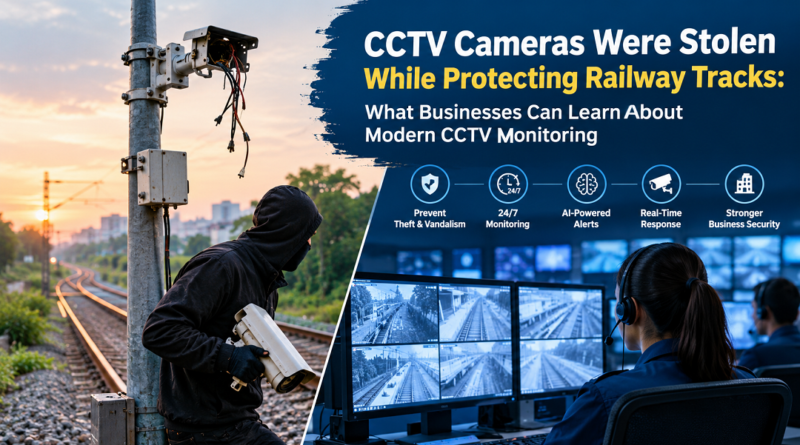
CCTV Cameras Were Stolen While Protecting Railway Tracks: What Businesses Can Learn About Modern CCTV Monitoring
Introduction: When Security Cameras Become the Target
Security cameras are designed to protect people, property, and infrastructure. But what happens when the cameras themselves become victims of theft?
That is exactly what happened recently in Bengaluru.
Railway authorities had installed 21 solar-powered CCTV cameras along vulnerable railway tracks near Banaswadi station to identify people involved in dangerous stone-pelting incidents targeting passing trains. However, one of those cameras disappeared from its pole only a few months after installation, forcing the Railway Protection Force (RPF) to launch an investigation.
The incident may sound ironic, but it highlights a much larger reality facing businesses across the world:
Installing CCTV cameras alone is no longer enough. Active monitoring, rapid response, and continuous oversight have become equally important.
Whether you operate warehouses, retail stores, construction sites, corporate offices, hospitals, logistics centers, or residential communities, this real-life incident offers valuable lessons about modern surveillance and why professional CCTV monitoring is becoming an essential part of business security.


The Bengaluru CCTV Theft: What Happened?
According to reports from The Times of India and Mirror Now, South Western Railway had installed solar-powered CCTV cameras along railway tracks in Bengaluru to combat repeated stone-pelting attacks on trains. These attacks had damaged railway property and endangered passenger safety.
The surveillance initiative included 21 strategically placed cameras designed to monitor vulnerable stretches of track.
However, commuters later noticed that one camera near Banaswadi railway station had vanished.
Officials suspect miscreants targeted the equipment because it had been installed at a relatively accessible height. Following the complaint, the Railway Protection Force registered a case and began investigating the disappearance.
The incident created several immediate problems.
- Authorities lost surveillance coverage over an important location.
- Future investigations became more difficult.
- The security infrastructure itself became vulnerable.
- Public confidence in surveillance effectiveness was questioned.
This wasn’t merely a stolen camera.
It exposed a critical weakness in relying solely on installed hardware without sufficient monitoring and protection.
Why This Incident Matters Beyond Railways
Many businesses assume that purchasing high-quality CCTV cameras automatically guarantees security.
Unfortunately, real-world incidents prove otherwise.
A camera that records footage but isn’t actively monitored often becomes a passive witness rather than an active security solution.
The Bengaluru railway case demonstrates that surveillance systems themselves require protection.
The same risks exist across industries.
- Retail stores experience shoplifting.
- Warehouses face inventory theft.
- Construction sites lose expensive equipment overnight.
- Office buildings deal with unauthorized access.
- Residential communities encounter vandalism.
In each case, delayed discovery increases losses.
Professional monitoring changes that equation.

Recording Footage vs. Real-Time CCTV Monitoring
One of the biggest misconceptions about CCTV systems is that recording automatically prevents crime.
It doesn’t.
Recording creates evidence.
Monitoring creates opportunities for intervention.
|
Traditional CCTV Recording |
Professional CCTV Monitoring |
|---|---|
|
Records incidents |
Observes incidents live |
|
Reviewed later |
Immediate attention |
|
Delayed response |
Faster action |
|
Passive surveillance |
Active security |
|
Evidence after loss |
Opportunity to reduce damage |
This distinction explains why governments, transportation networks, and large enterprises increasingly invest in centralized monitoring rather than relying only on recorded footage.
A Second Railway Security Lesson: AI-Powered Surveillance
Interestingly, the CCTV theft occurred only months after Bengaluru introduced another major railway surveillance upgrade.
KSR Bengaluru Railway Station installed 168 high-definition IP cameras equipped with facial recognition technology and video analytics capable of identifying habitual offenders and generating alerts for suspicious activity.


The new system includes:
- facial recognition
- intelligent video analytics
- automated threat alerts
- centralized monitoring
- high-definition surveillance
Rather than simply storing recordings, the system helps security personnel detect unusual activity much faster.
This reflects a broader trend across both public and private sectors.
The future of CCTV is becoming smarter, faster, and more proactive.
Why Businesses Are Moving Toward Remote CCTV Monitoring
Modern organizations face security challenges that traditional surveillance cannot always solve.
Rising Security Risks
Businesses today face:
- theft
- trespassing
- vandalism
- unauthorized access
- after-hours incidents
Waiting until the next morning to review footage often means valuable response time has already been lost.
Multiple Locations Increase Complexity
Companies with multiple branches cannot realistically watch every camera themselves.
Remote monitoring solves this by allowing trained professionals to oversee numerous locations simultaneously.
Faster Decisions Matter
When suspicious activity occurs, early detection can make a significant difference.
Instead of discovering problems after they happen, monitoring teams can escalate incidents immediately according to established procedures.
Industries That Benefit Most
Retail Stores

Retail businesses constantly deal with:
- shoplifting
- after-hours break-ins
- employee safety concerns
Live monitoring adds another layer of protection beyond recorded evidence.
Warehouses

Warehouses often contain high-value inventory.
Professional monitoring helps oversee:
- loading docks
- storage areas
- perimeter fencing
- vehicle movements
Construction Sites

Construction sites are particularly vulnerable during nights and weekends.
Remote monitoring can help identify unauthorized entry much sooner than periodic site inspections.
Office Buildings

Office environments benefit from monitoring of:
- entrances
- parking areas
- restricted zones
- visitor activity
Residential Communities
Apartment complexes increasingly rely on monitored surveillance to improve resident safety and manage shared spaces more effectively.
Why AI Is Changing CCTV Monitoring
Artificial intelligence is transforming surveillance—but not by replacing people.
Instead, AI assists operators.
Modern AI-assisted monitoring can help identify:
- unusual movement
- perimeter breaches
- restricted-area entry
- loitering
- after-hours activity
Human operators remain responsible for verifying incidents and determining appropriate responses.
This combination reduces unnecessary alerts while improving detection speed.
The Hidden Cost of Unmonitored Cameras
Many organizations invest thousands of dollars in surveillance equipment.
However, hidden costs appear when nobody actively oversees those systems.
Common problems include:
- cameras going offline unnoticed
- damaged equipment remaining unrepaired
- blind spots developing
- delayed incident discovery
- longer investigations
The Bengaluru railway case demonstrates exactly how surveillance gaps can emerge when equipment itself becomes compromised.
Best Practices for Protecting CCTV Infrastructure
Whether you manage ten cameras or hundreds, these practices improve surveillance effectiveness.
Install Cameras Strategically
Avoid placing cameras where they’re easily accessible.
Higher mounting positions often reduce tampering risks.
Perform Regular Health Checks
Ensure cameras remain:
- operational
- clean
- correctly aligned
- connected
Monitor Critical Locations
High-risk areas deserve additional attention.
Examples include:
- entrances
- loading docks
- storage yards
- parking lots
- perimeter fencing
Combine AI with Human Oversight
Technology performs best when experienced operators verify alerts and coordinate appropriate responses.
The Future of CCTV Monitoring
Security technology continues evolving rapidly.
Several trends are shaping the future.
Intelligent Analytics
Video analytics increasingly help identify unusual patterns before they become major incidents.
Cloud-Based Monitoring
Remote access allows businesses to oversee multiple sites more efficiently.
Centralized Operations
Organizations increasingly manage numerous locations through unified monitoring centers.
Cybersecurity Protection
Surveillance systems now require protection against both physical theft and digital threats.
As CCTV networks become connected, protecting the monitoring infrastructure itself becomes equally important.
Why Businesses Choose OURS Global for Outsourced CCTV Monitoring
Installing cameras is only the beginning.
What truly strengthens security is having experienced professionals actively monitoring those cameras around the clock.
OURS Global provides 24/7 Outsource CCTV Monitoring Services for businesses, CCTV installation companies, and security providers looking to deliver continuous surveillance without building an expensive in-house monitoring center.

Our CCTV Monitoring Services Include
- 24/7 Live CCTV Monitoring
- Remote Video Surveillance
- Real-Time Incident Detection
- Multi-Location Monitoring
- AI-Assisted Monitoring Support
- Instant Alert Escalation
- Detailed Incident Reporting
- Integration with Existing CCTV Systems
Instead of replacing your current cameras, OURS Global adds an active monitoring layer that helps businesses respond faster, reduce risks, and maintain continuous visibility across their operations.
Industries We Support
- Retail Stores
- Warehouses
- Logistics Companies
- Manufacturing Facilities
- Construction Sites
- Corporate Offices
- Residential Communities
- CCTV Installation Companies
Why Partner with OURS Global?
Businesses across the USA, UK, Canada, Australia, UAE, Germany, France, and other global markets trust outsourced monitoring because it offers:
- Professional 24/7 surveillance
- Cost-effective operations
- Faster incident awareness
- Scalable multi-site monitoring
- Experienced monitoring teams
If your business already has CCTV cameras, professional monitoring can help transform them from passive recording devices into a proactive security solution.
Learn more about OURS Global’s Outsource CCTV Monitoring Services: https://www.oursglobal.com/outsource-cctv-monitoring-services
Frequently Asked Questions
What is outsourced CCTV monitoring?
Outsourced CCTV monitoring is a professional service where trained operators remotely monitor live camera feeds and follow predefined response procedures when suspicious activity is detected.
Can remote monitoring work with existing CCTV cameras?
Yes. Most professional monitoring services are designed to integrate with existing CCTV infrastructure rather than requiring businesses to replace their entire camera system.
Is CCTV monitoring suitable for small businesses?
Yes. Remote monitoring can be scaled for single-location businesses as well as organizations with multiple sites.
Does AI replace human operators?
No. AI helps identify unusual activity, while trained operators verify alerts and coordinate the appropriate response.
Final Thoughts
The Bengaluru railway CCTV theft serves as a powerful reminder that security doesn’t end with installing cameras. Even surveillance systems designed to protect public infrastructure can become vulnerable when they lack sufficient oversight.
At the same time, newer initiatives like KSR Bengaluru’s AI-enabled surveillance network demonstrate where modern security is headed—toward intelligent monitoring, faster detection, and centralized response capabilities.
For businesses, the lesson is clear: cameras are valuable, but active monitoring is what turns surveillance into a stronger security strategy. By combining reliable CCTV infrastructure with professional 24/7 monitoring, organizations can improve visibility, respond more quickly to incidents, and better protect people, property, and operations.


