
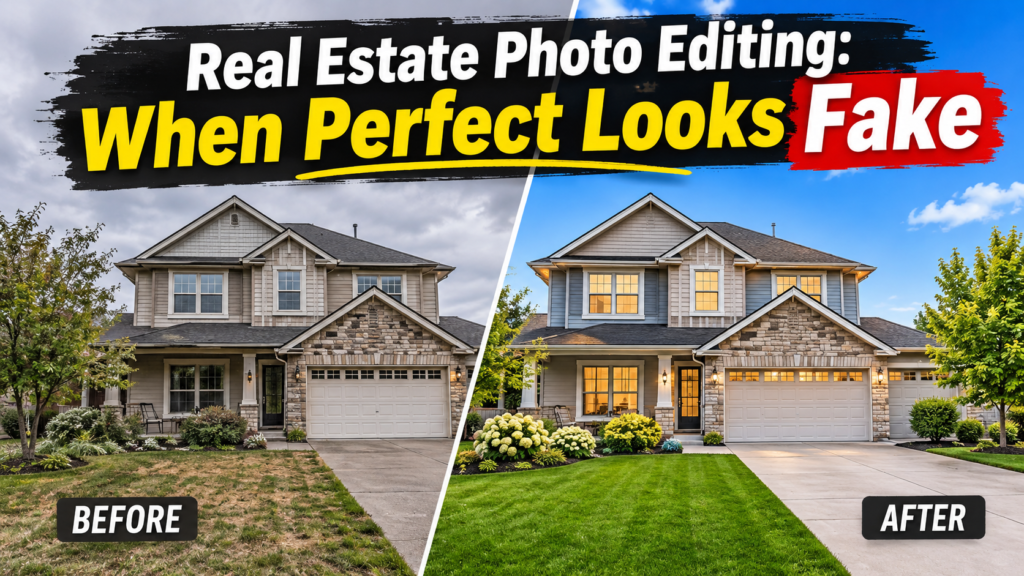
Real Estate Photo Editing: When Perfect Looks Fake
Would you rather have a property photograph that attracts attention—or one that helps a buyer understand what they are viewing?
A successful listing should aim for both.
Yet property images can become so polished that important details disappear. Walls turn unnaturally white. Rooms appear stretched. Window views look pasted into place. Every surface seems brighter than the light in the room could reasonably support.
The photograph may look dramatic. It may also leave the viewer with the wrong impression.
Real estate photo editing services should help present a property clearly, consistently and attractively. Before approving your next batch, ask a more useful question than “Does this look impressive?”
“Does this image still represent the property well?”
This guide explains where editing can lose its purpose—and how photographers, agents and property marketing teams can set a better standard.
The Problem With Asking Editors to “Make It Perfect”
“Make it brighter.”
“Remove everything distracting.”
“Make the room look bigger.”
These instructions sound straightforward, but they leave important decisions undefined.
How bright is appropriate? Which objects are temporary distractions? Does “bigger” mean correcting an awkward crop or changing the apparent proportions of the room?
Without a clear brief, the photographer, editor and agent may each imagine a different result.
Start with the purpose of the image. A property listing needs to communicate the space, its features and its condition. A design concept or renovation visualisation serves a different purpose.
Agree on that distinction before editing begins.
1. Brighter Is Not Always Clearer
A dark interior can hide useful information. However, pushing brightness too far can make an image harder to interpret in a different way.
Review whether pale walls still have visible edges. Check whether curtains, bedding and light-coloured furniture retain detail. Look at shaded areas and ask whether they still appear connected to the room’s lighting.
An effective approval brief might say:
“Make the interior readable while preserving the distinction between the walls, ceiling and furnishings.”
That is more useful than requesting maximum brightness.
Review the complete listing as well. If one bedroom looks dramatically brighter than the adjoining hallway, the sequence may feel inconsistent.
The objective is a coherent presentation, with natural differences between rooms allowed to remain.
2. White Walls Should Not Mean Removing Every Warm Tone
Not every warm surface has an unwanted colour cast.
Cream paint, timber flooring and warm-toned cabinetry may be part of the property. Editing them towards neutral white can change how the finishes appear.
Give your editor reference information when accurate colour matters. This could include an approved photograph from the shoot or a note identifying the actual finish.
For example:
“The kitchen cabinets are warm ivory. Please preserve that tone while correcting the yellow cast on the ceiling.”
During review, compare repeated materials across several images:
- The same flooring photographed from different rooms.
- Cabinetry shown in wide and close-up views.
- Walls visible through connecting doorways.
- Exterior paint shown from different angles.
Consistency does not mean forcing every room to share the same colour. It means avoiding unexplained changes to the same materials.
3. Window Views Should Belong to the Room
A balanced window view can help explain a property’s surroundings.
However, the result becomes distracting when the exterior looks unusually dark, excessively sharp or disconnected from the interior.
Inspect the transition around window frames. Check whether the view is consistent across photographs taken from the same room.
Provide complete source exposures where available and identify which images belong together. If the original capture does not contain usable exterior detail, discuss the limitation before asking for recovery.
A view that was not captured should not quietly become a different view.
If an image is intended as a creative concept rather than a factual listing photograph, make that purpose clear and keep the versions distinguishable.
4. Correcting Perspective Should Not Redesign the Room
Leaning walls and tilted door frames can make property images difficult to read.
When reviewing corrections, inspect both the architecture and the objects within it. A doorway may appear straighter while a sofa becomes noticeably stretched.
Check:
- Furniture near the edges of the frame.
- Round objects that appear unusually oval.
- Doors that look wider than expected.
- Fixtures whose proportions seem inconsistent.
- Rooms that appear substantially expanded.
Compare the edited image with the source.
If the correction requires a severe change, a different photograph may provide a better result. Discuss whether another frame from the shoot can solve the problem more naturally.
A property photograph should help explain the space, not create an entirely different impression of its dimensions.
5. Object Removal Needs Clear Boundaries
Removing a photographer’s bag is not the same decision as removing a permanent fixture.
Before commissioning object removal, classify the changes you want.
| Item or feature | What to discuss |
|---|---|
| Photography equipment | Whether removal is included and appropriate |
| Temporary personal belongings | Which items may be removed |
| Permanent fixtures | Preserve them unless producing a clearly identified concept |
| Visible damage | Keep the factual condition represented |
| Neighbouring structures | Avoid changing the actual surroundings |
| Reflections | Clarify whether they show equipment or meaningful property details |
This is an editorial review framework, not a substitute for checking the rules of the destination platform or market.
Give editors a specific list. “Remove all distractions” can lead to changes that no one intended.
Keep original files available so the final reviewer can compare important details.
6. Virtual Staging Should Help Viewers Understand a Possibility
An empty room can be difficult to visualise. Virtual staging can illustrate a possible furniture arrangement, but it should be distinguishable from the property’s current condition.
Before ordering it, agree on:
- Whether an unstaged version will also be supplied.
- How the staged image will be identified.
- The intended style and furniture placement.
- Which architectural features must remain unchanged.
- Who checks the final result before publication.
Review the furniture in relation to the room. Does it obstruct a doorway? Does a dining arrangement imply more usable space than the room actually offers? Have fixtures disappeared behind generated or added objects?
A staged image should answer, “How might this room be used?” without making it difficult to understand what is physically there.
7. One Beautiful Photograph Does Not Make a Consistent Listing
A listing is a sequence.
A buyer may move from the exterior to the living room, then to the kitchen, bedrooms and outdoor space. Each photograph contributes to their understanding.
Review the set together rather than approving files independently.
Look for changes in:
- Overall brightness.
- Colour treatment.
- Material appearance.
- Sharpening.
- Contrast.
- Sky and weather presentation.
- Cropping and orientation.
Different rooms do not need identical treatment. They should still feel as though they belong to the same property.
If several editors or photographers contribute to your work, an approved reference set can give everyone a shared standard.
What to Request From Real Estate Photo Editing Services
A useful editing brief defines the work before it defines the deadline.
Include the property identifier, source files, intended publishing destinations and the type of editing required.
For example:
Prepare a natural-looking listing set. Balance interior exposure, preserve the warm timber flooring, correct distracting verticals and remove only the photography equipment identified in the notes. Do not alter permanent features or visible property condition.
Then add the delivery requirements:
- Number of selected images.
- Required file formats and dimensions.
- Naming convention.
- Reference images.
- Permitted alterations.
- Review process.
- Delivery date and time zone.
OURS GLOBAL lists HDR blending, window editing, colour correction, perspective correction and virtual staging among its real estate photo editing services. Use your brief to specify which tasks your project actually needs.
Test the Difficult Images Before Sending the Full Batch
A sample is most useful when it represents the work you regularly produce.
If your projects include mixed lighting, reflective surfaces and bright windows, select sample photographs with those characteristics.
A simple exterior image may not tell you how the provider will handle a challenging interior.
Evaluate the sample against a short checklist:
| Review area | Approval question |
|---|---|
| Exposure | Can important details be seen without losing natural contrast? |
| Colour | Do materials remain believable and consistent? |
| Geometry | Are corrections helpful without obvious stretching? |
| Windows | Do the exterior and interior fit together? |
| Retouching | Were only the approved changes made? |
| Delivery | Are the files prepared as requested? |
Record corrections precisely.
“Please retain the beige wall colour” is more actionable than “the room looks wrong.”
Once approved, keep the sample and its instructions as a reference for future batches.
Low Editing Prices Can Be Difficult to Compare
A per-image price is meaningful only when the scope is clear.
One quotation may cover basic adjustments. Another may include exposure blending, detailed cleanup or additional output versions.
Before comparing providers, clarify:
- Which edits are included.
- What triggers an additional charge.
- Whether source preparation is required.
- What the revision process covers.
- How urgent work is handled.
- Whether your regular image volume changes the quotation.
OURS GLOBAL’s service page identifies image volume, editing complexity, turnaround and file format as factors affecting pricing. Request a project-specific quotation instead of assuming the starting price covers every photograph.
Also consider your own review time. A workflow that requires repeated clarification can be inconvenient even when the initial price is attractive.
Review the Final Files Where They Will Be Seen
A full-resolution image and a property portal preview are different viewing experiences.
Inspect the master for editing errors, then check the delivery version at the size your audience will see.
On a mobile-sized screen, ask:
- Is the main subject of each image clear?
- Has compression made important details distracting?
- Does the crop hide something useful?
- Are any labels readable?
- Does the image order help explain the property?
Confirm the current requirements of each publishing destination. Avoid assuming a single export specification will suit every website or listing platform.
Where several versions are required, label them clearly to prevent accidental uploads of the wrong files.
Frequently Asked Questions
What is natural real estate photo editing?
It is an editing approach that improves clarity and presentation while preserving a believable representation of the property. The brief should define acceptable changes to lighting, colour, geometry and visible objects.
Can editing fix every problem in a property photograph?
No. Missing detail, severe blur or an unsuitable viewpoint may limit what can be achieved. A different source frame or another photograph can sometimes be the better option.
Is virtual staging the same as standard photo enhancement?
No. Virtual staging adds or changes furnishing concepts, while standard enhancement generally focuses on the captured photograph. Agree on separate instructions and appropriate identification for staged versions.
How can I keep different property listings consistent?
Use approved reference images, written editing instructions, clear filenames and a repeatable review checklist. Update the brief when a recurring issue appears.
Will better property photographs guarantee more enquiries?
No. Images are one part of the listing. The property, price, location, audience, description and enquiry process also influence the result.
Give Buyers a Clearer View With OURS GLOBAL
The strongest property image does not need to look impossibly perfect. It needs to help the viewer see what matters.
That requires a clear brief, careful editing and a review process that considers the complete listing.
OURS GLOBAL provides real estate photo editing services for property photography workflows. Share representative images, explain the finish you want and identify the features that must remain unchanged.
For broader post-production requirements, explore its photo editing outsourcing services.
Request a quotation through the real estate editing page, or email your project requirements to sales@oursglobal.com.
Make the property easier to understand—not harder to recognise.