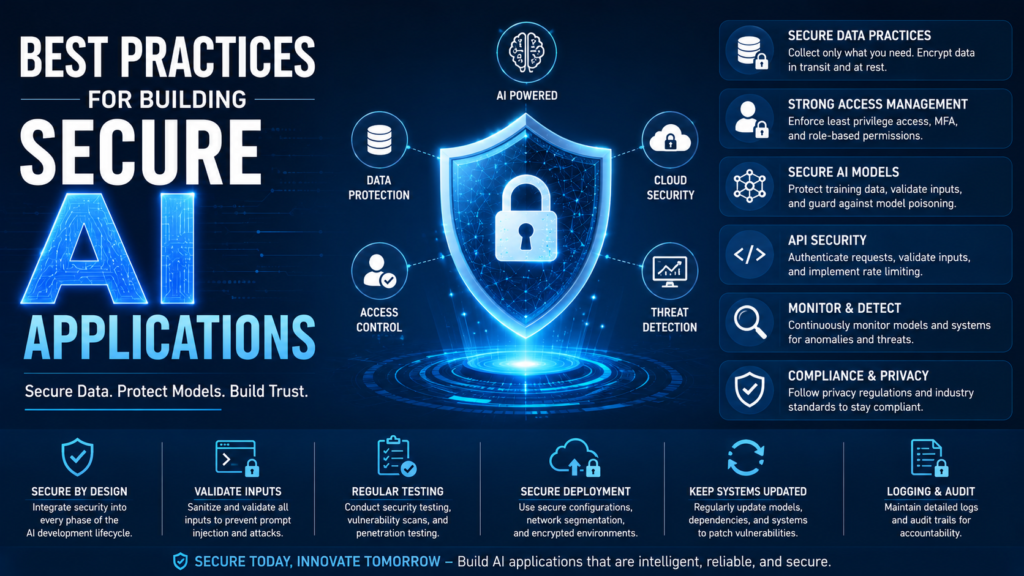
Best Practices for Building Secure AI Applications
Introduction
Artificial Intelligence (AI) is rapidly transforming the way businesses operate, enabling smarter decision-making, personalized customer experiences, automated workflows, and data-driven innovation. From AI-powered chatbots and virtual assistants to predictive analytics and intelligent automation, organizations across industries are integrating AI into their daily operations. However, as AI adoption accelerates, so do the security risks associate with these powerful technologies.
Building an AI application is no longer just about developing accurate models or delivering intelligent features. Security must be embedded into every stage of the AI lifecycle—from data collection and model training to deployment, monitoring, and ongoing maintenance. A single vulnerability can expose sensitive data, compromise AI models, or allow attackers to manipulate business decisions.
Unlike traditional software, AI applications rely heavily on data, machine learning models, APIs, and cloud infrastructure. These components introduce unique security challenges such as model poisoning, adversarial attacks, prompt injection, data leakage, unauthorized API access, and AI model theft.
This guide explores the best practices for building secure AI applications, helping organizations protect their AI systems, maintain customer trust, comply with regulations, and ensure long-term business success.
Why AI Application Security Matters
AI applications often process valuable business information, customer data, financial records, healthcare information, and proprietary intellectual property. If compromised, attackers can manipulate outputs, steal confidential data, or disrupt critical business operations.
Security is no longer optional—it is a fundamental requirement for responsible AI development.
Strong AI security helps organizations:
- Protect sensitive business and customer data
- Prevent unauthorized access
- Maintain regulatory compliance
- Reduce cybersecurity risks
- Improve customer trust
- Ensure reliable AI performance
- Protect intellectual property
- Minimize operational downtime
Organizations that prioritize AI security from the beginning avoid costly security incidents later.
-
Secure Data Collection
Every AI model depends on high-quality data. Poorly secured datasets can expose confidential information and introduce vulnerabilities into AI systems.
Before collecting data:
- Verify data sources
- Remove duplicate or corrupted records
- Encrypt sensitive information
- Obtain proper user consent
- Follow privacy regulations
- Minimize unnecessary data collection
Data security begins long before model training starts.
-
Protect Training Data
Training data is one of the most valuable assets in any AI project. If attackers manipulate training datasets, they can intentionally influence model behavior through a technique known as data poisoning.
Best practices include:
- Restrict dataset access
- Validate incoming data
- Monitor changes
- Store backups securely
- Maintain version control
- Regularly audit datasets
Protecting training data helps maintain model accuracy and reliability.
-
Implement Strong Identity and Access Management
Not every employee requires access to every AI resource.
Apply the Principle of Least Privilege (PoLP) by granting users only the permissions necessary for their responsibilities.
Secure access should include:
- Multi-Factor Authentication (MFA)
- Role-Based Access Control (RBAC)
- Single Sign-On (SSO)
- Strong password policies
- Session management
- Regular permission reviews
Restricting access significantly reduces insider threats.
-
Secure AI APIs
Most AI applications communicate through APIs. If APIs are left unsecured, attackers may gain unauthorized access to sensitive data or abuse AI services.
API security best practices include:
- Authentication tokens
- OAuth implementation
- API gateways
- Rate limiting
- Request validation
- Input sanitization
- HTTPS encryption
- API monitoring
Regular API testing helps identify vulnerabilities before attackers exploit them.
-
Encrypt Data Everywhere
Encryption protects sensitive information whether it is stored or transmitted.
Businesses should encrypt:
- Customer records
- Training datasets
- AI models
- Database storage
- Cloud backups
- API communications
Using modern encryption standards ensures confidential information remains protected even if systems are compromised.
-
Validate User Inputs
Many AI attacks begin with malicious user input.
Examples include:
- Prompt injection
- SQL injection
- Cross-site scripting
- Command injection
- Malicious file uploads
Always validate and sanitize user input before passing it to AI models.
Input validation reduces opportunities for attackers to manipulate AI behaviour.
-
Defend Against Prompt Injection
Large Language Models (LLMs) are vulnerable to prompt injection attacks, where malicious users attempt to override system instructions or extract confidential information.
To reduce this risk:
- Separate system prompts from user prompts
- Filter suspicious inputs
- Limit model permissions
- Validate AI responses
- Monitor unusual interactions
- Restrict sensitive operations
Prompt security should be considered during application design rather than after deployment.
-
Monitor AI Models Continuously
AI systems change over time as data patterns evolve.
Continuous monitoring helps identify:
- Performance degradation
- Security anomalies
- Unexpected outputs
- Data drift
- Model drift
- Unauthorized modifications
Organizations should implement automated monitoring and alerting to detect abnormal behavior quickly.
-
Secure Cloud Infrastructure
Most AI applications run in cloud environments.
Cloud security should include:
- Private networking
- Secure storage
- Firewall configuration
- Identity management
- Logging
- Backup strategies
- Network segmentation
- Continuous vulnerability scanning
Cloud misconfigurations remain one of the leading causes of security incidents.
-
Regularly Update AI Components
Outdated software introduces unnecessary risk.
Maintain updates for:
- Machine learning frameworks
- Operating systems
- Cloud services
- AI libraries
- Third-party packages
- Security tools
Patch management should become part of every organization’s security process.
-
Secure the AI Development Lifecycle
Security should be integrated throughout development rather than added after deployment.
A secure AI lifecycle includes:
- Secure planning
- Threat modeling
- Secure coding
- Code reviews
- Automated testing
- Vulnerability assessments
- Penetration testing
- Secure deployment
Following DevSecOps principles helps identify risks earlier.
-
Protect AI Models from Theft
AI models often represent years of research and significant financial investment.
Businesses should protect models by:
- Encrypting model files
- Restricting download access
- Watermarking models
- Monitoring API usage
- Logging inference requests
- Detecting unusual activity
Protecting intellectual property is just as important as protecting data.
-
Maintain Comprehensive Logging
Detailed logs improve visibility into AI systems.
Important events include:
- Login attempts
- API requests
- Model updates
- Configuration changes
- Failed authentication
- Data access
- Administrative actions
Centralized logging simplifies incident investigation.
-
Prepare an Incident Response Plan
No system is completely immune to cyber threats.
Organizations should prepare for incidents by defining:
- Response teams
- Communication procedures
- Backup strategies
- Recovery steps
- Investigation processes
- Customer notification plans
Regular security exercises help teams respond more effectively during real incidents.
-
Ensure Regulatory Compliance
AI applications often process regulated information.
Organizations should comply with relevant standards such as:
- GDPR
- HIPAA
- ISO 27001
- SOC 2
- PCI DSS (where applicable)
Compliance demonstrates responsible data handling and strengthens customer confidence.
Common Security Mistakes to Avoid
Many organizations unintentionally expose AI applications by making avoidable mistakes, including:
- Hardcoding API keys
- Using public datasets without validation
- Ignoring model monitoring
- Weak authentication
- Excessive user permissions
- Delayed software updates
- Poor encryption practices
- Missing security testing
- Exposed cloud storage
- Lack of employee cybersecurity training
Avoiding these mistakes significantly improves overall AI security.
Future of Secure AI Development
As AI continues to evolve, security will become even more important. Future AI systems will increasingly include automated threat detection, zero-trust architectures, privacy-preserving machine learning, confidential computing, and explainable AI.
Organizations that invest in secure AI development today will be better positioned to innovate responsibly while protecting customers, employees, and business operations.
Security should never be viewed as an obstacle to innovation. Instead, it enables businesses to deploy AI confidently, maintain compliance, and build long-term customer trust.
Conclusion
Artificial Intelligence is reshaping industries by improving productivity, enhancing customer experiences, and enabling smarter decision-making. However, the success of AI applications depends not only on intelligence but also on security. From protecting training data and securing APIs to defending against prompt injection and monitoring deployed models, every stage of the AI lifecycle requires careful attention to security.
By implementing strong access controls, encryption, secure development practices, continuous monitoring, and proactive risk management, organizations can reduce vulnerabilities and build resilient AI systems that users can trust.
As AI adoption continues to grow, businesses that prioritize security from the very beginning will be better equipped to safeguard sensitive information, meet regulatory requirements, and maximize the long-term value of their AI investments.
Discover secure AI, cloud, and digital transformation solutions for your business at: