AI Agents vs Traditional Automation: What’s the Difference?
Artificial intelligence is transforming how businesses operate, automate processes, and serve customers. While automation has been a core part of business operations for decades, the rise of AI agents is introducing a new level of intelligence, adaptability, and decision-making. Many organizations are now asking an important question: What is the difference between AI agents and traditional automation, and which one is right for my business?
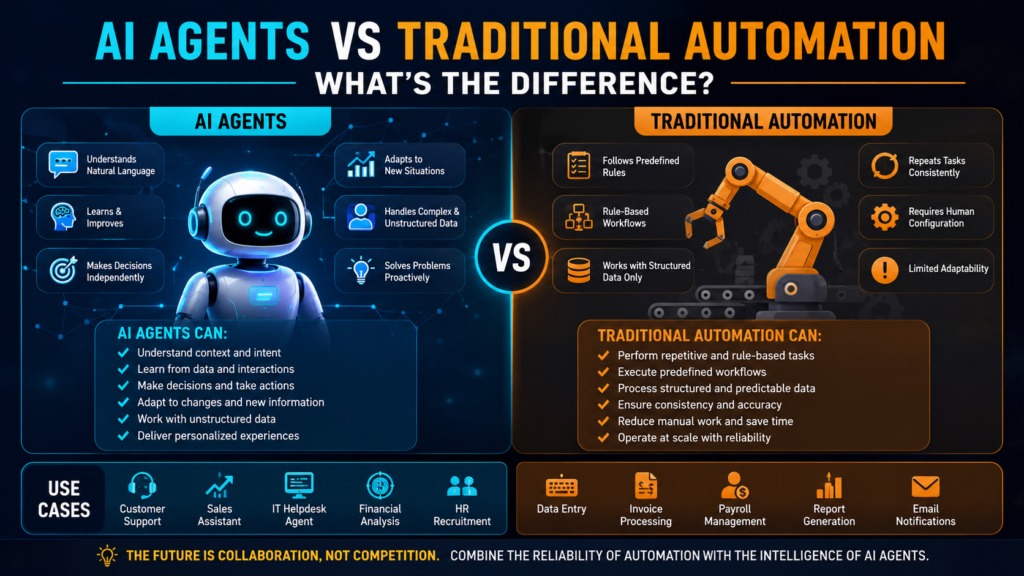
Although both technologies aim to improve efficiency and reduce manual work, they function in fundamentally different ways. Traditional automation follows predefined rules and executes repetitive tasks exactly as programmed. AI agents, on the other hand, can analyze information, learn from interactions, make decisions, and adapt to changing situations without requiring constant human intervention.
As businesses embrace digital transformation in 2026, understanding these differences is essential for making informed technology investments. This guide explores AI agents, traditional automation, their key differences, benefits, limitations, and how organizations can leverage both technologies for maximum business value.
What Is Traditional Automation?
Traditional automation refers to software or systems that perform repetitive tasks based on fixed rules and predefined workflows. It has been widely used in industries such as manufacturing, finance, healthcare, retail, and customer service to improve efficiency and reduce operational costs.
A traditional automation system only performs tasks according to the instructions provided by developers or business users. It does not learn, reason, or adapt when unexpected situations occur.
Examples of Traditional Automation
- Sending automatic email responses
- Invoice generation
- Payroll processing
- Scheduled database backups
- Order processing
- Data entry
- Employee attendance tracking
- Automated report generation
Traditional automation works exceptionally well when business processes are structured, repetitive, and predictable.
What Are AI Agents?
AI agents are intelligent software systems capable of understanding context, making decisions, learning from experience, and performing tasks with minimal human supervision. Unlike traditional automation, AI agents are designed to analyze data, interact with users, solve problems, and improve performance over time.
Modern AI agents combine technologies such as:
- Artificial Intelligence
- Machine Learning
- Natural Language Processing (NLP)
- Large Language Models (LLMs)
- Predictive Analytics
- Computer Vision (where applicable)
Rather than simply following predefined instructions, AI agents evaluate situations and determine the best possible action based on available information.
Examples of AI Agents
- AI customer support assistants
- Virtual sales representatives
- Intelligent IT helpdesk agents
- AI coding assistants
- Marketing optimization agents
- Financial analysis assistants
- Healthcare diagnostic assistants
- HR recruitment assistants
AI agents can handle dynamic environments where every interaction may be different.
Traditional Automation vs AI Agents
Although both technologies automate work, they differ significantly in capability.
| Feature | Traditional Automation | AI Agents |
| Decision Making | Rule-based | Intelligent reasoning |
| Learning Ability | No | Yes |
| Adaptability | Limited | High |
| Handles Unstructured Data | No | Yes |
| Understands Language | No | Yes |
| Context Awareness | None | Advanced |
| Continuous Improvement | No | Yes |
| Human Interaction | Limited | Natural conversations |
Traditional automation executes instructions.
AI agents understand objectives.
How Traditional Automation Works
Traditional automation relies on workflows designed by humans.
For example:
If a customer submits an online form:
- Validate required fields.
- Save information to database.
- Generate confirmation email.
- Notify support team.
Every action is predefined.
If something unexpected happens, the workflow usually stops until a human intervenes.
How AI Agents Work
AI agents work differently.
Instead of following fixed instructions, they:
- Observe data.
- Analyze context.
- Understand goals.
- Make decisions.
- Perform actions.
- Learn from results.
For example, an AI customer service agent can:
- Understand customer questions.
- Search company knowledge bases.
- Provide accurate responses.
- Escalate complex issues.
- Learn from previous conversations.
- Improve future recommendations.
The more information AI agents process, the more effective they become.
Key Differences Between AI Agents and Traditional Automation
- Intelligence
Traditional automation follows instructions.
AI agents make decisions.
For example:
Traditional automation:
“If payment is received, generate invoice.”
AI agent:
Analyze customer payment history, detect unusual behavior, predict payment delays, and recommend follow-up actions.
- Flexibility
Automation works only within predefined rules.
AI agents adapt when situations change.
If a customer asks an unexpected question, automation fails.
AI agents attempt to understand the request and provide the most relevant answer.
- Learning Capability
Traditional automation never improves unless programmers update it.
AI agents continuously improve by learning from interactions, feedback, and new data.
- Human-Like Communication
Automation cannot understand conversations.
AI agents use Natural Language Processing to communicate naturally with users.
Customers can ask questions in everyday language instead of selecting predefined options.
- Decision Making
Traditional automation executes workflows.
AI agents evaluate multiple options before making recommendations.
This makes AI suitable for complex business operations.
Benefits of Traditional Automation
Traditional automation remains valuable because it offers:
Lower Implementation Cost
Rule-based automation is generally less expensive to implement.
High Reliability
Tasks are performed consistently every time.
Faster Processing
Automation eliminates repetitive manual work.
Reduced Human Errors
Automated workflows minimize mistakes caused by manual data entry.
Easy Compliance
Predefined workflows help maintain regulatory compliance.
Benefits of AI Agents
AI agents provide capabilities beyond traditional automation.
Better Customer Experience
AI agents offer personalized conversations and faster responses.
Smarter Decision Making
They analyze large volumes of information before recommending actions.
Increased Productivity
Employees spend less time on repetitive work and more time on strategic initiatives.
Continuous Learning
AI improves with experience rather than remaining static.
Business Scalability
AI agents can simultaneously support thousands of customers or business processes.
Real Business Examples
Customer Support
Traditional Automation:
- Sends ticket confirmation.
- Assigns ticket.
- Sends status updates.
AI Agent:
- Understands customer issue.
- Suggests solutions.
- Resolves simple cases.
- Escalates complex problems.
- Learns from previous interactions.
Sales
Traditional Automation:
- Sends follow-up emails.
- Updates CRM.
AI Agent:
- Scores leads.
- Predicts purchase intent.
- Recommends products.
- Generates personalized proposals.
Human Resources
Traditional Automation:
- Schedules interviews.
- Sends offer letters.
AI Agent:
- Screens resumes.
- Answers candidate questions.
- Matches skills with job requirements.
- Predicts hiring success.
Finance
Traditional Automation:
- Creates invoices.
- Processes payroll.
AI Agent:
- Detects fraud.
- Forecasts cash flow.
- Identifies financial risks.
- Provides business insights.
When Should Businesses Use Traditional Automation?
Traditional automation works best when processes are:
- Repetitive
- Rule-based
- Structured
- Predictable
- High-volume
- Low complexity
Examples include:
- Payroll
- Attendance
- Inventory updates
- Invoice creation
- Email notifications
- Data synchronization
When Should Businesses Use AI Agents?
AI agents are ideal when work requires:
- Decision making
- Human interaction
- Context awareness
- Personalization
- Learning
- Problem solving
Examples include:
- Customer support
- Sales assistance
- IT support
- Marketing optimization
- Financial advisory
- Executive assistance
Can AI Agents and Traditional Automation Work Together?
Absolutely.
The most successful organizations combine both technologies.
For example:
A customer submits a request.
Traditional automation:
- Creates ticket.
- Stores customer information.
- Assigns department.
AI agent:
- Reads customer request.
- Determines urgency.
- Suggests solution.
- Answers questions.
- Escalates only when necessary.
This combination reduces costs while improving customer satisfaction.
Challenges of AI Agents
Although AI agents provide significant advantages, businesses should also consider:
Data Privacy
Sensitive business data must be protected.
Initial Investment
AI solutions may require greater upfront investment than traditional automation.
Training
Employees need guidance to effectively collaborate with AI systems.
Governance
Organizations should establish clear policies regarding AI usage, security, and ethical decision-making.
Future of Business Automation
The future belongs to intelligent automation.
Rather than replacing traditional automation, AI agents enhance it by adding reasoning, adaptability, and continuous learning.
Businesses will increasingly deploy AI agents to:
- Manage customer interactions
- Analyze business data
- Support employees
- Automate decision-making
- Optimize workflows
- Improve productivity
- Reduce operational costs
- Deliver personalized experiences
Organizations that adopt intelligent automation today will gain a competitive advantage through faster innovation and better customer service.
Best Practices for Implementing AI Agents
To maximize success:
- Start with a clearly defined business problem.
- Identify repetitive tasks that require decision-making.
- Ensure high-quality data for AI models.
- Integrate AI with existing business systems.
- Monitor AI performance regularly.
- Maintain human oversight for critical decisions.
- Continuously improve AI models using feedback.
- Prioritize cybersecurity and data privacy.
A phased implementation strategy allows businesses to realize value quickly while minimizing risk.
Conclusion
Traditional automation and AI agents both play vital roles in modern business operations, but they serve different purposes. Traditional automation excels at executing repetitive, rule-based tasks with speed and consistency, making it ideal for structured workflows. AI agents go a step further by understanding context, learning from experience, making intelligent decisions, and adapting to changing business needs.
Rather than viewing these technologies as competitors, organizations should see them as complementary tools. By combining the efficiency of traditional automation with the intelligence of AI agents, businesses can streamline operations, enhance customer experiences, improve decision-making, and unlock new opportunities for growth.
As AI continues to evolve, organizations that embrace intelligent automation will be better equipped to innovate, remain competitive, and meet the increasing expectations of customers in the digital age.
Learn more about AI, automation, and digital transformation solutions at: