
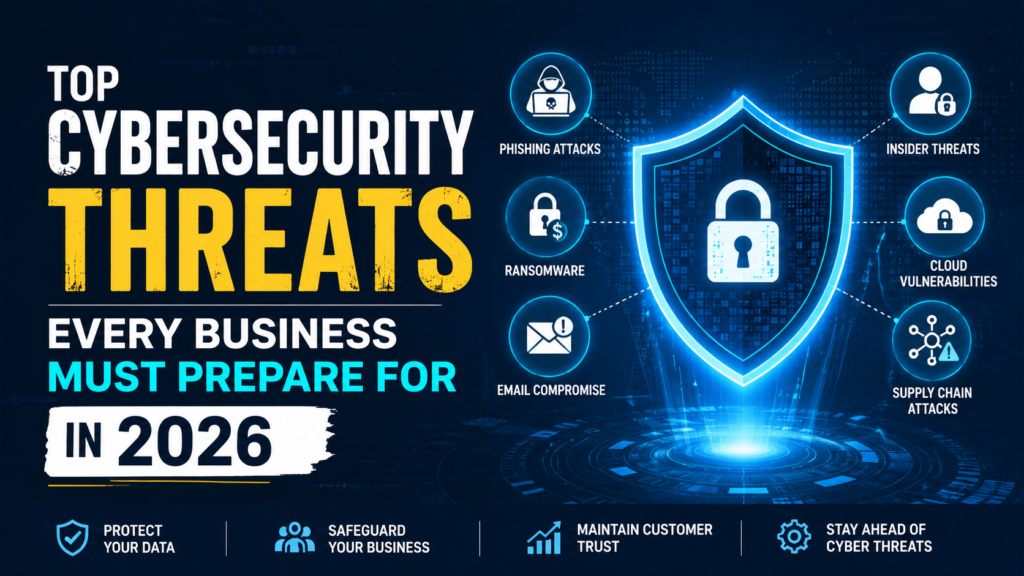
Top Cybersecurity Threats Every Business Must Prepare for in 2026
Introduction
Cybersecurity has become one of the most important priorities for businesses of every size. As organizations continue to embrace cloud computing, artificial intelligence, remote work, and digital transformation, cybercriminals are finding new ways to exploit security weaknesses. A successful cyberattack can result in financial losses, disrupted operations, legal consequences, and damage to customer trust. In many cases, recovering from a cyber incident costs far more than preventing one.
The threat landscape in 2026 is more sophisticated than ever. Attackers are no longer relying on simple viruses or spam emails. They use advanced phishing campaigns, ransomware, AI-generated scams, credential theft, and supply chain attacks to target businesses across every industry. Small and medium-sized businesses are especially attractive targets because they often lack dedicated cybersecurity teams and advanced security controls.
Protecting an organization requires more than installing antivirus software. Businesses need a proactive cybersecurity strategy that combines modern technology, employee awareness, strong policies, and continuous monitoring. Understanding the most significant cybersecurity threats is the first step toward building a resilient and secure business.
This article explores the top cybersecurity threats businesses should prepare for in 2026 and outlines practical strategies to reduce risk and strengthen overall security.
1. AI-Powered Phishing Attacks
Phishing has remained one of the leading causes of data breaches for years, but artificial intelligence has made these attacks significantly more convincing. Cybercriminals now use AI to create personalized emails, fake websites, and realistic messages that imitate trusted individuals or organizations.
Instead of sending generic emails, attackers gather information from company websites, social media platforms, and public records to create targeted attacks. Employees may receive emails that appear to come from executives, customers, or suppliers, making them much more likely to trust the message.
Businesses should invest in employee awareness training and encourage staff to verify unexpected requests before clicking links or sharing confidential information. Multi-factor authentication (MFA), advanced email filtering, and regular phishing simulations can greatly reduce the success of these attacks.
2. Ransomware Attacks
Ransomware continues to be one of the most damaging cybersecurity threats facing organizations. Attackers encrypt important files and demand payment to restore access. Many criminal groups now steal sensitive information before encrypting systems, increasing pressure on victims by threatening to publish confidential data.
A ransomware attack can shut down operations for days or even weeks. Manufacturing companies, healthcare providers, financial institutions, and government organizations have all experienced costly disruptions caused by ransomware.
Businesses can reduce their exposure by maintaining secure offline backups, updating software regularly, limiting user permissions, and deploying endpoint detection and response (EDR) solutions. A tested disaster recovery plan also helps organizations recover quickly without paying a ransom.
3. Business Email Compromise
Business Email Compromise (BEC) is a targeted scam in which criminals impersonate executives, vendors, or trusted business partners to trick employees into transferring money or sharing confidential information.
Unlike traditional phishing attacks, BEC emails often contain no malicious links or attachments. Instead, they rely on trust and urgency. An employee may receive an email that appears to come from the CEO requesting an immediate bank transfer or sensitive financial records.
Organizations should establish strict payment verification procedures, especially for large financial transactions. Employees should confirm unusual requests through a separate communication channel such as a phone call or video meeting before taking action.
4. Cloud Security Risks
Cloud computing has transformed how businesses store data and run applications. While cloud services offer flexibility and scalability, they also introduce new security challenges.
Common cloud security issues include weak passwords, excessive user permissions, misconfigured storage, and unsecured application programming interfaces (APIs). Even a simple configuration mistake can expose confidential customer information to the public internet.
Businesses should regularly review cloud security settings, encrypt sensitive information, implement identity and access management policies, and monitor cloud environments for suspicious activity. Security responsibilities should be clearly defined between the organization and its cloud service providers.
5. Credential Theft
Passwords remain one of the easiest ways for attackers to gain unauthorized access to business systems. Criminals steal login credentials through phishing attacks, malware, password reuse, and previous data breaches.
Once attackers obtain valid credentials, they can often bypass traditional security measures because they appear to be legitimate users. This allows them to access email accounts, cloud applications, financial systems, and confidential business data.
Businesses should require strong passwords, enable multi-factor authentication for all users, encourage the use of password managers, and regularly monitor accounts for suspicious login activity. Employees should never reuse passwords across multiple business applications.
6. Insider Threats
Not every cybersecurity incident originates outside the organization. Employees, contractors, or third-party vendors can unintentionally or deliberately create security risks.
Accidental insider threats include sending confidential information to the wrong recipient, using weak passwords, or downloading unauthorized software. Malicious insiders may steal sensitive information for personal or financial gain.
Organizations should implement the principle of least privilege, ensuring employees only have access to the information required for their jobs. Regular access reviews, security awareness programs, and activity monitoring can significantly reduce insider risks.
7. Supply Chain Attacks
Businesses increasingly rely on external vendors, software providers, and cloud services to support daily operations. Cybercriminals recognize that compromising a trusted supplier may provide access to multiple organizations at once.
Supply chain attacks often involve inserting malicious code into legitimate software updates or exploiting vulnerabilities within third-party systems. Because businesses trust their suppliers, these attacks can remain undetected for long periods.
Organizations should evaluate the cybersecurity practices of vendors, monitor third-party access, require security compliance from partners, and keep software updated with verified releases from trusted sources.
8. Internet of Things (IoT) Vulnerabilities
Modern workplaces use numerous connected devices, including printers, security cameras, smart sensors, conference systems, and industrial equipment. While these devices improve efficiency, they often receive less security attention than traditional computers.
Many IoT devices still operate with default passwords, outdated firmware, or weak encryption, making them attractive targets for attackers. Once compromised, these devices can provide an entry point into the corporate network.
Businesses should change default credentials, regularly update device firmware, separate IoT devices from critical business systems, and continuously monitor connected devices for unusual behavior.
9. Malware and Advanced Persistent Threats
Cybercriminals continue to develop increasingly sophisticated malware capable of stealing information, disrupting operations, or silently monitoring business activities.
Advanced Persistent Threats (APTs) differ from ordinary attacks because they focus on maintaining long-term access to business networks. Instead of causing immediate disruption, attackers quietly gather confidential information over weeks or months before detection.
Organizations should deploy modern endpoint security solutions, continuously monitor network traffic, perform regular vulnerability assessments, and establish an incident response plan to quickly contain potential threats.
10. Deepfake and Social Engineering Attacks
Artificial intelligence has introduced a new generation of social engineering attacks through realistic voice cloning and deepfake videos. Criminals can imitate executives, business partners, or customers to manipulate employees into approving payments or disclosing confidential information.
These attacks exploit human trust rather than technical vulnerabilities, making employee awareness one of the most effective defenses.
Businesses should establish verification procedures for sensitive requests, educate employees about deepfake technology, and encourage staff to question unusual communications regardless of how authentic they appear.
Best Practices for Strengthening Business Cybersecurity
Preparing for modern cyber threats requires a proactive and continuous approach. Every organization should develop a cybersecurity strategy that includes technology, employee training, and well-defined security policies.
Key best practices include:
- Enable Multi-Factor Authentication for all business accounts.
- Keep operating systems, applications, and security software updated.
- Train employees regularly on phishing and cybersecurity awareness.
- Perform regular data backups and test recovery procedures.
- Encrypt sensitive customer and business information.
- Conduct routine vulnerability assessments and penetration testing.
- Monitor networks continuously for suspicious activity.
- Limit user permissions based on job responsibilities.
- Develop and regularly test an incident response plan.
- Review third-party vendor security before sharing sensitive information.
Cybersecurity should become part of the organization’s culture rather than being viewed solely as an IT responsibility. Every employee plays an important role in protecting business assets.
Conclusion
The cybersecurity landscape in 2026 continues to evolve as businesses become increasingly dependent on digital technologies. AI-powered phishing, ransomware, credential theft, insider threats, cloud vulnerabilities, supply chain attacks, IoT security risks, malware, and deepfake scams present serious challenges for organizations across every industry.
While no business can eliminate every cyber risk, proactive preparation can significantly reduce the likelihood and impact of an attack. Investing in employee education, modern security technologies, regular system updates, strong authentication, and continuous monitoring helps create a resilient security posture.
Organizations that treat cybersecurity as a strategic business priority will be better positioned to protect their customers, maintain regulatory compliance, safeguard valuable information, and ensure uninterrupted operations in an increasingly connected world. The cost of prevention is almost always lower than the cost of recovering from a successful cyberattack.
For businesses looking to strengthen their cybersecurity strategy, explore professional technology and security solutions at: