How Small Businesses Can Benefit from Artificial Intelligence
Introduction
Artificial Intelligence (AI) is no longer a technology reserved for large enterprises with massive budgets and dedicated research teams. Today, AI has become more accessible, affordable, and practical, allowing small businesses to compete more effectively in an increasingly digital marketplace. From automating routine tasks and improving customer service to generating business insights and optimizing marketing campaigns, AI is transforming how small businesses operate and grow.
For many small business owners, time and resources are limited. Managing customer relationships, handling finances, marketing products, responding to inquiries, and making strategic decisions often fall on a small team—or even a single individual. Artificial Intelligence helps reduce this burden by automating repetitive tasks, analyzing data faster than humans, and providing valuable recommendations that support better decision-making.
The adoption of AI is no longer about staying ahead of competitors—it is about remaining competitive. Businesses that embrace AI can improve productivity, reduce operating costs, enhance customer experiences, and create new opportunities for growth.
This article explores how small businesses can benefit from Artificial Intelligence, practical use cases, implementation strategies, common challenges, and best practices for adopting AI successfully.
Why Artificial Intelligence Matters for Small Businesses
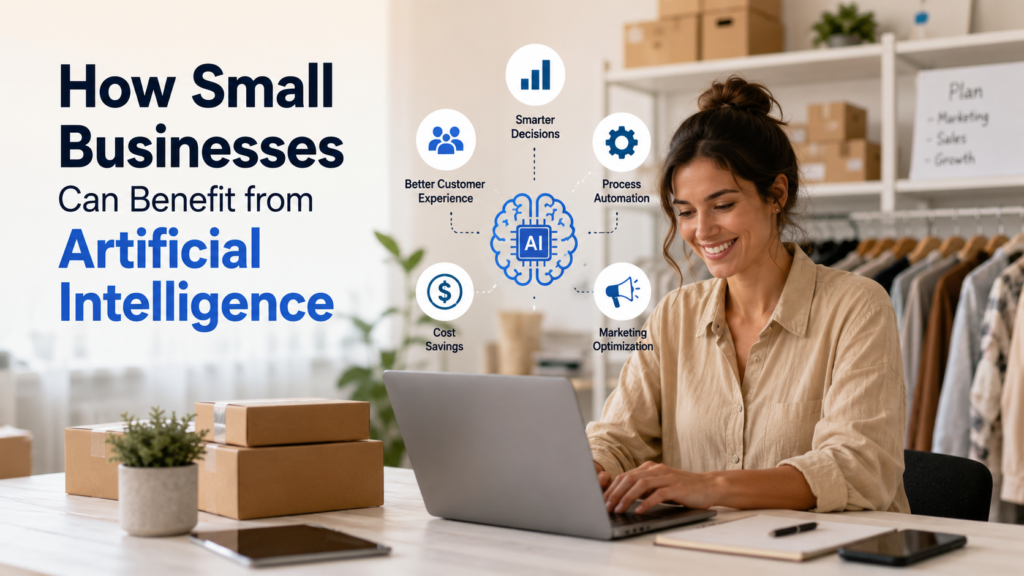
Small businesses often face challenges such as limited budgets, smaller workforces, and increasing customer expectations. AI helps bridge these gaps by enabling organizations to accomplish more with fewer resources.
Rather than replacing employees, AI supports them by handling repetitive and time-consuming tasks. This allows business owners and staff to focus on activities that require creativity, relationship building, and strategic thinking.
Key advantages include:
- Increased efficiency
- Faster decision-making
- Better customer experiences
- Reduced operational costs
- Improved business insights
- Enhanced competitiveness
As AI tools become easier to use, businesses of every size can benefit without requiring advanced technical expertise.
1. Automating Repetitive Tasks
One of the biggest advantages of AI is automation.
Many small businesses spend hours every week performing repetitive administrative tasks such as entering data, responding to emails, scheduling appointments, generating reports, and updating customer records.
AI-powered automation can perform these activities quickly and consistently.
Examples include:
- Invoice generation
- Appointment scheduling
- Email responses
- Payroll processing
- Inventory updates
- Data entry
- Document organization
Automation reduces manual work while minimizing human error and improving operational efficiency.
2. Improving Customer Service
Customer expectations continue to rise. People expect quick responses, personalized experiences, and support whenever they need it.
AI-powered chatbots and virtual assistants help businesses provide 24/7 customer support without increasing staffing costs.
These systems can:
- Answer common questions
- Provide product recommendations
- Track orders
- Schedule appointments
- Collect customer information
- Route complex issues to human representatives
This improves customer satisfaction while allowing employees to focus on more complex inquiries.
3. Smarter Marketing Campaigns
Marketing is essential for business growth, but creating effective campaigns requires time, creativity, and analysis.
AI helps businesses:
- Generate marketing content
- Personalize email campaigns
- Analyze customer behavior
- Predict purchasing trends
- Optimize advertising budgets
- Recommend products
- Improve social media engagement
Instead of relying on guesswork, AI enables businesses to make marketing decisions based on real customer data.
Personalized marketing often leads to higher engagement and improved conversion rates.
4. Better Decision-Making Through Data Analysis
Every business generates valuable data, but manually analyzing large amounts of information can be difficult.
AI transforms raw data into meaningful insights.
Business owners can use AI to analyze:
- Sales performance
- Customer preferences
- Website traffic
- Inventory levels
- Financial trends
- Employee productivity
These insights help organizations make informed decisions more quickly and confidently.
5. Enhancing Sales Performance
Artificial Intelligence supports sales teams by identifying potential opportunities and improving customer interactions.
AI can:
- Score leads
- Predict customer buying behavior
- Recommend products
- Personalize offers
- Automate follow-up emails
- Forecast sales trends
This allows businesses to focus their efforts on high-value prospects and improve overall sales performance.
6. Simplifying Financial Management
Managing finances is often one of the most time-consuming responsibilities for small business owners.
AI-powered accounting solutions help automate financial tasks such as:
- Expense tracking
- Invoice management
- Cash flow forecasting
- Tax preparation
- Budget planning
- Fraud detection
These tools improve financial accuracy while reducing administrative workload.
7. Strengthening Cybersecurity
Cybersecurity threats continue to increase, and small businesses are frequently targeted because attackers assume they have weaker defenses.
AI improves cybersecurity by:
- Detecting suspicious activity
- Monitoring network traffic
- Identifying malware
- Preventing unauthorized access
- Detecting phishing attempts
- Responding to threats faster
While AI is not a complete security solution, it significantly enhances an organization’s ability to detect and respond to cyber risks.
8. Improving Inventory Management
Inventory management directly impacts profitability.
Too much inventory ties up capital, while too little inventory leads to missed sales opportunities.
AI analyzes historical sales data, seasonal trends, and customer demand to help businesses:
- Predict inventory needs
- Reduce waste
- Optimize stock levels
- Prevent shortages
- Improve purchasing decisions
This leads to better inventory control and lower operating costs.
9. Supporting Human Resources
Hiring and managing employees requires significant effort.
AI assists HR teams by:
- Screening resumes
- Scheduling interviews
- Answering candidate questions
- Managing employee records
- Identifying training needs
- Improving onboarding
This allows HR professionals to spend more time focusing on employee engagement and development.
10. Creating Better Customer Experiences
Today’s customers expect personalized experiences.
AI analyzes customer behavior to deliver:
- Personalized recommendations
- Customized promotions
- Relevant product suggestions
- Tailored communication
- Faster support
Satisfied customers are more likely to become repeat buyers and recommend businesses to others.
Real-World Examples of AI in Small Businesses
Many industries already use AI successfully.
Retail
Retail businesses use AI to recommend products, manage inventory, and personalize customer experiences.
Healthcare
Clinics automate appointment scheduling, patient communication, and administrative tasks.
Restaurants
Restaurants use AI for online ordering, reservation management, demand forecasting, and customer feedback analysis.
Professional Services
Consultants, accountants, and legal firms automate document creation, appointment scheduling, and customer support.
E-commerce
Online stores use AI for product recommendations, dynamic pricing, customer service, and fraud prevention.
Challenges Small Businesses Should Consider
Although AI offers many advantages, businesses should plan carefully before implementation.
Common challenges include:
Initial Investment
Some AI solutions require upfront investment, although many cloud-based platforms offer affordable subscription models.
Employee Training
Employees need time to learn new tools and workflows.
Data Quality
AI performs best when trained on accurate and organized data.
Privacy and Security
Organizations must protect customer information and comply with privacy regulations.
Integration
Businesses should ensure AI tools work smoothly with existing software and systems.
Planning ahead helps minimize these challenges.
Best Practices for Adopting AI
Successful AI adoption requires more than simply purchasing software.
Businesses should:
- Start with clearly defined goals.
- Identify repetitive tasks suitable for automation.
- Choose scalable AI solutions.
- Train employees effectively.
- Protect customer data.
- Monitor AI performance regularly.
- Maintain human oversight.
- Continuously improve workflows.
- Measure business outcomes.
- Stay informed about new AI developments.
Small, incremental implementations often produce better long-term results than attempting large-scale changes all at once.
The Future of AI for Small Businesses
Artificial Intelligence will continue becoming more accessible, affordable, and capable.
Future developments are expected to include:
- Smarter AI assistants
- Intelligent business automation
- Improved predictive analytics
- Personalized customer engagement
- Advanced cybersecurity protection
- Better financial forecasting
- More efficient supply chain management
- AI-powered business intelligence
Businesses that begin exploring AI today will be better prepared to take advantage of these future innovations.
Conclusion
Artificial Intelligence is changing the way small businesses operate, compete, and grow. What was once considered advanced technology for large corporations is now an accessible business tool that helps organizations improve efficiency, reduce costs, enhance customer experiences, and make smarter decisions.
Whether automating repetitive tasks, strengthening cybersecurity, improving marketing campaigns, managing inventory, or providing personalized customer support, AI offers practical benefits across every aspect of business operations. The key to success is starting with clear objectives, selecting the right solutions, and integrating AI gradually while maintaining strong security and human oversight.
Small businesses that embrace AI today are positioning themselves for long-term success in an increasingly digital economy. By combining human creativity with intelligent technology, organizations can increase productivity, respond more quickly to customer needs, and build a stronger foundation for sustainable growth.
Explore AI-powered business solutions, digital transformation services, cloud technologies, and cybersecurity expertise at: