
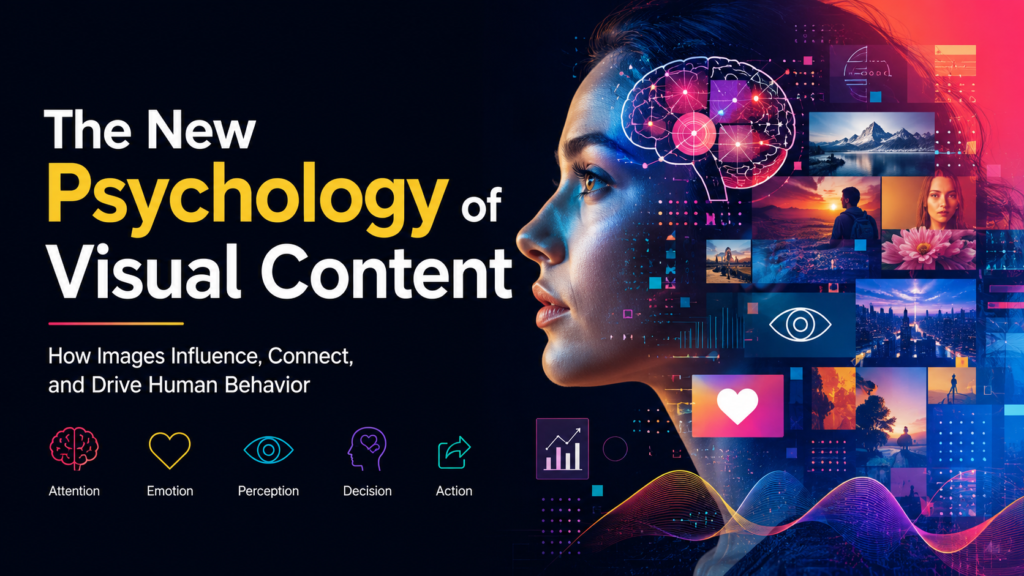
The New Psychology of Visual Content
Introduction
Visual content has become the most powerful form of communication in the modern digital world. Long before people read headlines, descriptions, or captions, they react emotionally to images. Every day, billions of people scroll through photographs, videos, advertisements, social media posts, product images, cinematic visuals, and digital stories. In only a few seconds, the human brain decides whether something deserves attention or should be ignored.
This rapid decision-making process is driven by psychology.
Modern visual communication is no longer only about taking technically correct photographs or creating attractive designs. It is about understanding how people think, feel, react, remember, and emotionally connect with visuals.
Today, successful visual content depends on emotional storytelling, human authenticity, psychological triggers, attention control, color perception, composition, and narrative depth.
The internet has completely changed how people consume visual media. Audiences have become faster, more selective, emotionally aware, and psychologically sensitive to what they see online. As a result, photography, branding, advertising, filmmaking, and social media content are evolving rapidly.
The creators who understand visual psychology are now leading digital engagement.
This article explores the new psychology of visual content, why emotional visuals outperform perfect visuals, how modern audiences react to imagery, and why visual storytelling has become more important than ever before.
Understanding the Psychology of Visual Content
Visual psychology refers to how humans emotionally and mentally respond to images, colors, light, shapes, composition, movement, and storytelling.
The human brain processes visuals significantly faster than text. Before someone consciously analyzes an image, the brain has already formed emotional impressions.
People instantly judge visuals based on:
- Emotional tone
- Facial expressions
- Lighting
- Composition
- Color balance
- Contrast
- Body language
- Environment
- Authenticity
- Storytelling depth
This reaction happens almost automatically.
For example, warm lighting may create feelings of comfort and safety. Dark cinematic shadows may create mystery or emotional tension. Natural candid expressions often build trust faster than highly posed images.
Every visual element influences human emotion.
That is why modern visual content has become deeply connected with psychology.
Why Human Attention Has Changed
Modern audiences are exposed to more content than any previous generation in history.
Every day people encounter:
- Social media feeds
- Advertisements
- Short-form videos
- YouTube thumbnails
- Product photography
- News graphics
- Streaming platforms
- Digital campaigns
- AI-generated visuals
- Branded content
Because of this overload, the human brain has developed stronger filtering behavior.
People no longer give equal attention to everything they see.
Instead, the brain rapidly searches for visuals that feel:
- Emotionally interesting
- Human
- Authentic
- Different
- Relatable
- Cinematic
- Meaningful
- Memorable
At the same time, audiences quickly ignore visuals that feel:
- Generic
- Emotionless
- Overedited
- Artificial
- Visually cluttered
- Predictable
- Fake
This shift explains why emotional storytelling now performs better than technically perfect but emotionally empty content.
The internet has trained audiences to emotionally filter visuals within seconds.
Emotion Is More Powerful Than Perfection
One of the biggest changes in modern photography and digital media is the growing importance of emotional realism.
For many years, visual culture focused heavily on perfection.
Brands and creators pursued:
- Perfect skin
- Flawless editing
- Extreme retouching
- Unrealistic lighting
- Highly polished images
- Artificial beauty standards
However, audiences are changing.
Modern viewers increasingly connect with visuals that feel emotionally real rather than visually perfect.
People now respond more strongly to:
- Genuine expressions
- Natural skin texture
- Candid moments
- Human vulnerability
- Real-life emotion
- Imperfect beauty
- Authentic environments
Why?
Because emotionally believable visuals create psychological trust.
When viewers feel that an image represents a real human experience, they form stronger emotional connections.
This emotional connection increases:
- Engagement
- Watch time
- Social shares
- Brand trust
- Audience loyalty
- Memory retention
Perfection may attract short attention.
Emotion creates lasting impact.
The Science of First Impressions
First impressions happen incredibly fast online.
In many cases, people decide how they feel about visual content within only a few seconds.
This means creators must immediately communicate emotional clarity.
Visual content that performs well often achieves several psychological goals instantly:
1. It Creates Curiosity
The brain naturally pays attention to unanswered questions.
Images that create mystery, tension, or emotional curiosity encourage viewers to stop scrolling.
For example:
- A cinematic silhouette
- A dramatic expression
- Unusual lighting
- Story-focused composition
- Emotional body language
These visual cues encourage the brain to investigate further.
2. It Creates Emotional Recognition
Humans naturally connect with emotions they recognize.
People emotionally respond to visuals that remind them of:
- Personal memories
- Relationships
- Fear
- Joy
- Loneliness
- Nostalgia
- Hope
- Adventure
Strong visual storytelling often succeeds because viewers emotionally project themselves into the image.
3. It Controls Attention Direction
Powerful visual content guides the eye intentionally.
Photographers and visual creators use:
- Leading lines
- Contrast
- Focus depth
- Lighting
- Subject placement
- Motion
- Negative space
These techniques influence where viewers look first and how long they stay engaged.
Visual psychology is deeply connected with attention control.
Why Storytelling Has Become Essential
Modern audiences no longer want visuals that simply look beautiful.
They want visuals that feel meaningful.
Storytelling has become one of the most valuable elements in photography and content creation because stories create emotional memory.
A strong visual story makes viewers ask questions like:
- What happened before this moment?
- What happens next?
- What emotion is this person experiencing?
- Why does this image feel important?
- Why does this visual feel cinematic?
These unanswered questions increase viewer engagement.
Storytelling transforms ordinary photographs into emotional experiences.
This is why cinematic photography has become so influential in modern digital culture.
Cinematic visuals create atmosphere, emotional tension, narrative depth, and psychological immersion.
Instead of simply documenting reality, cinematic photography creates emotional worlds.
That emotional immersion keeps viewers connected longer.
The Psychology of Color in Visual Content
Color strongly influences emotional interpretation.
Before viewers consciously understand an image, their brains already react psychologically to color.
Different colors trigger different emotional responses.
Warm Colors
Warm tones like red, orange, and yellow often create feelings of:
- Energy
- Warmth
- Passion
- Excitement
- Urgency
- Confidence
These colors are commonly used in advertising, fashion photography, food photography, and entertainment branding.
Cool Colors
Blue, green, and purple often create:
- Calmness
- Luxury
- Mystery
- Sadness
- Reflection
- Sophistication
Cool tones are widely used in cinematic photography, luxury branding, and emotional storytelling.
Black and White Psychology
Black and white imagery removes visual distractions and amplifies emotional intensity.
Without color, viewers focus more on:
- Expression
- Contrast
- Texture
- Emotion
- Light
- Storytelling
Black and white photography often feels timeless because it simplifies emotional communication.
Color Grading and Mood
Modern creators increasingly use color grading to shape emotional atmosphere.
Subtle color shifts can dramatically change how viewers emotionally interpret visuals.
For example:
- Warm cinematic grading may feel nostalgic
- Desaturated tones may feel dramatic
- Deep contrast may feel intense
- Soft pastel tones may feel calm or romantic
Color psychology has become one of the most powerful tools in visual storytelling.
Why Authenticity Matters More Than Ever
The rise of AI-generated imagery and heavily edited content has changed audience behavior.
People are becoming more sensitive to visuals that feel artificial.
Although AI can generate visually impressive images, audiences still crave human connection.
Real emotion remains difficult to fake.
This explains why authentic photography is becoming increasingly valuable.
Modern audiences trust visuals that feel:
- Human
- Honest
- Natural
- Relatable
- Emotionally believable
Authenticity creates psychological safety.
When viewers feel emotionally safe, they engage more deeply.
This shift has influenced:
- Social media trends
- Brand campaigns
- Portrait photography
- Influencer marketing
- Documentary photography
- Lifestyle content
- Wedding photography
- Commercial storytelling
People no longer want only polished perfection.
They want emotional honesty.
The Rise of Minimalist Visual Communication
Modern attention spans are shorter than ever.
As a result, visual simplicity has become extremely important.
Cluttered visuals often overwhelm viewers because the brain prefers clear emotional communication.
Minimalist visual content works because it:
- Reduces distraction
- Increases focus
- Simplifies emotional interpretation
- Improves attention retention
- Creates elegance
- Feels modern
Minimalism does not mean empty visuals.
It means intentional visuals.
Every visual element should support emotional storytelling.
This is why modern luxury branding often uses:
- Clean composition
- Negative space
- Soft lighting
- Controlled color palettes
- Minimal distractions
Psychologically, simplicity often feels more premium.
Social Media and the New Visual Behavior
Social media platforms have dramatically changed how humans consume visual content.
Algorithms reward engagement.
Engagement is strongly connected with emotional reaction.
As a result, creators now compete not only for visibility but for emotional attention.
Successful content often combines:
- Emotional storytelling
- Human relatability
- Visual clarity
- Strong composition
- Psychological curiosity
- Authentic emotion
- Fast communication
Short-form platforms especially reward visuals that communicate instantly.
People scroll rapidly.
This means creators have only moments to capture attention.
High-performing visual content often succeeds because it immediately triggers emotional interest.
The strongest visual creators understand that attention is now emotional currency.
Why Cinematic Photography Is Growing Rapidly
Cinematic photography has become one of the most influential visual trends because it combines storytelling and psychology.
Unlike traditional photography that focuses mainly on documentation, cinematic photography focuses on emotional atmosphere.
Cinematic visuals often use:
- Dramatic lighting
- Moody shadows
- Environmental storytelling
- Dynamic composition
- Color grading
- Narrative tension
- Motion-inspired framing
These techniques create immersive emotional experiences.
Viewers do not simply observe cinematic images.
They emotionally enter them.
This psychological immersion increases:
- Viewer retention
- Social sharing
- Emotional connection
- Brand memorability
- Visual impact
The rise of cinematic photography reflects a larger shift toward emotionally driven content.
The Role of Editing in Emotional Perception
Photo editing is no longer only about technical correction.
Editing now shapes emotional perception.
Every adjustment influences how viewers emotionally interpret visuals.
Editing affects:
- Mood
- Atmosphere
- Realism
- Warmth
- Energy
- Trust
- Depth
- Storytelling
Professional editing helps visual content feel polished while still maintaining emotional authenticity.
In industries like architecture and real estate, editing significantly influences how audiences emotionally perceive spaces.
Balanced lighting, realistic colors, and natural depth can dramatically improve viewer response.
For businesses, brands, and property marketing professionals, professionally enhanced visuals often create stronger emotional trust and better first impressions.
This is why many companies invest in specialized solutions such as real estate photo editing services to improve image quality, visual clarity, and online presentation.
Professional real estate editing helps properties appear:
- More spacious
- More inviting
- Better lit
- More realistic
- More visually balanced
- More emotionally appealing
High-quality property visuals are extremely important because buyers often emotionally judge homes before physically visiting them.
Strong visual presentation can influence perception, trust, and buyer interest.
Learn more about professional real estate photo editing services here:
https://www.oursglobal.com/photo-editing/real-estate-photo-editing-services
Why Human-Centered Creativity Will Dominate the Future
Artificial intelligence will continue transforming photography and digital media.
However, human-centered creativity is becoming more valuable, not less.
Why?
Because technology can imitate visuals.
But genuine human emotion remains difficult to replicate.
The future of visual communication will belong to creators who understand:
- Human psychology
- Emotional storytelling
- Authenticity
- Attention behavior
- Narrative depth
- Visual emotion
- Cultural sensitivity
- Human connection
Technical perfection alone will not define success.
Emotional intelligence will.
The creators who make people feel something will continue leading digital engagement.
The Future of Visual Content
The next generation of visual content will become increasingly psychological.
Audiences are evolving.
People now seek:
- Emotional realism
- Authentic storytelling
- Human connection
- Visual simplicity
- Cinematic atmosphere
- Meaningful experiences
- Trustworthy imagery
Visual communication is moving beyond aesthetics.
It is becoming emotional design.
Photography, filmmaking, branding, social media, and digital storytelling are all shifting toward emotionally intelligent content.
The future will reward creators who deeply understand human behavior.
Visuals that feel emotionally true will always outperform visuals that only look technically perfect.
Because at the core of every memorable image is not just beauty.
It is human emotion.
Conclusion
The psychology of visual content is transforming modern communication.
Images now influence attention, emotion, memory, trust, storytelling, and decision-making more powerfully than ever before.
In a world overwhelmed with content, audiences no longer respond only to polished visuals.
They respond to emotion.
They connect with authenticity.
They remember stories.
Modern visual success depends on understanding how humans emotionally experience imagery.
Whether through photography, cinematic storytelling, social media, branding, or professional editing, the future of visual communication belongs to creators who understand people—not just pixels.
As digital culture continues evolving, emotional intelligence will become the most important creative skill.
Because the most powerful visuals are not simply the ones people see.
They are the ones people feel.