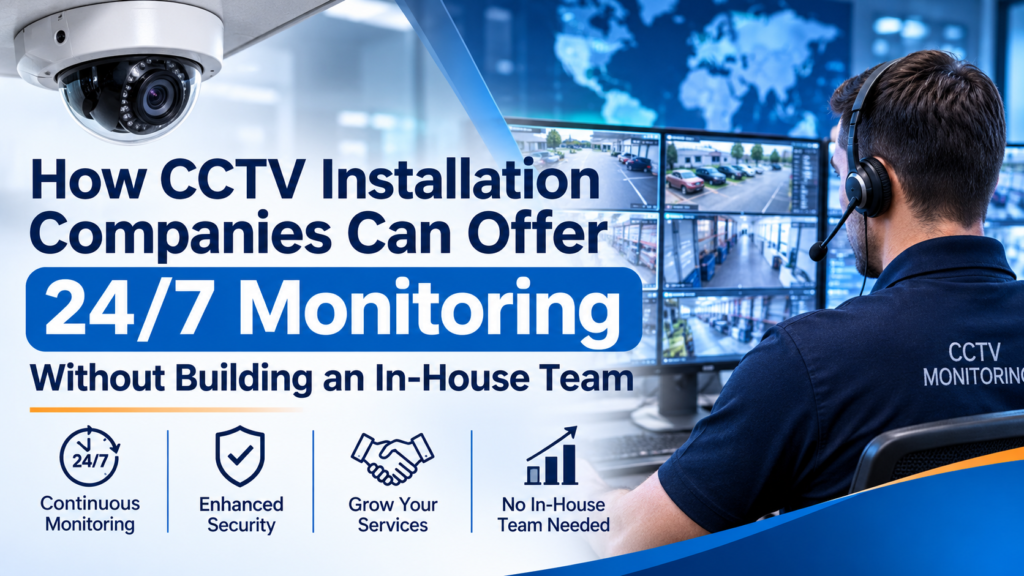
How CCTV Installation Companies Can Offer 24/7 Monitoring Without Building an In-House Team
CCTV installation companies help businesses protect their premises by installing security cameras, configuring surveillance systems and maintaining video recording infrastructure. However, there is another service opportunity beyond installation: providing continuous monitoring of those camera systems.
Many business customers want more than cameras that record footage. They want someone to monitor suspicious activity, identify potential security incidents and notify the appropriate people when something requires attention.
For CCTV installers, meeting this demand can be challenging. Providing 24/7 monitoring independently requires trained operators, shift management, monitoring infrastructure, incident-handling procedures and ongoing operational oversight.
Outsourced CCTV monitoring for CCTV installation companies offers an alternative: installers can work with a specialist monitoring provider to extend their service capabilities without having to build an entire monitoring operation internally.
This guide explains how the model works, what to consider before outsourcing and how CCTV businesses can evaluate a monitoring partner.
Why CCTV Installation Companies Are Expanding Beyond Installation
The traditional CCTV business model focuses on selling, installing and maintaining surveillance equipment.
A typical project might involve:
- Assessing the customer’s security requirements.
- Recommending suitable cameras and recording equipment.
- Installing and configuring the surveillance system.
- Setting up remote access and recording.
- Providing maintenance and technical support.
Once installation is complete, the customer’s ongoing relationship with the installer may become limited to maintenance, troubleshooting or occasional upgrades.
However, customers with warehouses, retail outlets, construction sites, commercial properties and multiple business locations may need continuous surveillance support.
They may ask questions such as:
- Who will monitor our cameras after business hours?
- Who will identify suspicious activity?
- Can someone monitor multiple locations centrally?
- How will our security team be notified about an incident?
- Can we receive ongoing monitoring rather than simply recorded footage?
These requirements create an opportunity for CCTV installation companies to expand their service portfolios.
Instead of providing only equipment and installation, they can explore ongoing monitoring services as an additional part of their customer offering.
What Is Outsourced CCTV Monitoring?
Outsourced CCTV monitoring is an arrangement in which a business engages an external monitoring service provider to monitor video surveillance feeds on its behalf.
Instead of recruiting and managing its own monitoring operators, the business works with a specialist provider that handles agreed monitoring activities.
For CCTV installation companies, this creates an opportunity to offer monitoring support to their customers without independently establishing a dedicated monitoring team.
Depending on the agreed service arrangement, outsourced monitoring can involve:
- Live CCTV feed monitoring.
- Monitoring of multiple camera locations.
- Identification of unusual or suspicious activities.
- Incident alerts and notifications.
- Remote site surveillance.
- Monitoring arrangements tailored to customer requirements.
The exact responsibilities depend on the provider agreement, technical compatibility, monitoring scope and incident escalation procedures.
Importantly, outsourced monitoring is not the same as simply recording CCTV footage. It introduces an active monitoring function, with defined responsibilities for reviewing activity and communicating potential incidents.
How Does Outsourced CCTV Monitoring Work for Installation Companies?
The process begins with an agreement between the CCTV installation company and its monitoring partner.
The installer continues to focus on its existing customer relationships and installation capabilities, while the monitoring provider performs the monitoring activities assigned under the agreement.
A typical workflow involves five stages.
1. Understand the Customer’s Monitoring Requirements
Before offering monitoring, the installer should understand what the customer actually needs.
Important questions include:
- How many sites need monitoring?
- How many cameras are installed at each location?
- Which areas require particular attention?
- Is monitoring required continuously or during selected hours?
- What activities should operators look for?
- Who should receive incident notifications?
- What should happen if suspicious activity is identified?
For example, a warehouse may prioritise loading docks, perimeter access points and storage areas.
A retail business may focus on entrances, cash-handling areas and inventory zones.
A construction company may require attention to equipment storage areas, site entrances and restricted sections after working hours.
A clearly defined monitoring scope makes it easier to design an appropriate service.
2. Assess Existing CCTV Infrastructure
The next step is to determine whether the customer’s existing surveillance infrastructure can support remote monitoring.
The assessment should cover:
- Camera specifications and video quality.
- DVR or NVR configuration.
- Video management software.
- Network connectivity and available bandwidth.
- Remote video access capabilities.
- User permissions and access controls.
- Camera positioning and visibility.
- Power and network reliability.
Not every existing CCTV installation will automatically be compatible with every monitoring provider.
Technical compatibility should therefore be confirmed before committing to a monitoring arrangement.
Where upgrades or configuration changes are required, the installer can identify them before service activation.
3. Establish Monitoring and Incident Procedures
Successful monitoring requires more than access to live camera feeds.
The monitoring provider and installation company should agree on what constitutes an incident and what action should follow.
For example:
| Potential event | Monitoring procedure |
|---|---|
| Unauthorised site access | Review the relevant camera feed and follow the agreed notification process |
| Suspicious activity near restricted areas | Verify the activity and notify designated contacts |
| Movement around storage areas after hours | Review the activity and escalate according to site instructions |
| Camera feed unavailable | Record the technical issue and notify the responsible contact |
| Unusual activity across multiple locations | Identify the affected site and follow its escalation instructions |
The procedure should specify notification contacts, escalation priorities, communication channels and expected acknowledgement arrangements.
It should also distinguish between identifying a potential incident and physically responding to it.
Remote monitoring does not automatically replace on-site security personnel or emergency response services.
4. Activate the Remote Monitoring Arrangement
After technical and operational requirements are agreed, the monitoring arrangement can be configured.
This may involve providing authorised access to the relevant video feeds, setting up site-specific monitoring instructions and testing the communication process.
The installer and monitoring provider should verify:
- Whether the required cameras are accessible.
- Whether video quality is sufficient for the intended purpose.
- Whether all agreed locations are visible.
- Whether notification contacts are correct.
- Whether incident escalation procedures work as intended.
- Whether access permissions are appropriately restricted.
A controlled initial deployment is preferable to immediately transferring a large number of customer sites without validation.
5. Review Performance and Expand Coverage
Once monitoring begins, the parties should review service performance against the agreed requirements.
Useful measures include:
- Camera and feed availability.
- Number of incidents identified.
- Time taken to review and communicate an incident.
- Accuracy of incident classification.
- Frequency of missed or unnecessary alerts.
- Completion of required reports.
- Resolution of technical issues.
These measures help identify operational gaps and determine whether additional locations or monitoring requirements can be introduced.
Why Should CCTV Installation Companies Outsource Monitoring?
Building an in-house monitoring operation may not be practical for every CCTV business.
Outsourcing offers several potential advantages.
1. Offer 24/7 Monitoring Without Recruiting an Entire Team
Continuous monitoring introduces staffing requirements that are different from ordinary installation and maintenance operations.
A business must consider shift coverage, operator availability, supervision, training and continuity.
By outsourcing the monitoring function, an installation company can access an external monitoring operation instead of independently recruiting and managing every operator.
This allows the company to concentrate more of its internal resources on installation projects, maintenance and customer acquisition.
2. Expand Service Offerings
Customers increasingly expect integrated security solutions rather than isolated equipment purchases.
Offering monitoring alongside CCTV installation gives installers an opportunity to address more of the customer’s ongoing surveillance requirements.
For example, a company installing cameras for a warehouse could also discuss remote monitoring of designated areas.
This creates an additional service opportunity and can strengthen the ongoing customer relationship.
3. Support Multiple Customer Locations
Monitoring several locations independently can create operational complexity.
A business serving retail chains, warehouses or commercial property operators may need to coordinate surveillance across different sites.
A remote monitoring arrangement can support centralised oversight of multiple locations, subject to camera connectivity, technical compatibility and the agreed service scope.
For CCTV installers, this can make larger or multi-location customer requirements easier to evaluate and support.
4. Reduce the Burden of Building Monitoring Infrastructure
An in-house operation requires more than hiring operators.
It also involves monitoring workstations, video management systems, network connectivity, access management, operational supervision and incident documentation.
Outsourcing can reduce the need for the installation company to independently establish all these operational components.
However, it is important to compare the complete cost of outsourcing against the actual cost of an in-house operation. Outsourcing is not automatically cheaper in every situation.
5. Scale Monitoring Services Alongside Business Growth
A CCTV installation company may initially serve a small number of commercial customers before expanding into larger projects.
Building an internal monitoring operation too early can create unnecessary fixed commitments.
An outsourced model can offer more flexibility when evaluating new customer requirements and adding monitoring locations, provided the provider has sufficient capacity and the commercial agreement supports expansion.
What Should CCTV Companies Look for in a Monitoring Partner?
Choosing an outsourced CCTV monitoring provider requires more than comparing hourly or monthly prices.
The provider will be handling a critical part of the customer’s security operation. Its processes, technical capabilities and communication practices should therefore be evaluated carefully.
Here are seven important considerations.
1. Monitoring Coverage and Availability
Confirm the hours during which the provider can monitor the agreed camera feeds.
If your customers require continuous coverage, establish how the provider handles shift transitions, staffing continuity and operational disruptions.
Do not assume that a provider advertising 24/7 availability automatically offers every monitoring activity around the clock.
2. Technical Compatibility
Ask which camera systems, DVRs, NVRs and video management platforms the provider can support.
Clarify the connection requirements, bandwidth expectations, remote access arrangements and any additional configuration needed.
Technical compatibility should be tested before onboarding customers.
3. Incident Detection and Escalation
A monitoring service needs clear incident-handling procedures.
Understand how operators identify suspicious activity, verify potential events and communicate with designated contacts.
Ask for an example of the incident escalation workflow and clarify which actions are included in the agreement.
4. Data Security and Access Management
Video surveillance footage may contain sensitive information about employees, customers, visitors and business operations.
Before sharing access, establish:
- How user access is authorised.
- Whether access permissions can be restricted by site.
- How credentials are protected.
- Whether monitoring access is logged.
- How long footage and incident records are retained.
- How access is revoked when a customer relationship ends.
- Which party is responsible for privacy and data protection obligations.
For international operations, the parties should also review applicable privacy and surveillance laws in the countries where the cameras are located.
5. Incident Documentation and Reporting
Ask how the provider documents incidents and what information is included in reports.
A useful incident record may contain:
- Site identification.
- Camera or monitored area.
- Date and time.
- Description of the observed activity.
- Actions taken by the monitoring team.
- Contacts notified.
- Escalation status.
Clear reporting makes it easier for the installation company and its customer to understand what happened and what action followed.
6. Commercial Transparency
Understand exactly what the service fee covers.
Clarify:
- Whether pricing is based on cameras, sites, hours or another arrangement.
- Whether setup or onboarding fees apply.
- Whether additional monitoring requirements incur extra charges.
- How service changes are priced.
- What happens when a customer adds or removes a site.
- Whether minimum commitments apply.
A transparent commercial structure helps the installer prepare accurate customer quotations and protect its margins.
7. Defined Responsibilities and Service Levels
The outsourcing agreement should clearly explain which organisation is responsible for each activity.
For example:
| Responsibility | Matters to clarify |
|---|---|
| CCTV installation | Who installs and configures the equipment? |
| Technical maintenance | Who resolves camera and connectivity issues? |
| Monitoring | Which feeds and locations are actively monitored? |
| Incident verification | What constitutes a verified incident? |
| Notifications | Who receives alerts and through which channels? |
| Emergency response | Who contacts on-site security or emergency services? |
| Reporting | Who prepares and receives incident records? |
| Data management | Who controls access, retention and deletion? |
Also agree on service availability, response-time targets, reporting frequency and escalation arrangements.
These details should be documented rather than left to informal assumptions.
Is Outsourced CCTV Monitoring Suitable for Every Installation Company?
Not necessarily. The model is most useful when there is a clear customer need for ongoing monitoring and the installation company has a practical way to support that service.
It may be particularly relevant to:
Commercial CCTV installers: Companies installing surveillance systems for offices, retail properties and commercial buildings.
Warehouse and industrial security integrators: Businesses supporting customers with valuable inventory, equipment and multiple restricted areas.
Construction site security providers: Companies serving projects that require surveillance outside normal working hours.
Multi-site CCTV installation companies: Installers supporting retail chains, franchises and businesses operating across multiple locations.
Video surveillance service providers: Businesses that already install and maintain surveillance infrastructure but want to explore outsourced monitoring capacity.
The most important factor is not company size. It is whether the customer requirements, camera infrastructure, monitoring scope and commercial model make the arrangement viable.
How OURS GLOBAL Supports Outsourced CCTV Monitoring
OURS GLOBAL provides outsourced CCTV monitoring services for businesses and CCTV-related service providers looking for remote surveillance support.
Its service offering includes:
- 24/7 CCTV monitoring: Continuous monitoring arrangements for agreed surveillance requirements.
- Live CCTV monitoring: Remote review of real-time camera feeds.
- Incident detection and alerting: Identification of unusual activity and notification according to agreed procedures.
- Remote site monitoring: Centralised monitoring support for multiple locations.
- Customised monitoring solutions: Monitoring arrangements tailored to business requirements.
OURS GLOBAL serves international business markets, including the USA, UK, Canada, Australia, UAE and European countries.
For CCTV installation companies and video surveillance businesses, outsourcing can provide an opportunity to explore monitoring as an extension of their existing service portfolio.
The appropriate arrangement depends on the number of locations, camera infrastructure, monitoring requirements and operational expectations.
Rather than assuming every installation requires the same monitoring package, businesses should first define their requirements and discuss a suitable service arrangement.
Explore OURS GLOBAL’s outsourced CCTV monitoring services to learn more.
Frequently Asked Questions About Outsourced CCTV Monitoring for Installation Companies
1. Can CCTV installation companies outsource their monitoring operations?
Yes. CCTV installation companies can engage an external monitoring provider to handle agreed surveillance activities. This allows installers to focus on camera installation, maintenance and customer relationships while outsourcing the monitoring function.
2. How does outsourced CCTV monitoring work?
CCTV feeds are made accessible to an authorised remote monitoring team through a compatible video surveillance system. Operators monitor the agreed camera views, identify potential incidents and follow predefined notification and escalation procedures.
3. Can an outsourced monitoring provider monitor existing CCTV cameras?
Potentially, yes. Existing cameras may be suitable if the camera system, recording equipment, video management software, connectivity and remote access arrangements are compatible with the provider’s requirements. A technical assessment should be completed first.
4. Do CCTV installation companies need to hire monitoring operators?
Not necessarily. By outsourcing the monitoring function, installation companies can work with an external provider instead of independently recruiting and managing an in-house monitoring team. The exact division of responsibilities should be established in the service agreement.
5. Can remote CCTV monitoring cover multiple customer locations?
Yes, multi-site monitoring is possible when the camera infrastructure and connectivity support it and the service agreement includes the relevant locations. Centralised monitoring can help businesses coordinate surveillance across warehouses, retail stores, offices and other facilities.
6. What types of incidents can remote CCTV monitoring identify?
Depending on camera coverage and monitoring instructions, operators may identify unauthorised access, unusual movement, suspicious activity near restricted areas and other events requiring attention. Detection capabilities depend on video quality, camera positioning, lighting and the monitoring scope.
7. Is outsourced CCTV monitoring cheaper than an in-house monitoring team?
It can be more cost-effective in some situations because businesses may avoid independently establishing a dedicated monitoring operation. However, actual savings depend on monitoring hours, camera numbers, staffing requirements, infrastructure, provider fees and the scope of service.
8. What should a CCTV company check before choosing an outsourcing provider?
Important considerations include monitoring availability, technical compatibility, operator training, incident escalation procedures, reporting, data security, pricing transparency and contractual responsibilities.
9. Does remote CCTV monitoring replace physical security guards?
No. Remote monitoring and physical security personnel perform different functions. Monitoring teams can identify and communicate potential incidents, while on-site security personnel can perform physical inspections and respond directly to situations. Both can complement each other.
10. Can monitoring services be customised for different industries?
Yes. Monitoring instructions can be structured around the customer’s operational environment and security priorities. For example, warehouses may prioritise loading areas, while construction sites may focus on perimeter access and equipment storage areas.
Conclusion: Expand Your CCTV Business Beyond Installation
CCTV installation companies already have an important role in helping businesses establish reliable surveillance infrastructure. However, customers may also need continuous monitoring after installation is complete.
Building an independent 24/7 monitoring operation requires people, processes, technology and ongoing management.
Outsourcing offers an alternative for companies that want to explore monitoring services without independently establishing every operational component.
By selecting a technically compatible provider, defining incident procedures and establishing clear commercial responsibilities, CCTV installation companies can explore a more comprehensive service offering.
Looking to expand your CCTV business with outsourced monitoring support?
OURS GLOBAL offers 24/7 CCTV monitoring, live video surveillance, incident detection and remote site monitoring services for businesses and CCTV-related service providers.
Contact OURS GLOBAL to discuss your CCTV monitoring requirements and explore a customised outsourcing arrangement.