How to Choose a Data Annotation Outsourcing Company for Your AI Project
Choosing the right data annotation outsourcing company can make a significant difference to the quality, consistency and usability of your AI training datasets. The right partner should understand your machine learning objectives, provide trained annotation specialists, follow clearly defined quality assurance processes, protect sensitive data and deliver datasets in formats compatible with your AI workflow.
However, not every annotation provider offers the same capabilities. Some specialize in image labeling, while others handle video annotation, NLP, audio processing, LiDAR data or large language model (LLM) evaluation.
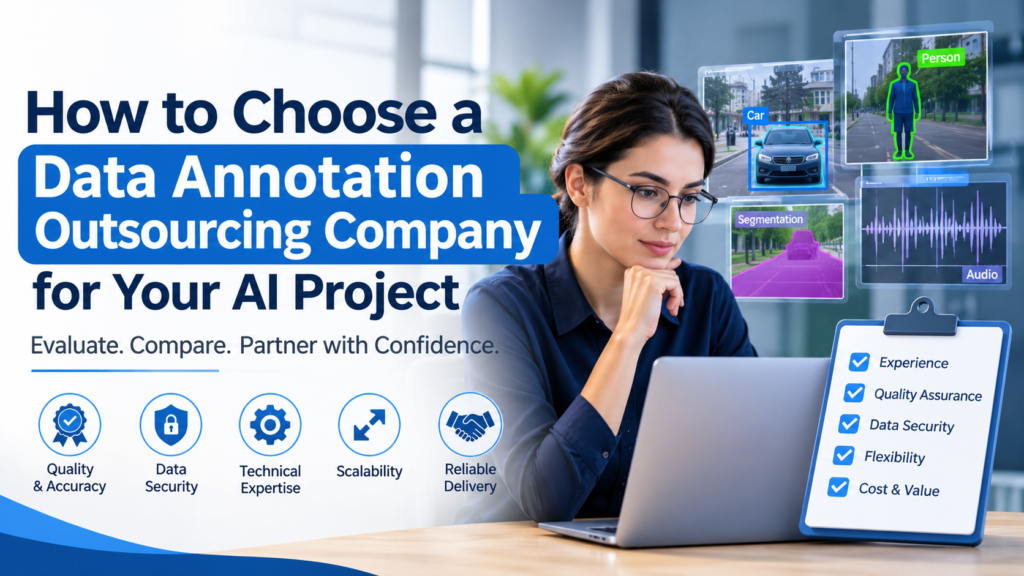
Before outsourcing your project, evaluate providers across six important areas: technical expertise, annotation quality, data security, scalability, workflow transparency and total project cost.
This guide explains what to look for, which questions to ask and how to determine whether an outsourcing partner is suitable for your AI initiative.
1. Understand Your Data Annotation Requirements First
Before comparing outsourcing companies, define exactly what your project needs.
Data annotation involves adding meaningful labels, tags, classifications, attributes or metadata to raw data so machine learning algorithms can interpret and learn from it.
Your requirements will depend on the type of AI application you are developing.
For example:
| AI application | Data annotation requirements |
|---|---|
| Computer vision | Object detection, bounding boxes, image classification and segmentation |
| Autonomous vehicles | LiDAR annotation, 3D bounding boxes, object tracking and sensor data labeling |
| Healthcare AI | Medical image annotation, clinical text labeling and entity recognition |
| Natural Language Processing | Sentiment analysis, intent classification and named entity recognition |
| Conversational AI | Speech transcription, speaker identification and intent annotation |
| Generative AI | Prompt annotation, response evaluation and human preference ranking |
| Retail AI | Product recognition, image classification and shelf monitoring |
A provider that specializes in basic image classification may not necessarily have the expertise required for medical image segmentation or complex LiDAR annotation.
What to prepare before contacting a provider:
- Type of data: Images, videos, audio, text, documents or 3D point clouds.
- Dataset size: Approximate number of files, frames, records or data points.
- Annotation methodology: Bounding boxes, polygons, semantic segmentation, transcription or other labeling requirements.
- Label taxonomy: Categories, attributes and classification rules.
- Quality expectations: Acceptance criteria, validation requirements and error tolerance.
- Delivery requirements: COCO, YOLO, Pascal VOC, JSON, XML, CSV or custom formats.
- Project timeline: Expected start date, milestones and delivery deadlines.
The more clearly you define your requirements, the easier it becomes to compare proposals from different providers.
2. Evaluate Technical Expertise and Annotation Experience
Technical expertise should be one of your first evaluation criteria.
An experienced data annotation company should understand the differences between annotation methodologies and how they apply to different machine learning applications.
For example, image annotation for an object detection model requires different labeling methods from semantic segmentation, where individual pixels are assigned predefined categories.
Similarly, NLP annotation requires an understanding of language context, entity relationships, intent and sentiment.
When assessing a provider, examine these capabilities:
Image and video annotation
Check whether the team can handle:
- Bounding box annotation.
- Polygon annotation.
- Semantic and instance segmentation.
- Image classification.
- Object detection.
- Video frame annotation.
- Multi-object tracking.
- Keypoint and pose annotation.
Text and NLP annotation
For language-based AI applications, look for experience in:
- Named Entity Recognition (NER).
- Sentiment analysis.
- Text classification.
- Intent classification.
- Relationship extraction.
- Chatbot training data preparation.
Audio annotation
Speech and audio AI projects may require:
- Speech transcription.
- Speaker diarization.
- Emotion annotation.
- Accent identification.
- Intent recognition.
- Audio classification.
LLM and generative AI annotation
For generative AI development, ask whether the provider can support:
- Prompt annotation.
- AI-generated response evaluation.
- Human feedback annotation.
- Human preference ranking.
- Response quality assessment.
- Human-in-the-Loop (HITL) workflows.
Questions to ask potential providers:
- Have you handled projects involving our specific data type?
- What annotation tools and platforms do your specialists use?
- Can your team follow our existing labeling guidelines?
- Can you support domain-specific annotation requirements?
- Can you provide sample annotations for evaluation?
Look for demonstrated capability rather than relying entirely on general statements about industry experience.
3. Examine the Quality Assurance Process
Annotation quality is one of the most important factors when choosing an outsourcing partner.
A large dataset is not necessarily a useful dataset. If labels are inconsistent, incomplete or incorrectly assigned, the resulting training data may not meet your model’s requirements.
For this reason, quality assurance should be integrated into the annotation workflow rather than treated as a final inspection.
Important quality control measures
Initial annotation review
Check whether the first batch is reviewed against your annotation guidelines before production scales up.
Validation checks
Confirm whether labels are checked for missing attributes, incorrect categories, invalid coordinates and formatting problems.
Statistical sampling
Ask whether a defined percentage of completed annotations undergoes additional inspection.
Consistency audits
Check whether the provider reviews annotation consistency across different workers, batches and datasets.
Expert reviews
For complex projects, specialist reviewers should be available to examine difficult cases and resolve disagreements.
Understand how accuracy is measured
Do not accept an accuracy percentage without understanding how it was calculated.
Ask the provider:
- Is accuracy measured per image, object, annotation or dataset?
- What is the evaluation methodology?
- Is there a separate validation dataset?
- How are ambiguous labels handled?
- How are disagreements between annotators resolved?
- What happens when a batch fails the agreed acceptance criteria?
Different annotation tasks require different evaluation metrics. For example, bounding box projects may use Intersection over Union (IoU), while classification projects may use precision, recall and F1-score.
The evaluation methodology should match your actual AI application.
4. Verify Data Security and Confidentiality
Outsourcing annotation means sharing project data with an external team. Depending on your industry, this may involve confidential business information, customer records, medical images, financial documents or proprietary datasets.
Before selecting a provider, understand how your data will be protected.
Essential security considerations
Non-Disclosure Agreements
Check whether the provider can sign an NDA covering your project information and confidential datasets.
Access controls
Ask whether access is restricted according to individual roles and project responsibilities.
Data encryption
Understand how data is protected during transfer and storage.
Secure work environments
Ask whether annotation activities take place in controlled work environments and whether downloads or unauthorized copying can be restricted.
Data retention and deletion
Establish how long the provider retains your datasets and what happens when the project ends.
Regulatory requirements
If your project involves personal or regulated information, identify the applicable legal and contractual requirements. Depending on the data and jurisdictions involved, these may include GDPR, HIPAA or other relevant frameworks.
Do not assume that a provider’s general security statement establishes compliance with a particular regulation. Request supporting documentation and clarify responsibilities in the contract.
5. Check Scalability and Delivery Capacity
Your annotation requirements may change as your AI project develops.
A small proof-of-concept dataset may eventually become a production-scale labeling requirement involving millions of data points.
Your outsourcing partner should be able to explain how it manages changing workloads without compromising agreed quality standards.
Consider these factors:
- Availability of trained annotation specialists.
- Ability to increase or reduce project capacity.
- Dedicated project management.
- Defined turnaround expectations.
- Progress reporting and milestone tracking.
- Backup arrangements for workload fluctuations.
- Capacity to handle multiple data types.
For example, an autonomous vehicle project may initially require a limited LiDAR dataset for model development. Later stages may involve additional point clouds, object tracking and sensor fusion annotation.
A provider should be able to explain how its team, review process and delivery schedule would adapt as requirements evolve.
Avoid choosing a vendor solely because it promises a large annotation workforce. Ask how additional capacity will be trained, supervised and reviewed.
6. Evaluate Annotation Tools and Output Compatibility
The annotation platform used by a provider can influence collaboration, workflow efficiency and delivery quality.
Depending on your project, you may need a provider familiar with platforms such as:
- CVAT.
- Labelbox.
- Supervisely.
- V7 Darwin.
- Roboflow.
- Label Studio.
- Amazon SageMaker.
- Scale AI.
The important question is not simply which tools a provider knows. It is whether the proposed workflow supports your project’s technical requirements.
Before signing an agreement, confirm:
- Can the team work within your existing annotation platform?
- Can you access project progress and review completed annotations?
- Can annotations be exported in your required format?
- Can the provider follow your naming conventions and metadata structure?
- Can revised guidelines and new label categories be incorporated?
- Who owns the annotated datasets and associated deliverables?
Request a sample export and validate it against your model’s data ingestion requirements.
A visually correct annotation can still create downstream problems if its schema, coordinates, metadata or export structure are incompatible with your training pipeline.
7. Compare the Total Cost, Not Just the Price Per Annotation
Cost is important, but the cheapest proposal may not represent the best value.
A provider’s quotation should be evaluated against the complete scope of work, including quality assurance, revisions, project management and delivery requirements.
Consider the following cost factors:
| Cost factor | What to evaluate |
|---|---|
| Annotation complexity | Simple classification versus detailed segmentation |
| Dataset size | Number of images, objects, frames or records |
| Data quality | Whether preprocessing or cleaning is required |
| Quality assurance | Sampling, validation and expert review |
| Turnaround time | Standard versus accelerated delivery |
| Rework | How corrections and rejected annotations are handled |
| Project management | Reporting, coordination and communication |
| Data security | Special infrastructure or handling requirements |
For example, two providers may offer different prices for annotating the same number of images. One quotation may include multiple review stages, while the other may cover annotation alone.
Compare the cost of accepted, usable annotations rather than focusing exclusively on the initial price.
Also clarify whether the quotation includes pilot work, revisions, additional labeling instructions and changes in project scope.
8. Start With a Pilot Project Before Scaling
One of the most practical ways to evaluate a data annotation outsourcing company is to begin with a controlled pilot.
Rather than immediately transferring your entire dataset, provide a representative sample containing both straightforward examples and challenging edge cases.
A useful pilot should test:
Instruction understanding: Can the team correctly interpret your labeling guidelines?
Annotation quality: Are the labels accurate and consistent?
Edge-case handling: Does the provider know when to escalate ambiguous examples?
Communication: Are questions and clarifications handled efficiently?
Turnaround: Can the team meet the proposed delivery schedule?
Output compatibility: Can the completed annotations be imported into your workflow?
After receiving the pilot results, compare them against predefined acceptance criteria.
Document any errors, update the annotation guidelines and request corrections where necessary.
Only proceed to larger production batches after both parties agree on the labeling methodology and quality requirements.
9. Why Consider OURS GLOBAL for Data Annotation Outsourcing?
Once you understand the selection criteria, you can evaluate potential providers against your specific project requirements.
OURS GLOBAL offers outsourced data annotation and data labeling services for organizations developing AI and machine learning applications.
Its service portfolio covers several data types and annotation requirements.
Comprehensive annotation capabilities
OURS GLOBAL lists services covering:
- Image annotation and object detection.
- Video annotation and object tracking.
- Text annotation and NLP.
- Audio annotation and speech transcription.
- 3D and LiDAR annotation.
- LLM and generative AI annotation.
- Human feedback and preference ranking.
- AI training data collection.
Structured quality assurance
The company describes a multi-level quality assurance approach that includes initial annotation reviews, validation checks, statistical sampling, consistency audits and expert reviews.
Its service page advertises up to 98% annotation accuracy. Buyers should request the applicable measurement methodology and project-specific acceptance criteria when evaluating this figure.
Flexible project workflows
The published process includes six stages:
- Requirement analysis.
- Pilot annotation.
- Annotation production.
- Multi-level quality assurance.
- Dataset delivery.
- Continuous improvement based on client feedback.
Security-focused workflows
OURS GLOBAL lists NDAs, secure access controls, role-based permissions, data encryption, secure workstations and GDPR-aligned workflows among its security measures.
For projects involving regulated or sensitive information, discuss the relevant documentation and contractual requirements before transferring data.
Multiple delivery formats
The company lists support for COCO, YOLO, Pascal VOC, JSON, XML, CSV, TXT and custom formats.
These capabilities provide a starting point for assessing whether its services align with your annotation requirements.
To learn more, visit the OURS GLOBAL Data Annotation and Labeling Services page.
10. Data Annotation Outsourcing Evaluation Checklist
Before finalizing your provider selection, use this checklist to compare shortlisted companies.
- Experience with the required data type and annotation methodology.
- Relevant industry or domain knowledge.
- Clearly documented annotation guidelines.
- Defined quality assurance and validation procedures.
- Transparent accuracy measurement methodology.
- NDA and appropriate data protection arrangements.
- Access controls and secure data handling.
- Ability to scale according to project requirements.
- Compatibility with existing annotation platforms.
- Delivery in the required formats.
- Defined timelines and project milestones.
- Clear pricing and revision policies.
- Successful completion of a representative pilot.
Use the same criteria for every provider so that your final decision is based on comparable evidence.
Frequently Asked Questions
1. What should I look for in a data annotation outsourcing company?
Look for relevant technical expertise, trained annotation specialists, documented quality assurance procedures, data security practices, scalable delivery capacity and compatibility with your required annotation formats. A pilot project is a useful way to validate these capabilities.
2. Which types of data can be outsourced for annotation?
Common data types include images, videos, audio recordings, text documents and 3D or LiDAR point clouds. Depending on the AI application, projects may involve object detection, semantic segmentation, transcription, sentiment analysis, named entity recognition or LLM response evaluation.
3. How much do outsourced data annotation services cost?
Pricing depends on data type, annotation complexity, dataset size, quality requirements, turnaround time and the amount of review required. Request a project-specific quotation that clearly separates annotation, quality assurance, revisions and other delivery costs.
4. How can I ensure annotation quality when outsourcing?
Establish clear labeling guidelines, define measurable acceptance criteria, review a representative pilot batch and implement regular quality checks. Ask your provider how it measures accuracy, handles disagreements and corrects rejected annotations.
5. Can a data annotation company handle large-scale AI projects?
Yes, suitable outsourcing providers can support projects ranging from smaller datasets to large-scale annotation requirements. However, confirm workforce capacity, specialist availability, quality control arrangements and delivery milestones before increasing production volume.
Final Thoughts: Choose a Data Annotation Partner That Fits Your AI Goals
Choosing a data annotation outsourcing company is an important decision for any organization developing machine learning, computer vision, NLP or generative AI applications.
The right provider should offer more than labeling capacity. It should understand your technical requirements, follow consistent annotation guidelines, maintain appropriate security practices and deliver datasets that integrate with your AI development workflow.
Start by defining your project scope, comparing providers against measurable criteria and testing their capabilities through a pilot project.
If you are looking for a partner for image, video, text, audio, LiDAR or generative AI annotation, OURS GLOBAL can help you explore an outsourcing solution aligned with your project requirements.
Request a Quote and Discuss Your Data Annotation Project with OURS GLOBAL