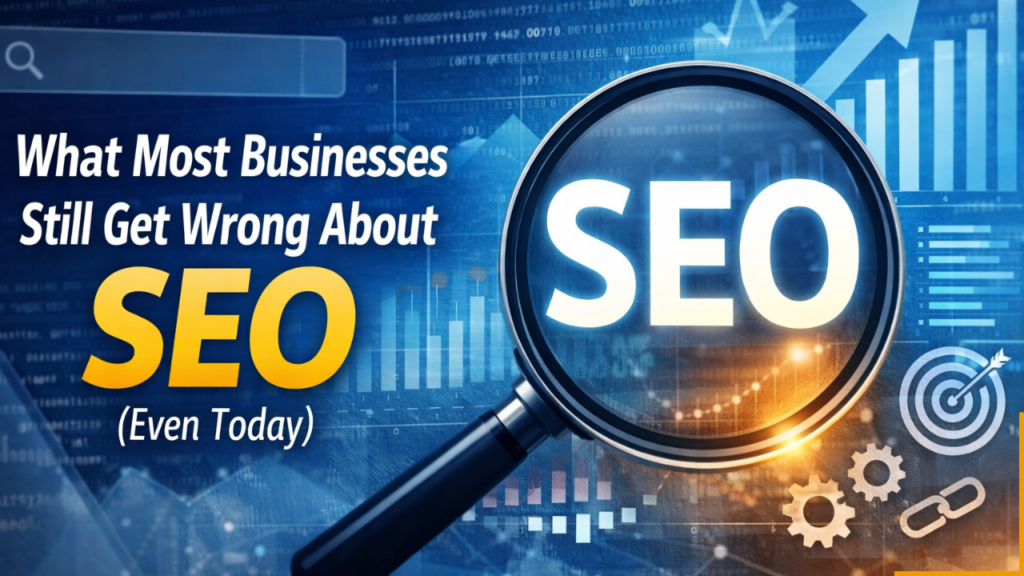
What Most Businesses Still Get Wrong About SEO (Even Today)
Introduction
Despite over two decades of evolution, Search Engine Optimization (SEO) remains one of the most misunderstood aspects of digital marketing. Many businesses invest time and resources into SEO but fail to achieve meaningful results – not because SEO doesn’t work, but because it’s often approached incorrectly.
Even today, outdated assumptions, misaligned strategies, and unrealistic expectations continue to hold businesses back from unlocking the full potential of search.
1. Treating SEO as a One-Time Activity
One of the most common mistakes businesses make is assuming SEO is a one-time setup rather than an ongoing process.
SEO is dynamic. Search engines continuously update their algorithms, competitors refine their strategies, and user behavior evolves. A website optimized once and left untouched will gradually lose visibility.
What actually works:
- Continuous content updates
- Regular technical audits
- Ongoing keyword and intent analysis
SEO should be treated as a long-term investment, not a one-off task.
2. Focusing Only on Keywords Instead of Intent
Many businesses still rely heavily on keyword stuffing or exact-match phrases, assuming that’s enough to rank.
However, modern search engines are powered by advanced systems like Google RankBrain and Google BERT, which prioritize search intent over keywords.
The shift:
- From “What keyword?” → to “What does the user need?”
- From isolated queries → to contextual understanding
Content that aligns with user intent consistently outperforms keyword-heavy pages.
3. Ignoring Technical SEO Foundations
A visually appealing website doesn’t guarantee strong search performance. Many businesses overlook technical SEO, which directly affects how search engines crawl and index a site.
Common issues include:
- Slow page loading speed
- Poor mobile responsiveness
- Broken links and crawl errors
Without a solid technical foundation, even high-quality content may struggle to rank.
4. Prioritizing Quantity Over Quality Content
Publishing large volumes of low-value content is still a widespread mistake.
Search engines now reward:
- Depth and expertise
- Original insights
- Comprehensive topic coverage
Thin or repetitive content not only fails to rank but can also harm overall site authority.
Modern SEO content should:
- Solve real problems
- Cover topics in-depth
- Provide unique value
5. Expecting Immediate Results
SEO is not a quick-win channel. Yet many businesses expect results within weeks.
In reality:
- SEO builds momentum over time
- Rankings fluctuate before stabilizing
- Authority develops gradually
Unrealistic expectations often lead to abandoning strategies that would have succeeded with patience.
6. Overlooking User Experience (UX)
Search engines increasingly evaluate how users interact with a website.
Key experience factors include:
- Easy navigation
- Fast load times
- Mobile usability
- Clear structure
A website that frustrates users will struggle to maintain rankings, regardless of how well it is optimized for search engines.
7. Neglecting Content Structure and Readability
Even well-written content can fail if it’s not structured properly.
Common mistakes:
- Large blocks of text
- Lack of headings
- Poor formatting
Optimized content should be:
- Easy to scan
- Logically structured
- Engaging and readable
This improves both user experience and search engine understanding.
8. Relying on Outdated Link Building Practices
Backlinks remain important, but not all links are equal.
Old practices like:
- Buying low-quality links
- Using spammy directories
are now ineffective or even harmful.
Modern link building focuses on:
- Relevance
- Authority
- Natural acquisition
9. Not Measuring the Right Metrics
Many businesses focus only on rankings or traffic, ignoring deeper performance indicators.
More meaningful metrics include:
- User engagement
- Conversion rates
- Content performance
- Search intent alignment
SEO success is not just about visibility – it’s about impact.
10. Lack of a Clear SEO Strategy
Perhaps the biggest mistake is approaching SEO without a structured plan.
A successful SEO strategy includes:
- Defined goals
- Target audience understanding
- Content planning
- Technical optimization
- Performance tracking
Without strategy, efforts become scattered and ineffective.
Conclusion
SEO today is far more than keywords and backlinks – it’s a combination of strategy, technology, and user understanding. Businesses that continue to rely on outdated methods often find themselves falling behind, while those that adapt to modern SEO principles achieve sustainable growth.
Understanding what doesn’t work is just as important as knowing what does. By avoiding these common mistakes, businesses can build a stronger, more resilient online presence.
Looking to Strengthen Your SEO Strategy?
If your business is aiming to move beyond outdated practices and build a results-driven SEO approach, working with experienced professionals can make a significant difference.
With over a decade of experience in search optimization, you can explore how structured, scalable, and insight-driven SEO works here:
👉 OURS GLOBAL