
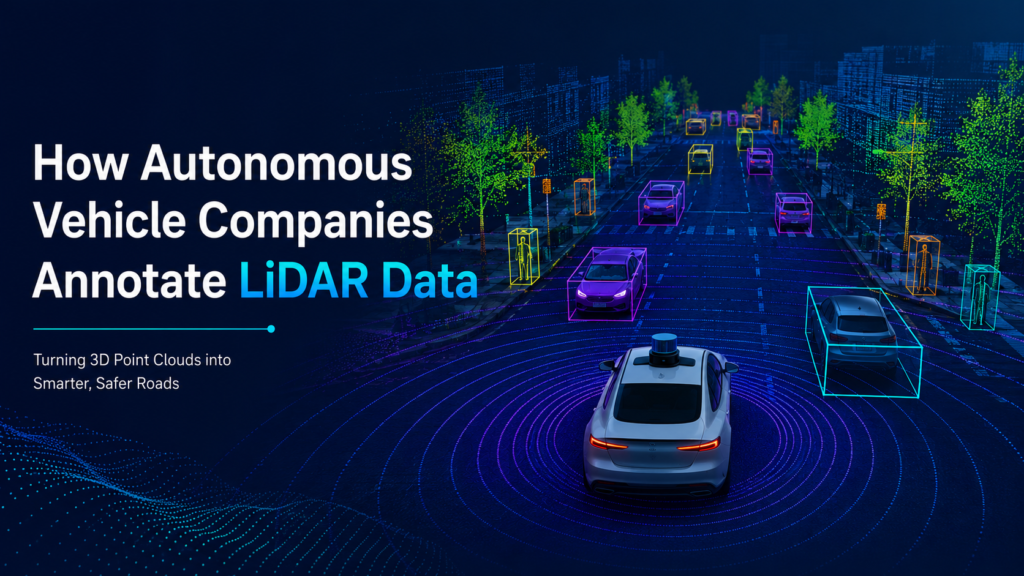
How Autonomous Vehicle Companies Annotate LiDAR Data
Autonomous vehicles depend on massive amounts of sensor data to understand roads, traffic, pedestrians, and surrounding environments. One of the most important technologies behind self-driving cars is LiDAR.
LiDAR sensors generate detailed 3D point clouds that help autonomous systems detect objects with high accuracy. However, raw LiDAR data alone is not enough. To train AI models effectively, companies must label and organize this data through a process called LiDAR annotation.
In this article, we explain how autonomous vehicle companies annotate LiDAR data, which tools and techniques they use, common challenges, and why autonomous vehicle datasets are essential for building safer self-driving systems.
Companies looking to scale AI training pipelines often choose to outsource data annotation and labelling services for faster dataset preparation, quality assurance, and cost-efficient autonomous vehicle dataset management.
What Is LiDAR Annotation?
LiDAR annotation is the process of labeling 3D point cloud data collected by LiDAR sensors. These labels help machine learning models identify and classify objects such as:
- Cars
- Trucks
- Pedestrians
- Cyclists
- Traffic signs
- Road barriers
- Lane markings
- Trees and roadside objects
The annotated data is then used to train computer vision and perception models for autonomous driving systems.
Why LiDAR Annotation Matters
LiDAR provides accurate depth information that cameras alone cannot deliver consistently. Annotation allows autonomous vehicles to:
- Detect obstacles accurately
- Understand object distance and movement
- Navigate complex road environments
- Improve object tracking
- Enhance safety in low-light conditions
- Train 3D perception AI models
Without properly annotated LiDAR data, self-driving AI systems cannot learn how to interpret real-world traffic scenarios.
How Autonomous Vehicle Companies Collect LiDAR Data
Before annotation begins, autonomous vehicle companies collect large volumes of sensor data using:
- Roof-mounted LiDAR systems
- High-resolution cameras
- Radar sensors
- GPS systems
- IMU sensors (Inertial Measurement Units)
Specialized vehicles drive through:
- Urban roads
- Highways
- Rural environments
- Construction zones
- Different weather conditions
- Day and night scenarios
The collected information forms large autonomous vehicle datasets used for training and testing AI models.
Types of LiDAR Annotation Used in Autonomous Vehicles
Different annotation methods are used depending on the AI model requirements.
-
3D Bounding Box Annotation
This is the most common LiDAR annotation technique.
Annotators draw 3D cuboids around objects in point clouds to define:
- Position
- Height
- Width
- Length
- Orientation
3D bounding boxes help AI systems recognize moving and stationary objects.
Commonly Annotated Objects
- Vehicles
- Pedestrians
- Cyclists
- Traffic cones
- Road barriers
-
Semantic Segmentation
Semantic segmentation labels every point in the LiDAR point cloud.
For example:
- Road = Road class
- Sidewalk = Sidewalk class
- Vehicle = Vehicle class
- Vegetation = Tree class
This provides a deeper scene understanding for autonomous systems.
-
Instance Segmentation
Instance segmentation separates individual objects even if they belong to the same category.
Example:
- Car 1
- Car 2
- Car 3
This helps autonomous vehicles track separate moving objects.
-
Sensor Fusion Annotation
Many companies combine LiDAR with camera data.
Annotators use synchronized sensor views to improve labeling accuracy. This process is known as sensor fusion annotation.
Benefits include:
- Better object recognition
- Improved depth understanding
- Higher annotation precision
- Reduced ambiguity
Step-by-Step LiDAR Annotation Workflow
Autonomous vehicle companies usually follow a structured workflow.
Step 1: Data Collection
Vehicles equipped with sensors gather real-world driving data.
Step 2: Data Preprocessing
Raw point cloud data is cleaned and synchronized.
This includes:
- Noise reduction
- Point cloud alignment
- Frame synchronization
- Sensor calibration
Step 3: Initial AI-Assisted Labeling
Many companies use AI-assisted annotation tools to speed up labelling.
Pre-trained models automatically generate preliminary annotations.
Step 4: Human Annotation Review
Human annotators verify and correct AI-generated labels.
Quality assurance teams check:
- Bounding box accuracy
- Object classification
- Occlusion handling
- Temporal consistency
Step 5: Quality Validation
Annotated datasets undergo multiple review stages.
Companies often measure:
- Annotation accuracy
- Precision and recall
- Consistency scores
- Edge-case handling
Step 6: Dataset Integration
The validated data is added to autonomous vehicle datasets for model training.
Popular Tools for LiDAR Annotation
Autonomous vehicle companies use advanced annotation platforms for large-scale labeling.
Common LiDAR Annotation Tools
- CVAT
- Supervisely
- Scale AI
- Labelbox
- V7
- BasicAI
- SuperAnnotate
Key Features of Annotation Platforms
- 3D point cloud visualization
- AI-assisted labeling
- Multi-sensor synchronization
- Collaborative workflows
- Automated object tracking
- Quality assurance systems
Challenges in LiDAR Annotation
LiDAR annotation is highly complex and resource-intensive.
- Massive Data Volumes
Self-driving vehicles generate terabytes of sensor data daily.
Managing and labeling this data requires scalable infrastructure.
- Occlusion Problems
Objects may be partially hidden behind other vehicles or obstacles.
Annotators must still identify them accurately.
- Sparse Point Clouds
Objects farther away contain fewer points, making annotation difficult.
- Weather and Lighting Conditions
Rain, fog, and snow can affect LiDAR sensor performance.
- Annotation Consistency
Maintaining consistent labels across large teams is a major challenge.
Importance of Autonomous Vehicle Datasets
High-quality autonomous vehicle datasets are critical for developing reliable AI systems.
These datasets help train models for:
- Object detection
- Lane detection
- Path planning
- Collision avoidance
- Traffic prediction
- Autonomous navigation
Popular Autonomous Vehicle Datasets
Some well-known public datasets include:
- KITTI
- Waymo Open Dataset
- nuScenes
- Argoverse
- ApolloScape
- Lyft Level 5 Dataset
These datasets accelerate research and innovation in autonomous driving.
How AI Improves LiDAR Annotation
Artificial intelligence is increasingly automating the annotation process.
AI-Assisted Annotation Benefits
- Faster labeling speed
- Reduced manual workload
- Improved scalability
- Lower annotation costs
- Better object tracking across frames
Human-in-the-Loop Systems
Most companies combine automation with human review.
This approach balances:
- Speed
- Accuracy
- Quality control
Human oversight remains essential for handling complex driving scenarios.
Future of LiDAR Annotation in Autonomous Driving
The future of LiDAR annotation is moving toward greater automation.
Emerging trends include:
- Foundation AI models
- Synthetic data generation
- Active learning systems
- Real-time annotation pipelines
- Self-supervised learning
- 4D annotation techniques
As autonomous vehicle technology advances, annotation systems will become faster, smarter, and more scalable.
Best Practices for LiDAR Annotation
Companies developing autonomous vehicle datasets often follow these best practices:
Use Clear Annotation Guidelines
Detailed instructions improve consistency across annotators.
Implement Multi-Level QA
Multiple review stages reduce annotation errors.
Combine Human and AI Workflows
Hybrid workflows improve efficiency and accuracy.
Regularly Update Datasets
Autonomous systems must adapt to new traffic patterns and environments.
Focus on Edge Cases
Rare driving scenarios are essential for improving vehicle safety.
Companies looking to scale AI training pipelines often choose to outsource data annotation and labelling services for faster dataset preparation, quality assurance, and cost-efficient autonomous vehicle dataset management.
Frequently Asked Questions
What is LiDAR annotation in autonomous vehicles?
LiDAR annotation is the process of labeling 3D point cloud data so AI systems can recognize objects and understand road environments.
Why is LiDAR important for self-driving cars?
LiDAR provides precise depth and distance measurements, helping autonomous vehicles detect obstacles and navigate safely.
What are autonomous vehicle datasets?
Autonomous vehicle datasets are collections of sensor data used to train and test self-driving AI models.
Which companies use LiDAR annotation?
Many autonomous driving companies, robotics firms, and AI startups use LiDAR annotation to develop perception systems.
Is LiDAR annotation automated?
Modern annotation workflows use AI-assisted tools, but human reviewers still play a major role in quality assurance.
Conclusion
LiDAR annotation is one of the most important components of autonomous driving development. By accurately labeling 3D point cloud data, autonomous vehicle companies can train AI systems to detect objects, understand environments, and make safe driving decisions.
As the demand for autonomous vehicle datasets continues to grow, companies are investing heavily in AI-assisted annotation tools, scalable workflows, and advanced quality assurance systems.
The future of self-driving technology depends on reliable, accurate, and scalable LiDAR annotation processes that can support increasingly intelligent autonomous systems.