
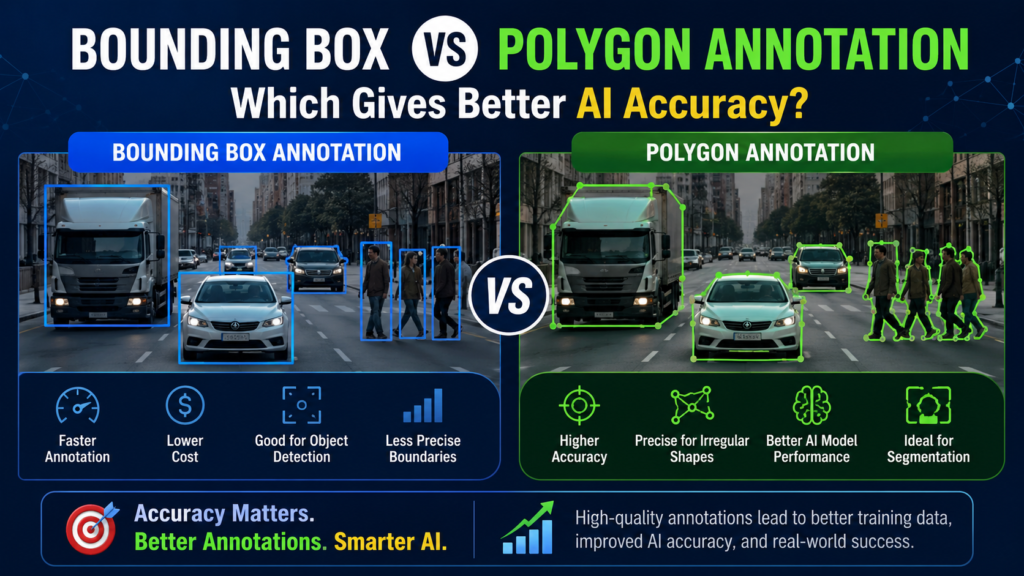
Bounding Box vs Polygon Annotation: Which Gives Better AI Accuracy?
Artificial Intelligence and Machine Learning models depend heavily on high-quality annotated datasets. Whether you are building autonomous vehicles, medical imaging systems, retail analytics, or security surveillance solutions, the type of annotation you choose directly impacts model performance and image annotation accuracy.
Among the most commonly used image annotation techniques, bounding box annotation and polygon annotation stand out as the top choices for computer vision projects. But which one actually delivers better AI accuracy?
In this article, we will compare both annotation methods, understand their strengths and limitations, and help you determine the right option for your AI training requirements.
For businesses looking for scalable and accurate annotation support, OURS GLOBAL Data Annotation & Labeling Services provides professional image annotation solutions tailored for AI and ML projects.
What is Bounding Box Annotation?
Bounding box annotation is a method where annotators draw rectangular boxes around objects within an image. These boxes help AI models identify and locate objects for object detection tasks.
This annotation method is widely used because it is fast, cost-effective, and easy to scale.
Common Use Cases of Bounding Box Annotation
- Autonomous vehicles
- Traffic monitoring
- Retail shelf analytics
- Facial recognition
- Security surveillance
- Drone object detection
2D bounding boxes are among the simplest and most budget-friendly annotation techniques for training AI systems.
Advantages of Bounding Box Annotation
1. Faster Annotation Process
Bounding boxes can be created quickly, making them ideal for large-scale datasets.
2. Lower Annotation Costs
Since annotation is simpler, businesses can reduce labeling expenses significantly.
3. Ideal for Basic Object Detection
Bounding boxes work effectively when object shape precision is not critical.
4. Easier Dataset Scaling
Large AI projects involving millions of images benefit from the speed of bounding box labeling.
Limitations of Bounding Box Annotation
Despite its popularity, bounding box annotation has several drawbacks:
- Rectangular boxes often include unnecessary background pixels.
- Overlapping objects can reduce detection precision.
- Irregularly shaped objects are not accurately represented.
- Complex environments may lower image annotation accuracy.
For example, in medical imaging or autonomous driving, even small inaccuracies can affect AI decision-making.
What is Polygon Annotation?
Polygon annotation involves drawing multiple connected points around the exact outline of an object. Unlike rectangular boxes, polygon annotations closely follow the object’s actual shape.
This method provides highly detailed image segmentation data that improves model precision.
Common Use Cases of Polygon Annotation
- Medical imaging
- Satellite imagery
- Autonomous driving
- Agriculture AI
- Robotics
- E-commerce product segmentation
OURS GLOBAL Data Annotation & Labeling Services provides advanced polygon annotation solutions for complex computer vision projects that demand precise object segmentation and improved AI model accuracy.
Advantages of Polygon Annotation
1. Higher Image Annotation Accuracy
Polygon annotation precisely captures object boundaries, reducing background noise.
2. Better for Irregular Shapes
Objects like trees, roads, tumors, or machinery components can be accurately labeled.
3. Improved AI Model Training
Detailed annotations help machine learning models better understand object structures.
4. Essential for Semantic Segmentation
Polygon labeling is ideal for segmentation-based computer vision applications.
Limitations of Polygon Annotation
While highly accurate, polygon annotation also comes with challenges:
- Annotation takes significantly longer.
- Costs are higher compared to bounding boxes.
- Requires skilled annotators.
- Large datasets may become time-consuming to process.
Bounding Box Annotation vs Polygon Annotation
| Feature | Bounding Box Annotation | Polygon Annotation |
|---|---|---|
| Annotation Speed | Fast | Slow |
| Cost | Lower | Higher |
| Precision | Moderate | High |
| Best For | Object detection | Image segmentation |
| Handles Irregular Shapes | Limited | Excellent |
| AI Accuracy | Good | Superior |
| Background Noise | More | Minimal |
| Scalability | Excellent | Moderate |
Which Annotation Type Gives Better AI Accuracy?
If your primary goal is maximum image annotation accuracy, polygon annotation generally performs better.
Because polygons tightly follow object boundaries, they provide cleaner and more precise training data. This leads to:
- Better object recognition
- Reduced false positives
- Improved segmentation performance
- Enhanced AI model reliability
However, bounding box annotation remains highly effective for:
- Faster project turnaround
- Budget-sensitive AI projects
- Real-time object detection applications
- Large-scale dataset labeling
The best choice depends on your AI project requirements.
When Should You Use Bounding Box Annotation?
Choose bounding box annotation when:
- You need rapid dataset creation
- Budget optimization is important
- Objects are relatively simple in shape
- Real-time object detection is the main goal
Examples include:
- Traffic sign detection
- Human detection
- Package detection in logistics
- Inventory management systems
When Should You Use Polygon Annotation?
Choose polygon annotation when:
- Precision is critical
- Objects have irregular boundaries
- Segmentation tasks are involved
- High AI accuracy is essential
Examples include:
- Tumor detection in healthcare
- Autonomous vehicle lane detection
- Satellite image analysis
- Agricultural crop monitoring
The Role of High-Quality Data Annotation in AI Success
Why Businesses Outsource Data Annotation Services
Managing large annotation projects internally can be expensive and time-consuming. Many organizations outsource annotation tasks to experienced providers for:
- Faster project completion
- Skilled annotation teams
- Quality assurance processes
- Scalable workforce support
- Cost-effective dataset management
Businesses seeking reliable annotation support can explore OURS GLOBAL Data Annotation & Labeling Services for customized AI data labeling solutions designed for computer vision and machine learning applications.
Final Thoughts
Both bounding box annotation and polygon annotation are valuable techniques in AI model development. The right choice depends on your project goals, budget, dataset complexity, and desired image annotation accuracy.
- Use bounding boxes for speed, scalability, and cost-efficiency.
- Use polygon annotation for maximum precision and advanced AI applications.
As AI systems continue to evolve, accurate data annotation remains one of the most important factors behind successful machine learning outcomes. Investing in the right annotation strategy can dramatically improve your AI model’s performance, reliability, and long-term success.