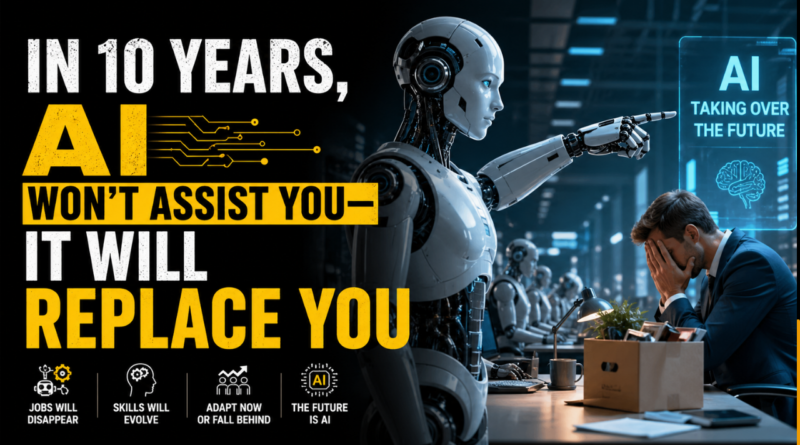
In 10 Years, AI Won’t Assist You—It Will Replace You
Artificial Intelligence is no longer a distant idea—it is already transforming how the world works. From writing content and generating videos to managing businesses and automating industries, AI has moved from a support tool to a powerful decision-maker.
But the real question is not whether AI will grow.
👉 The real question is: What happens to humans in the next 10 years?
Will jobs disappear? Which industries will survive? Can people adapt? And most importantly—what is the solution?
This complete, SEO-optimized article answers everything.
The AI Revolution Has Already Begun
AI is already doing tasks that once required human intelligence:
- Writing blogs, ads, and code
- Creating videos and images
- Automating customer service
- Managing data and decision-making
Businesses are rapidly adopting AI for one simple reason:
👉 It is faster, cheaper, and more scalable than human labor
This shift is happening across every major industry—from healthcare to finance to technology.
Will AI Replace Humans Completely?
No—but it will change almost every job.
AI doesn’t replace entire jobs overnight. Instead, it replaces tasks within jobs. Over time, when enough tasks are automated, entire roles disappear.
👉 So the future is not “no jobs”
👉 It is fewer traditional jobs and more AI-driven roles
Jobs Most at Risk in the Next 10 Years (Full Breakdown)
AI is expanding into every field—including tech, creative industries, and even decision-making roles.
Below is a complete overview of job categories at risk:
Administrative & Office Jobs
- Data entry clerks
- Office assistants
- HR coordinators (basic tasks)
- Payroll processors
👉 Repetitive and structured work is easily automated.
Customer Support Jobs
- Call center agents
- Chat support executives
- Email support staff
👉 AI chatbots now handle conversations 24/7.
Content Creation (Basic Level)
- Blog writers (basic SEO content)
- Copywriters (simple ads)
- Social media content creators
👉 AI can generate content instantly.
Manufacturing & Warehousing
- Assembly line workers
- Warehouse staff
- Inventory handlers
👉 Robots work faster and without fatigue.
Finance & Accounting
- Bookkeepers
- Junior accountants
- Invoice processors
👉 AI handles calculations and financial analysis efficiently.
Legal Jobs (Entry-Level)
- Paralegals
- Contract reviewers
- Legal researchers
👉 AI can scan and analyze documents in seconds.
Retail & Sales
- Cashiers
- Retail assistants
- Telemarketers
👉 Self-service systems are replacing human interaction.
Transportation & Logistics
- Truck drivers
- Delivery drivers
- Taxi drivers
👉 Autonomous vehicles are evolving rapidly.
IT & Tech Jobs (Partial Disruption)
AI will not fully replace these roles—but it will reduce demand for basic tasks.
Web Development
- Basic website developers
- Front-end developers (simple tasks)
👉 AI can generate websites from prompts.
Cloud Computing
- Cloud support roles
- Infrastructure setup jobs
👉 AI automates deployment and monitoring.
Cybersecurity
- Security monitoring analysts
- Threat detection roles
👉 AI detects threats faster—but experts are still needed.
Software Development
- Junior developers
- Manual testers
👉 AI can write, debug, and test code.
Creative & Design Jobs
- Graphic designers (basic work)
- Logo creators
- Video editors
👉 AI tools can create visuals instantly.
Healthcare Support Roles
- Medical transcriptionists
- Diagnostic assistants
👉 AI helps analyze medical data faster.
Education Jobs
- Basic tutors
- Test evaluators
👉 AI enables personalized learning systems.
The Truth: No Job Is Fully Safe
Here’s the reality:
👉 AI will not replace all jobs
👉 But it will change every job
Even high-level professionals must adapt.
The Hidden Industry Powering AI: Data Annotation
Most people don’t realize this:
👉 AI cannot function without human-labeled data
This process is called data annotation.
It involves:
- Labeling images
- Tagging text
- Annotating videos and audio
This helps AI systems learn and improve.
Real-World Solution: The Growing Demand for Data Annotation
As AI continues to expand, one critical requirement remains constant—high-quality training data.
This is where data annotation becomes essential. Every AI system, whether it’s a chatbot, self-driving car, or healthcare model, depends on accurately labeled data to function effectively.
Businesses across industries are now outsourcing this process to specialized providers to ensure speed, accuracy, and scalability.
One such solution is
👉 https://www.oursglobal.com/outsource-data-annotation-labelling-services
These services support AI development through:
- Text, image, video, and audio annotation
- Advanced 3D and LiDAR data labeling
- High-accuracy datasets for machine learning models
With millions of data points annotated and strong quality control processes, professional annotation services play a key role in making AI systems reliable and production-ready.
👉 In simple terms: Better data = Smarter AI
The Ultimate Solution: How to Stay Relevant
Instead of fearing AI, focus on adapting.
1. Learn AI Tools
Understand how to use:
- Content AI
- Automation tools
- Data platforms
2. Build Human Skills
Focus on what AI cannot easily replace:
- Creativity
- Critical thinking
- Communication
- Emotional intelligence
3. Shift Toward AI-Driven Roles
Explore opportunities like:
- AI training
- Data annotation
- AI operations
- Prompt engineering
4. Work With AI, Not Against It
Use AI to:
- Increase productivity
- Create new income streams
- Improve efficiency
The Future: Humans + AI
The next decade will not be about humans vs AI.
👉 It will be about humans who adapt vs those who don’t
Businesses will:
- Automate repetitive work
- Hire fewer but more skilled workers
- Depend on AI systems
Workers will:
- Need continuous learning
- Change careers more often
- Collaborate with AI
Conclusion
“In 10 Years, AI Won’t Assist You—It Will Replace You” is not just a bold statement—it’s a wake-up call.
Yes, AI will replace many tasks.
Yes, jobs will change.
Yes, industries will transform.
But:
👉 This is not the end—it’s a shift
The biggest opportunity lies in adapting early.
- Will AI replace jobs? → Yes, many roles will change or disappear
- Are tech jobs safe? → No, but they will evolve—not vanish
- What is the biggest opportunity? → AI-related work like data annotation
- What is the solution? → Learn AI + build human skills + adapt fast
Final Thought
👉 The future will not belong to AI alone
👉 It will belong to people who know how to use AI better than others