
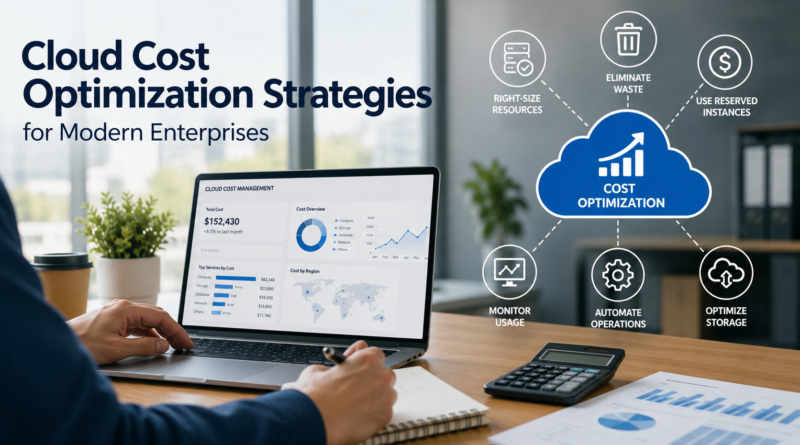
Cloud Cost Optimization Strategies for Modern Enterprises
Introduction
Cloud computing has transformed how businesses build, deploy, and scale applications. Organizations no longer need to invest heavily in physical infrastructure, allowing them to innovate faster and respond quickly to changing market demands. From startups to global enterprises, businesses rely on cloud platforms to host applications, store data, run analytics, and power artificial intelligence (AI) solutions.
However, while the cloud offers flexibility and scalability, it also introduces a new challenge—managing costs. Many organizations move to the cloud expecting lower IT expenses, only to discover that poorly managed resources, unused services, and inefficient architectures can lead to unexpectedly high monthly bills.
Cloud cost optimization is not simply about reducing spending. It is about maximizing the value of every dollar invested in cloud infrastructure while maintaining performance, security, reliability, and business agility. A well-planned optimization strategy enables organizations to eliminate waste, improve resource utilization, and align cloud spending with business goals.
This article explores practical cloud cost optimization strategies that modern enterprises can implement to control expenses, improve operational efficiency, and build a sustainable cloud environment.
What Is Cloud Cost Optimization?
Cloud cost optimization is the continuous process of monitoring, analyzing, and improving cloud resource usage to reduce unnecessary expenses without affecting business performance.
Instead of simply cutting costs, optimization focuses on using the right resources, at the right time, and for the right workloads.
An effective cloud cost optimization strategy helps businesses:
- Reduce unnecessary spending
- Improve infrastructure efficiency
- Increase return on investment (ROI)
- Support business growth
- Improve financial visibility
- Prevent budget overruns
Cloud optimization should be treated as an ongoing business practice rather than a one-time project.
Why Cloud Costs Continue to Increase
Many enterprises experience rising cloud expenses because cloud environments grow rapidly over time.
Common reasons include:
- Idle virtual machines
- Overprovisioned resources
- Unused storage volumes
- Duplicate cloud services
- Inefficient application architecture
- Lack of monitoring
- Poor governance
- Rapid business expansion
Without regular reviews, cloud environments often accumulate resources that no longer provide business value.
1. Monitor Cloud Usage Continuously
The first step toward optimization is understanding where money is being spent.
Organizations should continuously monitor:
- Compute usage
- Storage consumption
- Network traffic
- Database utilization
- AI workloads
- Container resources
- Backup storage
Real-time monitoring helps identify unusual spending patterns before they become expensive problems.
Visibility is the foundation of effective cloud cost management.
2. Right-Size Cloud Resources
Many businesses allocate more computing power than applications actually require.
For example, an application running on a large virtual machine may only use a small percentage of its CPU and memory.
Regular performance analysis allows organizations to:
- Reduce oversized virtual machines
- Optimize storage capacity
- Resize databases
- Improve container utilization
Right-sizing ensures businesses pay only for the resources they truly need.
3. Eliminate Idle Resources
Unused cloud resources are among the most common causes of unnecessary spending.
Examples include:
- Idle virtual machines
- Unattached storage volumes
- Unused IP addresses
- Old snapshots
- Inactive databases
- Obsolete development environments
Regular audits help identify and remove resources that no longer support business operations.
Even small savings can add up significantly over time.
4. Implement Auto Scaling
Business demand changes throughout the day.
Instead of running maximum capacity continuously, enterprises should automatically adjust resources based on workload requirements.
Auto scaling provides several benefits:
- Lower operating costs
- Improved application performance
- Better resource utilization
- Enhanced customer experience
Applications automatically scale up during peak demand and scale down during quieter periods.
5. Schedule Non-Production Environments
Development, testing, and staging environments often remain operational even when employees are not using them.
Organizations can reduce costs by automatically shutting down non-production systems during evenings, weekends, and holidays.
Scheduling these environments significantly lowers compute expenses without affecting development activities.
6. Optimize Cloud Storage
Storage costs increase steadily as businesses generate more data.
Effective storage optimization includes:
- Removing duplicate files
- Archiving inactive data
- Compressing large datasets
- Deleting obsolete backups
- Choosing appropriate storage tiers
- Implementing lifecycle management policies
Not all data requires high-performance storage.
Frequently accessed information should remain on premium storage, while archival data can move to lower-cost storage options.
7. Use Reserved Capacity for Predictable Workloads
Many enterprise applications operate continuously throughout the year.
Predictable workloads often benefit from long-term pricing commitments, which generally reduce costs compared to on-demand usage.
Examples include:
- Production databases
- ERP systems
- Internal business applications
- Customer portals
Planning long-term infrastructure requirements helps improve budgeting and overall cost efficiency.
8. Adopt Containerization
Containers improve infrastructure efficiency by allowing multiple applications to share computing resources.
Compared to traditional virtual machines, containers:
- Consume fewer resources
- Start quickly
- Scale efficiently
- Improve application portability
- Reduce infrastructure overhead
Modern enterprises increasingly use container orchestration platforms to optimize resource utilization while simplifying application deployment.
9. Optimize Database Performance
Databases are often among the most expensive cloud services.
Optimization strategies include:
- Removing unused databases
- Optimizing queries
- Eliminating duplicate data
- Scaling databases appropriately
- Archiving historical information
- Monitoring performance continuously
Efficient database management reduces costs while maintaining application responsiveness.
10. Improve Application Architecture
Application design directly influences cloud spending.
Modern architectures improve efficiency through:
- Microservices
- Event-driven processing
- Serverless computing
- API optimization
- Caching
- Content delivery networks (CDNs)
Well-designed applications require fewer computing resources while delivering better performance.
11. Implement Strong Governance
Cloud governance establishes policies that control how resources are created, managed, and retired.
Effective governance includes:
- Budget controls
- Resource tagging
- Access management
- Spending alerts
- Approval workflows
- Security policies
Clear governance prevents uncontrolled cloud growth and improves financial accountability.
12. Automate Cost Management
Automation reduces manual effort while improving consistency.
Examples include:
- Automatic resource cleanup
- Budget alerts
- Scaling policies
- Backup scheduling
- Resource tagging
- Usage reporting
Automation helps organizations maintain optimized environments without constant manual intervention.
13. Strengthen Resource Tagging
Tagging enables businesses to understand exactly where cloud spending occurs.
Resources can be categorized by:
- Department
- Project
- Application
- Environment
- Cost center
- Business unit
Proper tagging improves reporting, budgeting, and accountability across the organization.
14. Optimize Network Costs
Network traffic can become expensive, particularly for global organizations.
Businesses should review:
- Data transfer patterns
- Geographic traffic
- Content delivery strategies
- Cross-region communication
- API traffic
Reducing unnecessary data movement lowers networking costs while improving performance.
15. Build a Cost-Aware Culture
Technology alone cannot optimize cloud spending.
Employees should understand how their decisions affect cloud costs.
Organizations can encourage cost awareness by:
- Providing cloud cost training
- Sharing usage reports
- Setting departmental budgets
- Reviewing optimization opportunities regularly
- Encouraging responsible resource usage
When finance, operations, and engineering teams collaborate, cost optimization becomes more effective.
Common Cloud Cost Optimization Mistakes
Many businesses unknowingly increase expenses through avoidable practices.
Common mistakes include:
- Ignoring usage reports
- Overprovisioning infrastructure
- Running unused environments
- Poor resource tagging
- Storing unnecessary data
- Delaying cleanup activities
- Failing to monitor spending
- Lack of governance
- Choosing inappropriate storage options
- Missing optimization reviews
Avoiding these issues can significantly reduce cloud expenses.
Measuring Success
Organizations should evaluate cloud optimization using measurable indicators such as:
- Monthly cloud spending
- Resource utilization
- Infrastructure efficiency
- Cost per application
- Storage growth
- Budget accuracy
- Application performance
- Return on cloud investment
Regular reporting helps leadership understand the financial impact of optimization initiatives.
Future Trends in Cloud Cost Optimization
As cloud technology evolves, optimization strategies are becoming more intelligent.
Emerging trends include:
- AI-driven cost recommendations
- Predictive spending analysis
- Automated resource optimization
- FinOps adoption
- Intelligent workload scheduling
- Sustainable cloud operations
- Carbon-aware computing
- Advanced analytics for resource planning
Organizations that embrace these innovations will be better equipped to control costs while supporting long-term business growth.
Best Practices Summary
Successful cloud cost optimization depends on continuous improvement rather than occasional reviews.
Key recommendations include:
- Monitor cloud usage regularly.
- Right-size computing resources.
- Remove idle infrastructure.
- Implement auto scaling.
- Optimize storage management.
- Strengthen governance.
- Automate repetitive processes.
- Improve application architecture.
- Review cloud spending frequently.
- Foster collaboration between finance and IT teams.
Consistent optimization delivers lasting financial and operational benefits.
Conclusion
Cloud computing provides organizations with unmatched flexibility, scalability, and innovation opportunities, but those advantages come with the responsibility of managing costs effectively. Without a clear optimization strategy, cloud environments can quickly become inefficient, leading to unnecessary spending and reduced return on investment.
By continuously monitoring resource usage, eliminating idle infrastructure, right-sizing workloads, automating routine tasks, improving application architecture, and implementing strong governance, enterprises can significantly reduce cloud costs without sacrificing performance or reliability.
Cloud cost optimization is an ongoing journey that requires collaboration between IT, finance, operations, and business leaders. Organizations that build a culture of cost awareness and continuously refine their cloud strategy will be better positioned to scale efficiently, maximize business value, and remain competitive in a rapidly evolving digital landscape.
Learn more about cloud solutions, AI, cybersecurity, and digital transformation services at: