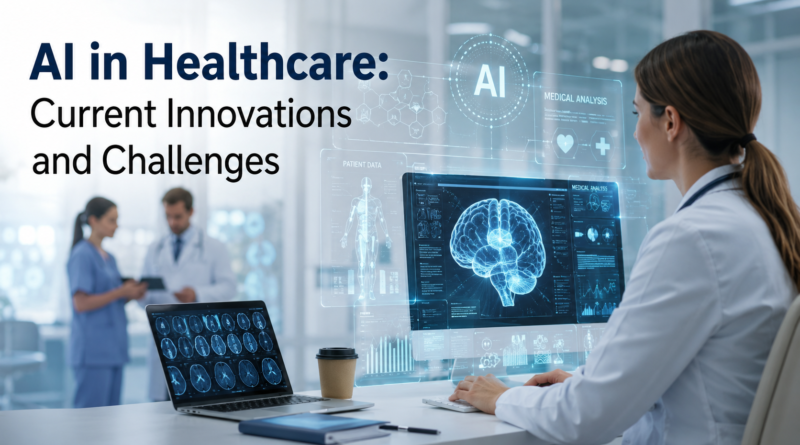
AI in Healthcare: Current Innovations and Challenges
Artificial intelligence (AI) is no longer a futuristic concept in healthcare—it has become an essential technology that is transforming how hospitals, clinics, research organizations, and healthcare providers operate. From improving disease diagnosis to automating administrative tasks, AI is helping healthcare systems become more efficient, accurate, and patient-centered.
Healthcare organizations worldwide are investing heavily in AI-powered solutions to reduce costs, improve patient outcomes, and streamline complex workflows. At the same time, the rapid adoption of AI introduces important challenges related to privacy, ethics, regulation, workforce adaptation, and data security.
As AI continues to evolve, understanding both its opportunities and limitations is essential for healthcare providers, policymakers, and patients alike.
What Is AI in Healthcare?
Artificial intelligence in healthcare refers to computer systems that can analyze large amounts of medical data, recognize patterns, make predictions, and assist healthcare professionals in making informed decisions.
Unlike traditional software that follows predefined rules, AI systems continuously learn from data, enabling them to improve their performance over time.
Modern healthcare AI combines several technologies, including:
- Machine Learning (ML)
- Deep Learning
- Natural Language Processing (NLP)
- Computer Vision
- Predictive Analytics
- Robotic Process Automation (RPA)
Together, these technologies help healthcare organizations process enormous volumes of clinical and administrative information more efficiently than ever before.
How AI Is Transforming Healthcare
1. Faster and More Accurate Diagnosis
One of AI’s greatest strengths is its ability to analyze medical images and clinical data rapidly.
AI-powered systems can assist radiologists in detecting abnormalities in X-rays, CT scans, MRIs, mammograms, and pathology slides. These tools help identify potential diseases earlier, allowing healthcare professionals to begin treatment sooner.
Rather than replacing physicians, AI acts as a decision-support tool that helps reduce diagnostic errors and improves confidence in complex cases.
Personalized Patient Care
Every patient has unique medical conditions, genetics, lifestyle factors, and treatment responses.
AI enables personalized medicine by analyzing patient-specific information to recommend treatment options that may be more effective for an individual’s condition.
Healthcare providers can use AI to:
- Predict treatment outcomes
- Recommend personalized medication plans
- Identify high-risk patients
- Optimize chronic disease management
- Improve preventive care strategies
This personalized approach leads to better patient satisfaction and improved clinical outcomes.
Drug Discovery and Medical Research
Developing a new medicine traditionally takes many years and billions of dollars.
AI significantly accelerates this process by analyzing molecular structures, predicting drug interactions, and identifying promising compounds much faster than conventional research methods.
Researchers now use AI to:
- Discover new drug candidates
- Repurpose existing medications
- Analyze clinical trial data
- Predict potential side effects
- Improve pharmaceutical research efficiency
The COVID-19 pandemic demonstrated how AI can support rapid scientific research and global collaboration.
AI-Powered Virtual Health Assistants
Virtual assistants and AI chatbots are improving patient engagement by providing instant access to healthcare information.
These systems help patients:
- Schedule appointments
- Receive medication reminders
- Answer common medical questions
- Monitor chronic conditions
- Track symptoms
- Access healthcare resources
While they cannot replace medical professionals, they improve accessibility and reduce the workload for healthcare staff.
Predictive Healthcare Analytics
Healthcare organizations collect enormous amounts of patient data every day.
AI analyzes this information to identify patterns that humans might overlook.
Predictive analytics helps hospitals:
- Forecast patient admissions
- Identify patients at risk of complications
- Prevent hospital readmissions
- Optimize staffing requirements
- Improve resource allocation
Better forecasting allows healthcare facilities to deliver more efficient and cost-effective care.
AI in Medical Imaging
Medical imaging has become one of the fastest-growing applications of artificial intelligence.
AI systems assist specialists by:
- Detecting tumors
- Identifying fractures
- Measuring organ abnormalities
- Comparing previous scans
- Highlighting suspicious regions
These capabilities reduce interpretation time while supporting more accurate diagnoses.
Importantly, final clinical decisions remain the responsibility of qualified healthcare professionals.
Administrative Automation
Healthcare organizations spend significant time on administrative tasks.
AI automates many repetitive processes, including:
- Medical coding
- Claims processing
- Appointment scheduling
- Billing verification
- Insurance documentation
- Patient record management
- Clinical documentation support
Automation reduces manual errors while allowing healthcare staff to spend more time focusing on patient care.
Remote Patient Monitoring
Wearable devices and connected medical equipment generate continuous health data.
AI analyzes information such as:
- Heart rate
- Blood pressure
- Oxygen levels
- Blood glucose
- Physical activity
- Sleep patterns
Healthcare providers can receive alerts when patients show signs of deterioration, allowing earlier intervention and reducing emergency hospital visits.
Benefits of AI in Healthcare
The growing adoption of AI offers several important advantages.
Improved Accuracy
AI assists clinicians by identifying patterns across vast datasets, supporting more informed decision-making.
Faster Decision Making
Large volumes of clinical information can be analyzed in seconds, reducing delays in diagnosis and treatment planning.
Better Patient Experience
Automation shortens waiting times while improving communication and care coordination.
Increased Efficiency
Routine administrative tasks are completed faster, allowing healthcare professionals to focus on patient care.
Cost Reduction
Optimized workflows, fewer errors, and improved resource utilization help reduce operational expenses.
Challenges Facing AI in Healthcare
Despite its enormous potential, AI adoption comes with significant challenges.
Data Privacy and Security
Healthcare data is among the most sensitive personal information.
Organizations must protect patient records through:
- Strong cybersecurity measures
- Data encryption
- Secure cloud infrastructure
- Strict access controls
- Compliance with healthcare regulations
Building patient trust requires maintaining the highest standards of privacy and security.
Ethical Concerns
Healthcare decisions directly affect people’s lives.
Questions remain regarding:
- AI transparency
- Algorithm bias
- Accountability
- Informed consent
- Fairness across diverse populations
Healthcare providers must ensure that AI supports equitable and ethical care.
Regulatory Compliance
Medical AI systems must comply with national and international healthcare regulations before clinical deployment.
Regulatory agencies continue developing frameworks to evaluate AI safety, effectiveness, and reliability.
Integration with Existing Systems
Many hospitals use legacy information systems that were not designed for AI integration.
Successful implementation often requires infrastructure upgrades, interoperability planning, and staff training.
Workforce Adaptation
AI changes how healthcare professionals work.
Rather than replacing clinicians, AI shifts many repetitive administrative tasks toward automation.
Healthcare organizations must invest in employee training so professionals can effectively collaborate with AI-powered tools.
The Future of AI in Healthcare
Artificial intelligence will continue expanding across nearly every area of healthcare.
Future innovations may include:
- Earlier disease detection
- Digital twins for treatment simulation
- AI-assisted robotic surgery
- Advanced precision medicine
- Smarter clinical decision support
- Automated documentation
- Population health management
- Enhanced medical research
As technology matures, AI will become an increasingly valuable partner in delivering high-quality, patient-centered care.
The Importance of Healthcare BPO Services in an AI-Driven Industry
While AI automates many routine processes, healthcare organizations still rely on skilled professionals to manage complex administrative, clinical support, and operational functions.
Healthcare Business Process Outsourcing (BPO) providers help hospitals, clinics, insurers, and healthcare organizations improve efficiency by handling tasks such as medical billing, claims processing, patient support, medical data management, appointment scheduling, and back-office operations.
Combining AI technologies with experienced healthcare BPO teams allows organizations to reduce operational costs, improve accuracy, maintain regulatory compliance, and deliver better patient experiences.
If your healthcare organization is looking to optimize administrative workflows while maintaining high standards of quality and compliance, learn more about professional healthcare outsourcing services here:
https://www.oursglobal.com/outsource-healthcare-bpo-services
Conclusion
Artificial intelligence is transforming healthcare at an unprecedented pace. From improving diagnostic accuracy and accelerating medical research to automating administrative tasks and enhancing patient care, AI offers enormous opportunities for healthcare organizations around the world.
However, successful adoption requires careful attention to ethics, privacy, regulatory compliance, cybersecurity, and workforce development.
The future of healthcare will not be defined by AI alone, but by how effectively healthcare professionals, technology providers, and support organizations work together to deliver safer, more efficient, and more personalized care. Organizations that embrace this balanced approach will be best positioned to meet the evolving needs of patients while driving innovation across the healthcare industry.
Learn more about healthcare outsourcing services:
https://www.oursglobal.com/outsource-healthcare-bpo-services