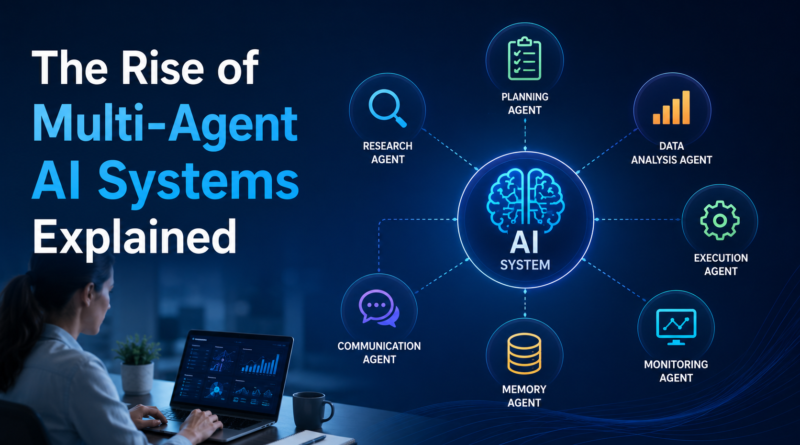
The Rise of Multi-Agent AI Systems Explained
Introduction
Artificial Intelligence (AI) has evolved rapidly over the past few years, moving beyond simple automation and single-purpose chatbots to intelligent systems capable of solving complex business problems. One of the most significant developments in this evolution is the emergence of Multi-Agent AI Systems. Instead of relying on a single AI model to perform every task, businesses are increasingly deploying multiple AI agents that work together, communicate, and collaborate to achieve shared goals.
This approach mirrors how human teams operate. In a company, employees specialize in different roles such as customer support, finance, marketing, operations, and management. Each person contributes unique expertise while collaborating to complete larger objectives. Multi-Agent AI Systems follow a similar principle by assigning specialized AI agents to different responsibilities, enabling them to work together more efficiently than a single AI model.
As organizations adopt AI to automate workflows, improve decision-making, and enhance customer experiences, Multi-Agent AI Systems are becoming a key part of enterprise digital transformation. They provide greater flexibility, scalability, and resilience while enabling businesses to automate increasingly complex processes.
This article explains what Multi-Agent AI Systems are, how they work, their benefits, real-world applications, challenges, and why they are shaping the future of intelligent automation.
What Are Multi-Agent AI Systems?
A Multi-Agent AI System is a network of intelligent AI agents that collaborate to complete tasks, solve problems, or achieve business objectives. Each agent has a specific role, area of expertise, or responsibility. Instead of relying on one large AI model to handle every request, work is distributed among specialized agents that communicate and coordinate their actions.
For example, an e-commerce business could use several AI agents simultaneously:
- A customer support agent to answer inquiries.
- An inventory agent to monitor stock levels.
- A pricing agent to adjust prices based on demand.
- A logistics agent to coordinate deliveries.
- A marketing agent to personalize promotions.
These agents share information, exchange updates, and work together to improve overall business performance.
How Multi-Agent AI Systems Work
Although implementations vary, most Multi-Agent AI Systems follow a structured workflow.
Step 1: Receive a Request
The system receives a user query or business event, such as a customer order or a support request.
Step 2: Identify the Required Tasks
The request is analyzed and divided into smaller tasks.
Step 3: Assign Specialized Agents
Each task is assigned to the AI agent best suited to perform it.
Step 4: Collaboration
Agents exchange relevant information while completing their responsibilities.
Step 5: Combine Results
Outputs from individual agents are merged into a complete solution.
Step 6: Deliver the Final Response
The user receives a unified response without needing to interact with multiple systems.
This collaborative process allows businesses to automate complex workflows with greater accuracy and efficiency.
Key Components of a Multi-Agent AI System
Successful implementations typically include several core components.
AI Agents
Each agent performs a specialized function such as reasoning, data analysis, customer interaction, or scheduling.
Communication Layer
Agents communicate through APIs, messaging systems, or shared memory to exchange information securely.
Task Manager
A coordinator assigns tasks, prioritizes workloads, and manages collaboration between agents.
Knowledge Base
Agents access centralized information such as business policies, product catalogs, customer records, or technical documentation.
Monitoring System
Performance monitoring tracks response times, accuracy, resource usage, and overall system health.
Why Multi-Agent AI Systems Are Growing in Popularity
Businesses are adopting Multi-Agent AI Systems because modern workflows have become increasingly complex.
Instead of expecting one AI model to perform every function, organizations benefit from specialized agents that excel in specific tasks.
Major drivers include:
- Growing business complexity
- Increased AI adoption
- Need for scalable automation
- Better decision-making
- Improved customer experiences
- Demand for real-time collaboration
- Expansion of cloud computing
- Advances in large language models
As AI capabilities continue to improve, organizations are recognizing that collaboration between intelligent agents often delivers better results than relying on a single model.
Benefits of Multi-Agent AI Systems
1. Higher Efficiency
Multiple agents can work simultaneously, allowing tasks to be completed much faster than sequential processing.
For example, while one agent analyzes customer behavior, another generates reports and a third updates inventory records.
Parallel processing significantly improves productivity.
2. Better Decision-Making
Specialized agents contribute expertise from different domains before recommendations are made.
Rather than relying on one AI perspective, businesses receive richer insights based on multiple analyses.
This leads to better-informed decisions.
3. Improved Scalability
As organizations grow, additional AI agents can be introduced without redesigning the entire system.
Businesses can expand capabilities gradually while maintaining performance.
4. Greater Reliability
If one AI agent encounters an issue, other agents can often continue operating.
This distributed architecture improves system resilience and reduces operational disruptions.
5. Flexible Business Processes
Businesses frequently update workflows.
Multi-Agent Systems allow organizations to modify or replace individual agents without affecting the entire platform.
This flexibility supports continuous innovation.
6. Enhanced Customer Experience
Customers receive faster and more personalized responses because multiple AI agents collaborate behind the scenes.
Examples include:
- Faster issue resolution
- Personalized recommendations
- Accurate information
- Reduced waiting times
- Consistent support
Real-World Business Applications
Customer Service
Customer support teams increasingly deploy multiple AI agents.
One agent verifies customer identity.
Another retrieves account information.
A third recommends solutions.
A fourth schedules follow-up actions.
The customer experiences one seamless conversation.
Healthcare
Healthcare organizations use Multi-Agent AI Systems for:
- Patient scheduling
- Medical record analysis
- Diagnostic assistance
- Treatment recommendations
- Administrative automation
Specialized agents improve efficiency while allowing healthcare professionals to focus on patient care.
Financial Services
Banks and financial institutions use AI agents to:
- Detect fraud
- Assess credit risk
- Monitor transactions
- Generate compliance reports
- Support customer service
Collaboration between agents enables faster and more accurate financial operations.
Manufacturing
Manufacturers deploy AI agents for:
- Predictive maintenance
- Quality inspection
- Supply chain optimization
- Production scheduling
- Inventory management
These systems improve operational efficiency while reducing downtime.
Retail and E-commerce
Retail businesses benefit from AI agents that manage:
- Product recommendations
- Pricing optimization
- Inventory forecasting
- Customer support
- Order fulfillment
- Marketing campaigns
This creates a highly personalized shopping experience.
Multi-Agent AI vs Single AI Models
| Feature | Single AI Model | Multi-Agent AI System |
|---|---|---|
| Task Handling | One model manages all tasks | Multiple specialized agents collaborate |
| Scalability | Limited | Highly scalable |
| Flexibility | Lower | High |
| Fault Tolerance | Lower | Higher |
| Decision Quality | Generalized | Specialized and collaborative |
| Performance | Sequential | Parallel processing |
For complex enterprise environments, Multi-Agent AI Systems often provide greater flexibility and efficiency.
Challenges of Multi-Agent AI Systems
While the advantages are significant, businesses should also consider potential challenges.
Communication Complexity
Agents must exchange information accurately and efficiently.
Poor coordination may reduce overall performance.
Security
Multiple AI agents accessing sensitive business information require strong authentication, encryption, and access controls.
Governance
Organizations need clear policies regarding agent responsibilities, permissions, and decision-making authority.
Integration
Connecting AI agents with existing business applications may require careful planning and technical expertise.
Monitoring
Businesses should continuously monitor agent performance to ensure reliable operation.
Proper governance minimizes these risks.
Best Practices for Implementing Multi-Agent AI Systems
Organizations planning to deploy Multi-Agent AI should consider the following recommendations:
- Start with clearly defined business objectives.
- Assign specific responsibilities to each agent.
- Use secure communication between agents.
- Implement role-based access controls.
- Monitor system performance continuously.
- Maintain detailed audit logs.
- Test agent collaboration regularly.
- Protect sensitive business data with encryption.
- Keep AI models updated.
- Ensure human oversight for critical business decisions.
A phased implementation strategy often delivers the best long-term results.
Future of Multi-Agent AI Systems
The future of enterprise AI is increasingly collaborative.
Over the next several years, Multi-Agent AI Systems are expected to become more autonomous, adaptive, and capable of handling sophisticated business operations.
Emerging developments include:
- Self-organizing AI agents
- Autonomous business workflows
- Intelligent enterprise assistants
- AI-powered software development
- Collaborative robotics
- Advanced cybersecurity automation
- Smart supply chain management
- Personalized digital experiences
As AI technologies continue to mature, businesses will rely on networks of intelligent agents rather than isolated AI models.
Why Businesses Should Pay Attention
Organizations that adopt Multi-Agent AI Systems gain more than automation. They create intelligent ecosystems capable of adapting to changing business requirements, improving collaboration, and delivering faster outcomes.
Whether supporting customer service, finance, healthcare, manufacturing, or retail, these systems enable organizations to respond more quickly, reduce operational costs, and make smarter decisions.
Businesses that invest in collaborative AI today will be better prepared for the future of intelligent automation.
Conclusion
Multi-Agent AI Systems represent the next stage in the evolution of artificial intelligence. By allowing specialized AI agents to collaborate, communicate, and solve complex problems together, businesses can achieve higher efficiency, greater scalability, improved resilience, and more informed decision-making than with traditional single-model AI approaches.
From customer support and financial services to healthcare, manufacturing, and e-commerce, Multi-Agent AI Systems are transforming how organizations operate. Their ability to distribute tasks, adapt to changing environments, and integrate with existing business processes makes them a valuable asset for modern enterprises.
As AI adoption continues to accelerate, organizations that embrace collaborative AI architectures will be better positioned to innovate, improve customer experiences, and remain competitive in an increasingly digital world.
Explore enterprise AI, intelligent automation, cloud solutions, and digital transformation services at: