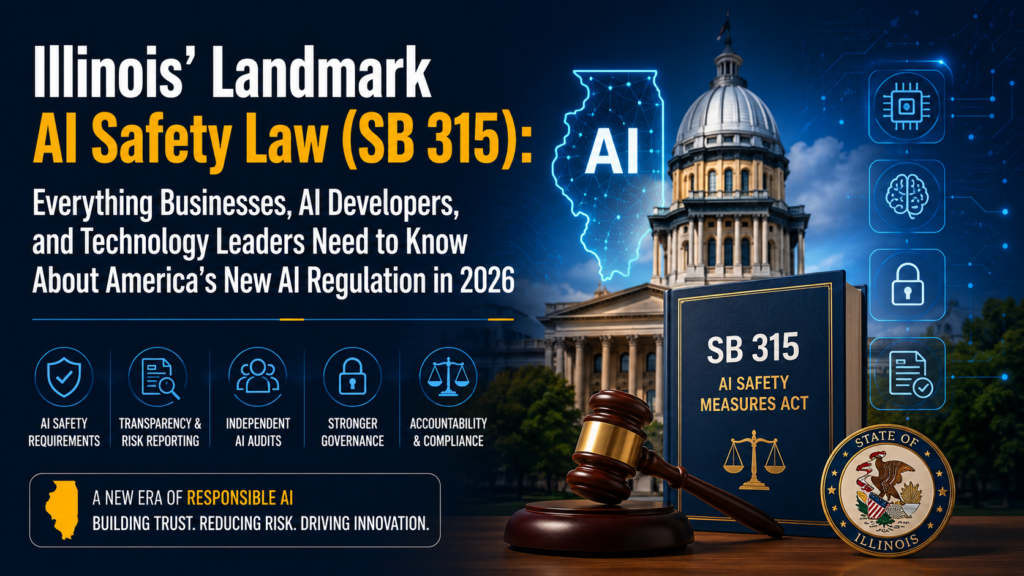
Illinois’ Landmark AI Safety Law (SB 315): Everything Businesses, AI Developers, and Technology Leaders Need to Know About America’s New AI Regulation in 2026
Artificial Intelligence has entered a new era of regulation. Illinois has officially enacted the Artificial Intelligence Safety Measures Act (SB 315), establishing one of the strongest state-level AI governance frameworks in the United States. The legislation represents a significant shift from voluntary AI safety commitments toward legally enforceable transparency, accountability, and independent oversight.
As generative AI systems become increasingly capable, governments worldwide are introducing regulations to ensure these technologies are developed responsibly. Illinois has now positioned itself at the forefront of AI governance by requiring large AI developers to demonstrate that safety is built into the entire AI lifecycle—from development and testing to deployment and monitoring.
For businesses, software companies, AI startups, and enterprise organizations, this law signals a future where AI compliance becomes just as important as cybersecurity and data privacy.
Why Illinois Introduced the AI Safety Law
The rapid advancement of foundation models and large language models has created enormous opportunities across healthcare, finance, education, manufacturing, and customer service. At the same time, policymakers have expressed growing concerns about:
- AI-generated misinformation
- Cybersecurity risks
- Deepfake technology
- Privacy violations
- Critical infrastructure threats
- Autonomous decision-making
- Lack of transparency in advanced AI models
Rather than waiting for comprehensive federal legislation, Illinois introduced SB 315 to establish clear standards for responsible AI development while encouraging innovation through greater accountability.
Key Highlights of SB 315
The Illinois Artificial Intelligence Safety Measures Act introduces several groundbreaking requirements for qualifying AI developers.
1. Independent Third-Party AI Audits
One of the most notable provisions requires qualifying AI developers to undergo annual independent third-party safety audits. This is considered one of the first state-level requirements of its kind in the United States and is designed to verify that companies follow their own published safety practices rather than relying solely on self-reporting.
2. Greater Transparency
Organizations developing frontier AI systems must publish documentation explaining:
- AI safety policies
- Risk management processes
- Security safeguards
- Governance frameworks
- Model evaluation procedures
This increased transparency is intended to build public trust while providing regulators with greater visibility into how advanced AI systems are managed.
3. Mandatory Risk Reporting
The legislation also requires qualifying developers to report significant AI-related risks within defined timeframes, particularly when systems could contribute to serious cybersecurity incidents, public safety threats, or other catastrophic harms.
4. Stronger Internal Governance
Companies covered by the law must establish internal AI governance processes that address:
- Model safety testing
- Security controls
- Risk mitigation
- Incident response
- Documentation and compliance
These requirements encourage organizations to treat AI governance as an ongoing operational responsibility rather than a one-time exercise.
What This Means for Businesses
Although the law primarily targets the largest frontier AI developers, its influence is likely to extend across the broader AI ecosystem.
Businesses that integrate AI into products or enterprise workflows should expect increasing customer and regulatory expectations around:
- AI governance
- Data quality
- Model transparency
- Security testing
- Compliance documentation
- Responsible AI practices
Organizations that prepare early will be better positioned as similar regulations emerge in other U.S. states and internationally.
The Growing Importance of High-Quality AI Training Data
As regulatory expectations increase, one area receiving greater attention is the quality of training data.
High-performing AI models depend on accurately labeled, well-structured datasets that reduce bias, improve model accuracy, and support responsible AI deployment. Poor-quality annotations can introduce errors, unfair outcomes, and compliance risks.
Businesses building machine learning applications can improve AI performance through professional data annotation, image labeling, text annotation, video annotation, and natural language processing datasets.
Organizations looking to build reliable AI systems can learn more about enterprise-grade annotation solutions here:
https://www.oursglobal.com/outsource-data-annotation-labelling-services
Reliable data annotation not only improves model performance but also supports explainability, fairness, and long-term regulatory readiness.
Impact on the AI Industry
The Illinois legislation may influence future AI regulation across the United States. Similar to how GDPR shaped global privacy practices, state-level AI laws are expected to encourage organizations to adopt stronger governance frameworks even outside jurisdictions where they are legally required.
Technology companies are increasingly investing in:
- Responsible AI frameworks
- AI governance teams
- Security testing
- Bias detection
- Human oversight
- Compliance reporting
- AI risk management
These investments are becoming competitive advantages as customers demand more trustworthy AI solutions.
Preparing for the Future
Businesses should begin strengthening their AI governance strategies by:
- Establishing internal AI policies.
- Improving documentation of AI systems.
- Investing in high-quality annotated datasets.
- Conducting regular model evaluations.
- Monitoring AI risks throughout the development lifecycle.
- Implementing responsible AI best practices.
Organizations that proactively embrace AI governance are likely to gain greater customer trust while reducing regulatory and operational risks.
Final Thoughts
Illinois’ Artificial Intelligence Safety Measures Act represents an important milestone in the evolution of AI governance. Rather than slowing innovation, the legislation encourages the development of AI systems that are transparent, secure, accountable, and trustworthy.
As AI adoption accelerates worldwide, businesses that invest today in governance, compliance, and high-quality training data will be better prepared for the next generation of AI regulation and enterprise AI deployment.