
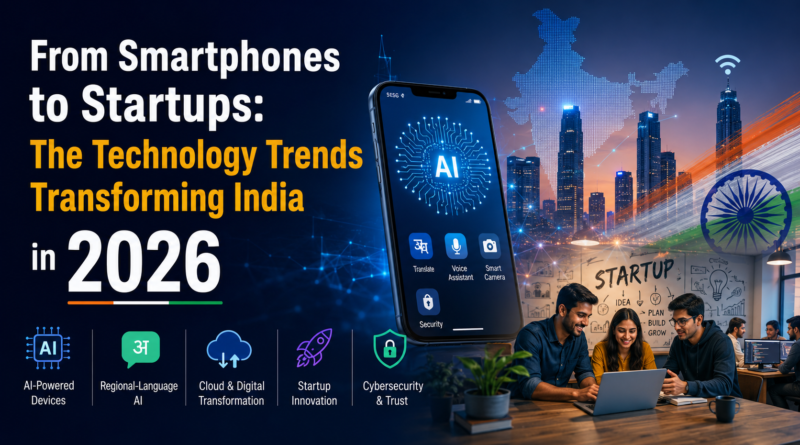
From Smartphones to Startups: The Technology Trends Transforming India in 2026
India’s technology ecosystem is entering a defining phase in 2026. What began as a smartphone revolution over the past decade has evolved into a nationwide digital transformation movement powered by artificial intelligence, cloud computing, regional-language technologies, automation, and startup innovation.
Today, technology is no longer limited to large enterprises or metropolitan cities. From small businesses in Tier-2 towns to manufacturing units, healthcare providers, educational institutions, and government services, digital adoption is reshaping how India works, communicates, and grows.
As India positions itself as a global technology hub, several trends are driving this transformation.
AI-Powered Devices Become Mainstream
Artificial intelligence has moved beyond chatbots and virtual assistants. In 2026, AI is embedded directly into smartphones, laptops, wearable devices, and business applications.
Modern smartphones now offer:
- Real-time language translation
- AI-powered photography
- Voice-based assistance
- Smart call summarization
- Predictive battery optimization
- Personalized user experiences
The biggest shift is that many AI functions are now processed directly on devices rather than relying entirely on cloud servers. This improves privacy, speed, and performance while making advanced features accessible to millions of users. AI-powered devices are becoming standard across both premium and mid-range segments, expanding adoption throughout India.
Regional-Language AI Unlocks Digital Inclusion
India’s linguistic diversity presents both a challenge and an opportunity. While English remains important, the next wave of digital growth is being driven by regional-language users.
Technology companies are investing heavily in:
- Hindi AI assistants
- Tamil and Telugu voice interfaces
- Bengali and Marathi language models
- Multilingual customer support systems
- Speech-to-text and text-to-speech solutions
The ability to interact with technology in native languages is expanding digital access for millions of first-time internet users. Regional-language AI is expected to play a crucial role in sectors such as education, healthcare, agriculture, and e-governance.
Digital Transformation Becomes a Business Necessity
Indian businesses are no longer asking whether they should digitize. The focus has shifted toward how quickly they can modernize operations.
Organizations are investing in:
- Cloud infrastructure
- Cybersecurity solutions
- Business automation
- Data analytics platforms
- Customer experience technologies
- AI-driven workflows
Industry analysts project strong growth in India’s technology spending as organizations continue modernizing applications, strengthening security, and adopting AI-enabled systems. Businesses that successfully integrate digital technologies are seeing improvements in productivity, operational efficiency, and customer engagement.
The Rise of AI-Driven Startups
India continues to be one of the world’s most dynamic startup ecosystems. In 2026, startups are increasingly focusing on AI-powered solutions that address local challenges.
Emerging sectors include:
- Healthcare technology
- FinTech innovation
- Agricultural technology
- Logistics automation
- EdTech platforms
- Manufacturing intelligence
Investors are showing growing interest in startups that combine artificial intelligence with practical business applications. Rather than building technology for technology’s sake, successful startups are solving real-world problems while creating scalable business models.
Cloud Computing and Managed IT Services Gain Importance
As businesses expand digitally, managing technology infrastructure has become more complex. Organizations require secure, scalable, and reliable IT environments to support growth.
This has led to increased demand for outsourced IT support, cloud management, cybersecurity monitoring, and infrastructure services. Companies are looking for technology partners that can help manage daily operations while allowing internal teams to focus on strategic initiatives.
Businesses seeking professional managed IT solutions can explore services offered by Ours Global:
https://www.oursglobal.com/outsource-managed-it-support-services
Managed IT support is becoming particularly valuable for small and mid-sized businesses that want enterprise-level technology capabilities without maintaining large internal IT departments.
Sovereign AI and India’s Technology Independence
A major discussion in 2026 revolves around digital sovereignty. India is increasingly focused on developing domestic AI infrastructure, computing capabilities, and data ecosystems.
Key priorities include:
- Local AI models
- National computing infrastructure
- Secure data management
- Responsible AI governance
- Indigenous innovation ecosystems
Technology leaders and policymakers view AI as a strategic capability that can influence economic growth, innovation, and global competitiveness. This has accelerated investment in research, talent development, and AI infrastructure across the country.
Workforce Transformation Through AI Skills
The future workforce requires more than traditional technical skills. Organizations increasingly seek professionals who can work alongside AI systems, interpret data, and drive digital innovation.
Demand is growing for expertise in:
- Artificial intelligence
- Machine learning
- Cloud engineering
- Cybersecurity
- Data analytics
- Automation technologies
Companies are investing heavily in reskilling and upskilling programs to prepare employees for technology-driven workplaces. The ability to combine domain expertise with digital capabilities is becoming a key competitive advantage.
Cybersecurity Moves to the Center of Digital Strategy
As digital adoption accelerates, cybersecurity is no longer just an IT concern. It has become a boardroom priority.
Businesses are strengthening defenses through:
- Zero-trust security models
- AI-powered threat detection
- Endpoint protection
- Security monitoring services
- Compliance frameworks
With increasing digital transactions and cloud adoption, organizations must ensure that security remains integrated into every stage of their transformation journey.
Looking Ahead
India’s technology transformation in 2026 is about more than innovation. It is about creating a digitally inclusive economy that combines artificial intelligence, cloud infrastructure, startup innovation, and local-language accessibility.
From AI-powered smartphones in consumers’ hands to enterprise-grade digital transformation initiatives in businesses, technology is becoming deeply embedded in everyday life. Organizations that embrace these changes today will be better positioned to compete, innovate, and grow in the years ahead.
The next chapter of India’s digital journey will be defined not only by technological advancement but by how effectively technology improves productivity, accessibility, and opportunities for people and businesses across the nation.