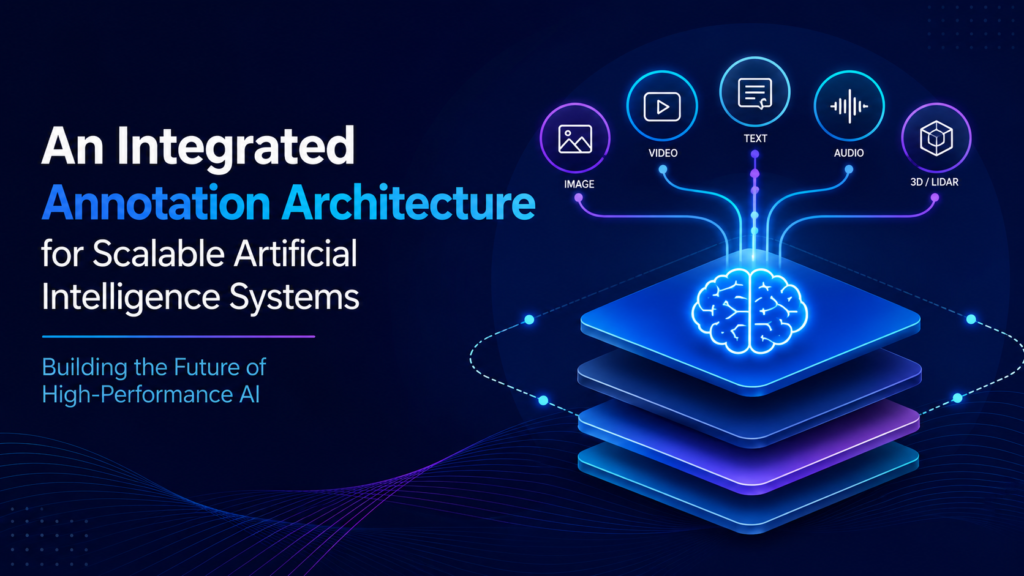
An Integrated Annotation Architecture for Scalable Artificial Intelligence Systems: Building the Future of High-Performance AI
Artificial Intelligence is transforming industries at an unprecedented pace. From autonomous vehicles and medical diagnostics to intelligent chatbots and predictive analytics, AI systems now influence nearly every sector of the digital economy. However, behind every successful AI model lies a critical foundation that often receives less attention than algorithms and computing power: high-quality data annotation.
Data annotation is the process of labeling and structuring raw data so machine learning systems can interpret patterns, relationships, and contextual meaning. Without accurate annotation, even the most advanced AI models struggle to produce reliable outcomes. As organizations scale their AI initiatives, traditional annotation workflows are becoming increasingly inefficient, expensive, and difficult to manage. This has led to the emergence of integrated annotation architectures designed specifically to support scalable artificial intelligence systems.
Modern enterprises require annotation ecosystems that combine automation, human expertise, quality assurance, cloud scalability, and secure data governance into a unified operational framework. Businesses are no longer searching only for annotation services; they are seeking intelligent annotation infrastructures capable of accelerating AI deployment while maintaining precision, compliance, and operational efficiency.
Professional annotation providers such as OURS GLOBAL are helping enterprises manage large-scale AI training requirements through secure and scalable data annotation solutions tailored for modern machine learning environments.
Understanding Data Annotation in Artificial Intelligence
Data annotation serves as the backbone of supervised machine learning. AI systems learn by analyzing annotated examples that define objects, categories, sentiments, relationships, and patterns within datasets. The quality of these annotations directly impacts the accuracy and reliability of AI predictions.
Organizations today work with enormous volumes of structured and unstructured data generated from:
- Images
- Videos
- Audio files
- Medical records
- Customer interactions
- Satellite imagery
- Sensor systems
- Financial documents
- Social media content
- E-commerce platforms
To transform this information into usable AI training data, annotation specialists apply labels and metadata that enable algorithms to understand context and meaning.
Modern annotation processes include:
- Image annotation
- Video annotation
- Text labeling
- Audio transcription
- Semantic segmentation
- Bounding box annotation
- Named entity recognition
- Intent classification
- Sentiment analysis
- LiDAR annotation
- Polygon annotation
- Medical image labeling
As AI applications become more advanced, annotation systems must evolve beyond manual workflows toward integrated architectures that support scalability, speed, automation, and quality control.
Why Scalable AI Systems Need Integrated Annotation Architecture
Traditional annotation methods were designed for smaller datasets and limited machine learning projects. Today’s AI ecosystems require infrastructure capable of managing millions of annotated data points continuously and efficiently.
Integrated annotation architecture solves several critical challenges faced by AI-driven organizations:
Massive Data Volumes
Modern AI systems generate terabytes of training data daily. Manual annotation alone cannot process this scale efficiently.
Quality Consistency
Inconsistent labels can significantly reduce model performance. Centralized quality assurance frameworks are essential for maintaining annotation accuracy.
Faster AI Development Cycles
AI companies must train, test, and deploy models rapidly. Integrated architectures accelerate annotation throughput and reduce bottlenecks.
Multi-Format Data Processing
Organizations now manage diverse datasets involving text, images, speech, videos, and sensor information simultaneously.
Global Collaboration
Distributed annotation teams require centralized workflow management systems for seamless collaboration.
Data Security and Compliance
Sensitive industries such as healthcare, finance, and legal services demand secure annotation environments with strict compliance standards.
An integrated annotation architecture creates a unified environment where automation tools, human annotators, AI-assisted labeling systems, and quality assurance mechanisms work together efficiently.
Core Components of an Integrated Annotation Architecture
A scalable annotation ecosystem depends on multiple interconnected layers designed to optimize workflow efficiency and AI model readiness.
Data Collection Infrastructure
The first layer involves gathering data from multiple enterprise sources including:
- IoT devices
- Surveillance systems
- Mobile applications
- Enterprise databases
- Cloud platforms
- Autonomous systems
- E-commerce systems
- Customer support channels
Data ingestion pipelines standardize incoming information and prepare it for preprocessing.
Intelligent Data Preprocessing
Raw datasets often contain duplicated records, corrupted files, incomplete information, or inconsistent formats. Preprocessing ensures that only high-quality data enters the annotation workflow.
Key preprocessing functions include:
- Data cleansing
- Noise reduction
- File normalization
- Metadata extraction
- Image enhancement
- Speech optimization
- Format conversion
Effective preprocessing improves annotation speed and minimizes downstream machine learning errors.
Human-in-the-Loop Annotation Systems
Despite advances in automation, human expertise remains essential for handling complex annotation tasks requiring contextual reasoning and domain-specific interpretation.
Human annotators play a critical role in:
- Medical image interpretation
- Semantic understanding
- Intent recognition
- Sentiment evaluation
- Edge-case analysis
- Context-sensitive labeling
Human-in-the-loop systems combine machine efficiency with human intelligence to produce highly accurate training datasets.
This hybrid model is especially valuable for industries where annotation errors can lead to serious operational or safety consequences.
AI-Assisted Annotation Technologies
Automation is becoming increasingly important for scaling annotation operations. AI-assisted labeling systems reduce manual workload by predicting annotations using pre-trained models.
Advanced annotation architectures now integrate:
- Auto-labeling algorithms
- Active learning systems
- Predictive tagging
- Semi-supervised learning
- AI-driven segmentation
- Automated object tracking
These technologies dramatically improve processing speed while reducing operational costs.
However, AI-generated annotations still require human validation to ensure reliability and prevent model bias.
Annotation Workflow Orchestration
One of the defining features of integrated annotation architecture is centralized workflow management.
Modern workflow orchestration systems provide:
- Task assignment automation
- Role-based access control
- Real-time collaboration
- Annotation tracking
- Reviewer management
- Progress monitoring
- Version control
- Productivity analytics
These systems enable organizations to coordinate large distributed annotation teams efficiently while maintaining quality standards across projects.
Advanced Quality Assurance Frameworks
Annotation quality directly determines AI model performance. Even minor labeling inconsistencies can create inaccurate predictions and biased outputs.
Integrated architectures therefore implement multi-layer quality assurance systems designed to validate annotation accuracy continuously.
Multi-Step Review Processes
Enterprise-grade annotation environments often use:
- Double-blind annotation
- Consensus validation
- Gold-standard benchmarking
- Inter-annotator agreement analysis
- Statistical sampling reviews
These methods improve consistency and reduce human error.
AI-Powered Validation
Modern architectures increasingly utilize AI validation engines capable of identifying:
- Missing labels
- Incorrect classifications
- Boundary inconsistencies
- Annotation conflicts
- Duplicate records
Real-time error detection minimizes retraining costs and improves dataset reliability.
Cloud-Based Annotation Infrastructure
Cloud computing has become essential for scalable AI annotation systems.
Cloud-native annotation environments provide:
- Elastic scalability
- Global accessibility
- Distributed collaboration
- Real-time synchronization
- Infrastructure redundancy
- High-performance processing
Organizations can rapidly expand annotation operations without investing heavily in on-premise infrastructure.
Cloud-based systems also support continuous AI model retraining and real-time data updates required for adaptive machine learning environments.
Security and Compliance in Annotation Systems
Data security has become a top priority for AI organizations handling confidential or regulated information.
Integrated annotation architectures must comply with global security and privacy standards including:
- GDPR
- HIPAA
- ISO compliance frameworks
- Enterprise cybersecurity protocols
Modern annotation systems implement:
- End-to-end encryption
- Secure access management
- Audit trails
- Data anonymization
- Role-based authentication
- Secure cloud storage
These protections ensure enterprise datasets remain secure throughout the annotation lifecycle.
The Growing Importance of Annotation Outsourcing
As annotation complexity increases, many enterprises are outsourcing annotation workflows to specialized providers.
Outsourcing delivers several strategic advantages:
Reduced Operational Costs
Organizations avoid expenses related to:
- Infrastructure management
- Workforce recruitment
- Internal training programs
- Operational scaling
Access to Skilled Annotation Teams
Professional annotation providers maintain specialized teams trained for:
- Medical annotation
- Computer vision labeling
- NLP annotation
- Multilingual content processing
- Enterprise QA management
Faster Project Delivery
Dedicated annotation vendors operate high-capacity production environments capable of handling large-scale AI datasets efficiently.
Flexible Scalability
Businesses can quickly scale annotation operations based on project demands without long-term workforce commitments.
Industry-focused providers such as OURS GLOBAL Data Annotation Services support enterprises with scalable annotation infrastructures designed for AI development, machine learning optimization, and enterprise automation initiatives.
Industry Applications of Integrated Annotation Architecture
Integrated annotation systems now support a wide range of AI-driven industries.
Healthcare AI
Medical AI applications require highly accurate annotation for:
- MRI scans
- CT imaging
- X-ray interpretation
- Histopathology analysis
- Electronic health records
Precise annotation improves diagnostic accuracy and predictive healthcare systems.
Autonomous Vehicle Systems
Self-driving technologies rely heavily on annotation for:
- Pedestrian detection
- Lane identification
- Traffic sign recognition
- Object tracking
- LiDAR mapping
These systems require real-time scalable annotation with near-perfect precision.
Natural Language Processing
NLP applications depend on annotation for:
- Intent recognition
- Entity extraction
- Sentiment analysis
- Speech transcription
- Conversational AI training
Integrated architectures enable multilingual and context-aware NLP model development.
E-Commerce Intelligence
Retail AI systems use annotation for:
- Product categorization
- Customer behavior analysis
- Recommendation engines
- Visual search optimization
- Inventory automation
Annotation improves personalization and enhances customer experience.
Future Trends in AI Annotation Architecture
The future of annotation architecture is increasingly driven by automation and adaptive learning technologies.
Emerging trends include:
- Generative AI annotation
- Synthetic data generation
- Self-supervised learning
- Federated annotation systems
- AI-driven quality scoring
- Real-time adaptive labeling
- Reinforcement learning feedback loops
These innovations will reduce manual effort while improving annotation scalability and efficiency.
Best Practices for Scalable Annotation Systems
Organizations seeking long-term AI success should focus on:
- Building strong quality assurance frameworks
- Implementing secure data governance policies
- Combining AI automation with human expertise
- Investing in scalable cloud infrastructure
- Continuously training annotation teams
- Using workflow automation tools
- Monitoring annotation performance metrics
- Establishing strategic outsourcing partnerships
- Prioritizing compliance and security standards
- Maintaining continuous dataset validation
Conclusion
Integrated annotation architecture has become a critical foundation for scalable artificial intelligence systems. As enterprises continue expanding AI capabilities across industries, the demand for accurate, secure, and scalable annotation environments will continue to grow rapidly.
Traditional annotation workflows are no longer sufficient for handling the complexity of modern AI ecosystems. Organizations now require intelligent infrastructures capable of combining automation, human expertise, workflow orchestration, and advanced quality assurance into a unified framework.
Businesses that invest in scalable annotation systems gain significant advantages in AI model accuracy, deployment speed, operational efficiency, and long-term innovation potential. By leveraging advanced annotation architectures and experienced service providers such as OURS GLOBAL, enterprises can accelerate AI transformation while maintaining the quality and scalability required for next-generation intelligent systems.