
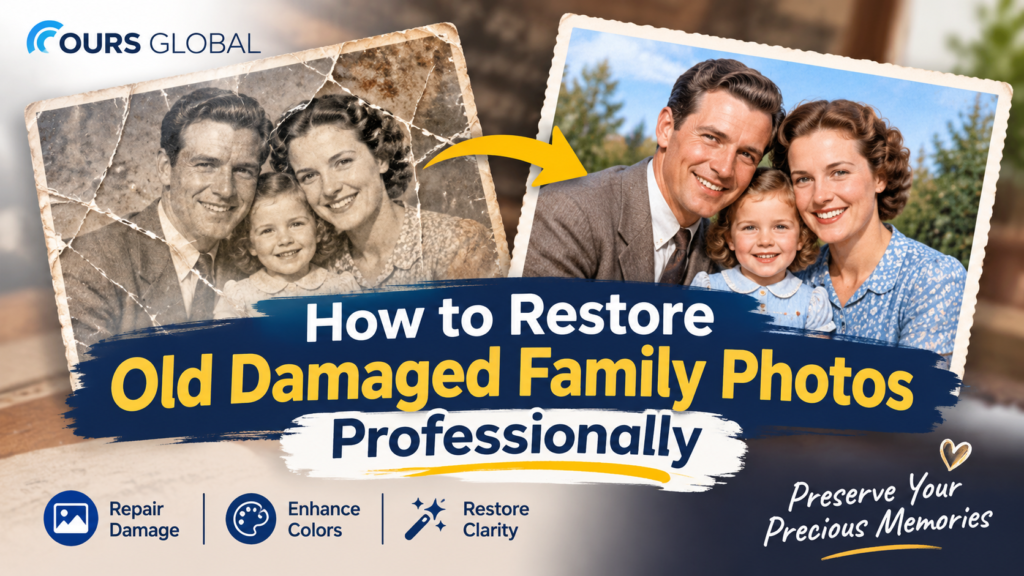
How to Restore Old Damaged Family Photos Professionally
Old family photographs preserve moments that cannot be recreated. Unfortunately, years of exposure to sunlight, humidity, dust, moisture and improper storage can leave these pictures faded, scratched, torn or discolored. The good news is that professional digital photo restoration can repair many visible imperfections, improve image clarity and preserve important photographic memories in digital form.
To restore old damaged family photos professionally, start by assessing the photograph’s condition, creating a high-quality digital copy when it is safe to do so, identifying the required repairs and selecting a restoration provider that combines appropriate editing technology with careful manual corrections.
Whether you have a faded wedding portrait, a damaged photograph of your grandparents or an old family group picture, understanding the restoration process helps you make better decisions and protect the original image.
1. Identify the Type of Damage in Your Old Photographs
Before choosing a restoration service, understand what has happened to the photograph. Different types of damage require different editing techniques.
Faded and discolored photographs
Older color photographs may develop yellow, orange or reddish tones. Black-and-white photographs can also lose contrast and appear washed out.
Professional color correction can help improve brightness, contrast, tonal balance and overall appearance while retaining the photograph’s original character.
Scratches, creases and surface marks
Repeated handling and improper storage can cause scratches, folds, creases and stains.
Digital restoration techniques can remove or reduce many visible imperfections without physically altering the original print.
Torn photographs and missing sections
A photograph that has been torn into pieces or has missing sections may require more extensive reconstruction.
A restoration specialist can digitally repair damaged edges, reconstruct portions of the background and carefully address missing visual details.
The result depends on the amount of surviving image information. Missing details cannot always be recovered exactly.
Water and mold damage
Water exposure can cause stains, discoloration, surface deterioration and other visible imperfections. Mold can create additional preservation concerns.
Digital editing may improve the appearance of a scanned photograph, but it does not treat active mold or physically stabilize a damaged original.
If a photograph is wet, fragile, stuck to another surface or showing active mold, consult a qualified photograph conservator before attempting to clean, separate or scan it.
2. Understand How Professional Photo Restoration Works
Professional photo restoration is a combination of digital image editing, visual assessment and detailed correction.
At OURS GLOBAL, the restoration process includes several stages.
Step 1: Photograph assessment and scanning
The first step is evaluating the photograph’s condition and determining whether a suitable digital copy is available.
For stable printed photographs, OURS GLOBAL describes using 600 DPI scanning to capture image details for restoration.
The quality of the digital source matters because a clearer scan gives the editor more information to work with.
For fragile, valuable or deteriorating photographs, do not force the print flat or attempt to remove it from an album. Seek appropriate preservation advice first.
Step 2: Color correction and enhancement
Photographs can develop uneven colors and poor contrast over time.
Professional editors adjust elements such as:
- Brightness and exposure.
- Contrast and tonal balance.
- Color saturation.
- Hue and color balance.
- Overall image sharpness.
The objective is to improve visibility without unnecessarily changing the photograph’s original appearance.
Step 3: Scratch and stain removal
Digital editing techniques can address visible scratches, spots, stains and other imperfections.
The restoration specialist works on the affected areas while considering the surrounding image texture, background and lighting.
Step 4: Reconstruction and detailing
Heavily damaged photographs may need more detailed work.
Missing sections, torn edges and damaged facial areas can require careful digital reconstruction. AI-based tools may assist with parts of the process, while manual editing helps refine the result.
Reconstruction should be approached carefully: newly generated details may be plausible interpretations rather than an exact recovery of the original information.
Step 5: Final enhancement and digital delivery
Once restoration is complete, the image can be reviewed for consistency, clarity and presentation.
OURS GLOBAL lists JPEG, PNG, TIFF and PDF among its supported delivery formats.
The appropriate format depends on whether you need a convenient image for sharing, a high-quality file for further editing or a document suitable for a particular workflow.
3. How to Prepare Old Photographs for Digital Restoration
Preparing your photographs properly can make the restoration process easier.
Follow these practical recommendations.
Provide the highest-quality available image
If the photograph is stable and suitable for scanning, use a good-quality flatbed scanner.
A scan at 600 DPI is a useful starting point for many restoration projects, particularly when enlargement is required.
Avoid relying on heavily compressed images or low-resolution screenshots if a better original is available.
Avoid automatic image corrections
Automatic enhancement can sometimes change the original colors, contrast or details before a professional editor has assessed the photograph.
Where possible, preserve an unedited scan and provide the original digital file.
Include the entire photograph
Do not crop away damaged edges or surrounding areas.
The complete photograph provides useful context for understanding the original composition and reconstructing damaged sections.
Explain what you want restored
When submitting an image, describe the specific problems.
For example:
- Remove scratches and dust marks.
- Correct fading and yellow discoloration.
- Repair torn sections.
- Improve facial clarity.
- Restore missing background details.
- Colorize a black-and-white photograph.
If historical accuracy is important, explain that natural-looking restoration is more important than dramatic enhancement.
Share reference photographs when available
If you have other photographs of the same person, period or event, these may help guide restoration decisions.
However, reference images should be treated as supporting material rather than proof of exactly how an individual looked in the damaged photograph.
4. How to Choose the Right Professional Photo Restoration Service
Not every photo restoration provider offers the same level of editing or reconstruction.
Before choosing a service, consider the following factors.
1. Range of restoration capabilities
Look for a provider that can address your particular requirements.
Depending on the condition of the photograph, you may need:
- Old photograph restoration.
- Black-and-white photo colorization.
- Scratch and stain removal.
- Torn photo repair.
- Water damage appearance correction.
- Face and object retouching.
- High-resolution image enhancement.
- Historical photograph restoration.
A provider should be able to explain which repairs are realistic for your source image.
2. Combination of AI and manual editing
AI restoration tools can help automate certain image improvements, but they may also introduce invented details or alter facial features.
Manual editing is particularly important when preserving the original identity, expression, clothing and historical character of a photograph.
Ask how the provider reviews AI-assisted results and whether you can request a more conservative restoration.
3. Restoration samples and before-and-after comparisons
Examples can help you assess the provider’s visual approach.
Look for photographs with damage similar to yours.
Pay attention to:
- Facial accuracy.
- Natural skin texture.
- Background consistency.
- Removal of visible damage.
- Preservation of original expressions.
- Realistic colors.
Do not judge restoration quality solely by how dramatic the transformation looks.
4. Pricing and project scope
Photo restoration pricing depends on the amount of work involved.
A photograph with a few scratches may require relatively simple corrections. A severely torn photograph with missing facial details may need considerably more editing.
Ask for a quote that clarifies:
- The number of photographs included.
- The restoration work covered.
- Whether colorization is included.
- The expected output resolution.
- Available file formats.
- Revision arrangements.
- Delivery expectations.
Avoid choosing a provider based exclusively on the lowest advertised price.
5. Privacy and file handling
Family photographs can contain personal and sensitive information.
Before uploading them, understand how the provider handles submitted files, who can access them and how long they are retained.
For historical archives and commercial projects, establish appropriate confidentiality and file-handling requirements before sharing large collections.
5. Common Mistakes to Avoid When Restoring Old Family Photos
Some well-intentioned actions can make an already damaged photograph harder to preserve.
Avoid these mistakes:
Using adhesive tape on torn photographs: Ordinary tape can leave residue and cause additional deterioration.
Cleaning with water or household chemicals: Different photographic materials react differently to moisture and cleaning products.
Trying to flatten brittle photographs: Pressure can cause cracking or additional physical damage.
Applying excessive sharpening: Too much sharpening can produce artificial edges and make the restored photograph look unnatural.
Overusing AI enhancement: Automated tools may change facial characteristics, clothing details and other historically significant features.
Colorizing without considering the original context: Colorization involves interpretation. If accurate historical colors are unknown, the result should not be presented as an exact representation.
The Library of Congress recommends consulting a photograph conservator for valuable, deteriorating or complicated photographs rather than attempting inappropriate repairs yourself.
6. How OURS GLOBAL Helps Restore Old Damaged Photographs
OURS GLOBAL provides digital photo restoration services for individuals, families, photographers, museums, historical archives, genealogists and publishing businesses.
Its restoration offering combines AI-based tools, professional photo editing techniques and manual corrections.
The service includes:
- Old photo restoration: Repairing faded, torn and stained photographs.
- Black-and-white photo colorization: Adding color to monochrome and sepia photographs.
- Scratch and stain removal: Addressing visible imperfections.
- Photo reconstruction: Rebuilding missing or damaged image sections.
- High-resolution enhancement: Improving sharpness and clarity.
- Water and mold damage restoration: Digitally improving the appearance of affected images.
- Historical photo restoration: Enhancing photographs for personal and archival applications.
The company also describes a restoration workflow involving scanning, color correction, detailing and presentation improvements.
For customers with multiple photographs, bulk restoration services are available. Project pricing and turnaround depend on the requirements and complexity of the work.
What should you provide when requesting a quote?
To help the restoration team understand your requirements, prepare:
- A digital copy or suitable scan of the photograph, if available.
- A short description of the visible damage.
- The specific restoration work you need.
- Any reference photographs that may help.
- Your preferred output format.
- Your expected delivery timeframe.
If you have more than five images or a larger collection, discuss the preferred file-sharing method with the team.
Frequently Asked Questions
1. Can severely damaged old family photographs be restored?
Many severely damaged photographs can be digitally improved through reconstruction, retouching, color correction and image enhancement. However, the final result depends on the amount of original visual information that remains. Missing details cannot always be recovered accurately.
2. Can faded black-and-white photographs be restored and colorized?
Yes. Professional editors can improve contrast, sharpness and tonal balance in black-and-white photographs. They can also add color through digital colorization. The colors are interpretations unless reliable historical references are available.
3. What resolution should I use when scanning old photographs?
A 600 DPI scan is a useful starting point for many old printed photographs, especially when you plan to enlarge the image. The best settings depend on the original photograph’s size, condition and intended use. Fragile originals should not be forced onto a scanner.
4. How much does professional photo restoration cost?
The cost depends on the photograph’s condition, the extent of damage, reconstruction requirements, colorization and the number of images. OURS GLOBAL provides personalized quotes based on individual project requirements.
5. Can I restore photographs damaged by water or mold?
Digital restoration can improve the appearance of water stains, discoloration and some visible mold-related damage. However, it cannot remove active mold or repair physical deterioration. Fragile or mold-affected originals should be assessed by a qualified conservator before handling or digitization.
Preserve Your Precious Memories with Professional Photo Restoration
Old photographs are more than pictures. They preserve family history, relationships and moments that deserve careful attention.
Whether you need to repair a faded family portrait, reconstruct a torn wedding photograph, enhance an old black-and-white image or restore a collection of historical photographs, choosing the right digital restoration approach can make a meaningful difference.
OURS GLOBAL offers professional photo restoration services combining AI-assisted tools and manual editing techniques to address a range of photographic damage.
Ready to restore your old photographs?
Visit OURS GLOBAL’s Professional Photo Restoration Services and submit your requirements to request a personalized quote.
Give your treasured photographs a new digital life while preserving the memories they represent.