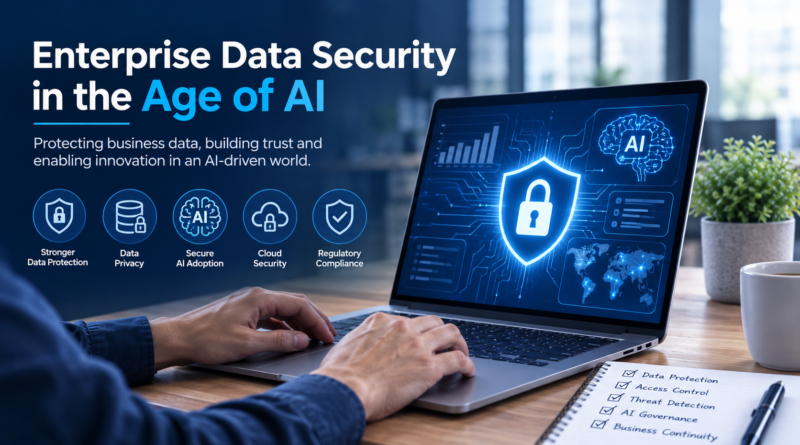
Enterprise Data Security in the Age of AI
Introduction
Artificial Intelligence (AI) is reshaping the modern enterprise. Organizations across industries are using AI to automate workflows, analyze massive datasets, improve customer experiences, detect fraud, optimize supply chains, and support faster decision-making. As AI capabilities continue to evolve, businesses are generating, collecting, and processing more data than ever before. While this creates new opportunities for innovation, it also introduces significant challenges for protecting sensitive information.
Enterprise data has become one of the most valuable assets for any organization. Customer records, financial information, intellectual property, employee data, operational insights, and business strategies all require strong protection. AI systems depend on high-quality data to deliver accurate results, making data security even more critical in today’s digital environment.
Cybercriminals are also leveraging AI to launch more advanced attacks, automate phishing campaigns, identify vulnerabilities, and bypass traditional security measures. At the same time, organizations must comply with increasingly strict data privacy regulations while ensuring that AI systems remain secure, transparent, and trustworthy.
Enterprise data security is no longer solely the responsibility of the IT department. It requires collaboration between business leaders, security professionals, developers, compliance teams, and employees. This article explores the importance of enterprise data security in the age of AI, common risks, practical security strategies, and best practices for building a resilient data protection framework.
Why Data Security Is More Important Than Ever
Data drives every aspect of modern business operations. AI systems rely on large volumes of information to generate insights, automate processes, and support business decisions.
Without proper security, organizations face risks such as:
- Data breaches
- Financial losses
- Regulatory penalties
- Business disruption
- Reputation damage
- Loss of customer trust
- Intellectual property theft
- Operational downtime
A single security incident can have long-term financial and reputational consequences, making proactive data protection a business priority.
How AI Is Changing Enterprise Data Security
AI has introduced both new opportunities and new challenges for cybersecurity.
On one hand, AI strengthens security by:
- Detecting unusual network activity
- Identifying suspicious user behavior
- Automating threat detection
- Accelerating incident response
- Improving fraud detection
- Analyzing security logs at scale
On the other hand, AI introduces risks such as:
- Prompt injection attacks
- AI model manipulation
- Data poisoning
- Unauthorized AI access
- Sensitive data leakage
- AI-generated phishing campaigns
Organizations must secure both their traditional IT infrastructure and the AI systems operating within it.
Common Enterprise Data Security Threats
Understanding potential threats helps businesses prepare effective defenses.
Data Breaches
Unauthorized access to confidential information remains one of the biggest cybersecurity risks.
Attackers may target:
- Customer databases
- Financial systems
- Healthcare records
- Employee information
- Intellectual property
- Cloud storage
Strong access controls and encryption significantly reduce exposure.
Insider Threats
Not every security incident originates outside the organization.
Employees, contractors, or third-party partners may unintentionally—or intentionally—expose sensitive information through:
- Weak passwords
- Unauthorized sharing
- Misconfigured permissions
- Lost devices
- Human error
Security awareness training helps reduce insider risks.
Ransomware
Ransomware continues to be one of the most damaging cyber threats.
Attackers encrypt business data and demand payment for restoration.
Organizations can reduce risk through:
- Regular backups
- Network segmentation
- Endpoint protection
- Employee training
- Multi-Factor Authentication (MFA)
Preparation is essential because recovery can be expensive and time-consuming.
Cloud Misconfigurations
Cloud computing offers flexibility, but poorly configured environments often expose sensitive information.
Common issues include:
- Public storage buckets
- Weak access policies
- Excessive permissions
- Missing encryption
- Unsecured APIs
Routine cloud security reviews help identify these weaknesses before attackers do.
AI-Specific Threats
As AI adoption grows, organizations must address threats unique to intelligent systems.
Examples include:
- Prompt injection
- Model theft
- Training data poisoning
- Adversarial attacks
- AI output manipulation
- Unauthorized model access
Protecting AI models is just as important as protecting the underlying data.
Best Practices for Enterprise Data Security
1. Classify Sensitive Data
Not all business information requires the same level of protection.
Organizations should classify data based on sensitivity, such as:
- Public
- Internal
- Confidential
- Highly restricted
Classification enables security teams to apply appropriate controls and prioritize protection efforts.
2. Implement Strong Access Controls
Employees should access only the information necessary for their roles.
Effective access management includes:
- Role-Based Access Control (RBAC)
- Least Privilege principles
- Multi-Factor Authentication
- Single Sign-On
- Regular permission reviews
Reducing unnecessary access minimizes potential damage if accounts are compromised.
3. Encrypt Data at Rest and in Transit
Encryption protects sensitive information whether it is stored or transmitted across networks.
Businesses should encrypt:
- Customer databases
- Financial records
- AI training datasets
- Cloud storage
- Backup files
- API communications
Modern encryption standards help safeguard data even if unauthorized access occurs.
4. Secure AI Training Data
AI models are only as trustworthy as the data used to train them.
Organizations should:
- Verify data sources
- Remove corrupted records
- Monitor dataset integrity
- Restrict access
- Maintain version history
- Regularly audit training data
Protecting datasets prevents model manipulation and maintains AI accuracy.
5. Protect APIs
Enterprise AI applications frequently communicate through APIs.
Secure APIs by implementing:
- Authentication
- Authorization
- Rate limiting
- Input validation
- HTTPS encryption
- Continuous monitoring
API security is essential because attackers often target exposed interfaces.
6. Monitor Systems Continuously
Continuous monitoring enables organizations to detect suspicious behavior before significant damage occurs.
Monitor:
- User activity
- Network traffic
- Cloud resources
- AI models
- Administrative actions
- API requests
Real-time alerts allow security teams to respond quickly to emerging threats.
7. Adopt a Zero Trust Security Model
Zero Trust assumes that no user or device should be trusted automatically.
Key principles include:
- Verify every request
- Authenticate continuously
- Limit permissions
- Monitor activity
- Segment networks
This approach significantly reduces the impact of compromised accounts.
8. Maintain Regular Backups
Reliable backups remain one of the most effective defenses against ransomware and accidental data loss.
Best practices include:
- Automated backups
- Encrypted storage
- Geographic redundancy
- Routine recovery testing
- Backup integrity verification
Organizations should regularly test backup restoration to ensure systems can recover quickly.
9. Strengthen Employee Awareness
Human error remains one of the leading causes of security incidents.
Training programs should cover:
- Phishing awareness
- Password security
- Safe AI usage
- Data handling procedures
- Device security
- Incident reporting
Well-informed employees become an important layer of defense.
10. Secure the AI Development Lifecycle
Security should be integrated into every stage of AI development.
Organizations should include:
- Threat modeling
- Secure coding
- Vulnerability testing
- Code reviews
- Penetration testing
- Compliance validation
Embedding security into development reduces risks before deployment.
Compliance and Data Privacy
Many organizations process regulated information that requires compliance with industry standards and privacy regulations.
Businesses should align security programs with applicable frameworks such as:
- GDPR
- ISO 27001
- HIPAA
- SOC 2
- PCI DSS (where relevant)
Compliance demonstrates responsible data management while helping organizations avoid legal and financial penalties.
AI Governance and Responsible Data Use
AI governance establishes policies that ensure AI systems operate responsibly and securely.
Effective governance includes:
- Clear accountability
- Data quality standards
- Bias monitoring
- Ethical AI principles
- Risk assessments
- Human oversight
Governance frameworks help organizations balance innovation with accountability.
Emerging Trends in Enterprise Data Security
Technology continues to reshape cybersecurity strategies.
Important trends include:
AI-Powered Threat Detection
AI enables security platforms to analyze vast amounts of data and identify threats more quickly than traditional methods.
Privacy-Enhancing Technologies
Advanced privacy techniques allow organizations to analyze data while minimizing exposure of sensitive information.
Confidential Computing
Sensitive workloads can now be processed within secure execution environments, reducing the risk of unauthorized access.
Security Automation
Automation accelerates incident response, vulnerability management, and compliance reporting.
Continuous Risk Assessment
Organizations increasingly evaluate security risks in real time rather than relying on periodic reviews.
Common Mistakes Enterprises Should Avoid
Many security incidents result from avoidable mistakes, including:
- Weak passwords
- Excessive user permissions
- Delayed software updates
- Poor cloud configurations
- Missing encryption
- Unsecured APIs
- Lack of employee training
- Inadequate monitoring
- Ignoring AI-specific risks
- Failing to test backup recovery
Regular security assessments help identify and correct these issues before they become serious problems.
Building a Long-Term Data Security Strategy
Enterprise data security should support long-term business objectives rather than focusing only on immediate threats.
A strong strategy includes:
- Executive leadership support
- Continuous security assessments
- Investment in modern security technologies
- Employee education
- AI governance policies
- Incident response planning
- Regular audits
- Ongoing improvement
Security is most effective when it becomes part of the organization’s culture rather than a standalone IT initiative.
The Future of Enterprise Data Security
As AI becomes more deeply integrated into business operations, enterprise security will continue to evolve. Organizations will increasingly adopt intelligent threat detection, automated incident response, privacy-preserving AI, confidential computing, and Zero Trust architectures to protect valuable business data.
Businesses that invest in proactive security measures today will be better prepared to defend against emerging cyber threats while maintaining customer trust and regulatory compliance.
The future of enterprise security will depend on balancing innovation with responsible data management, ensuring that AI technologies deliver value without compromising privacy or security.
Conclusion
Enterprise data security has become a critical foundation for successful AI adoption. As organizations generate more data and deploy increasingly sophisticated AI systems, protecting sensitive information is essential for maintaining business continuity, customer confidence, and regulatory compliance.
By implementing strong access controls, encryption, Zero Trust principles, continuous monitoring, secure AI development practices, and comprehensive governance frameworks, businesses can significantly reduce cybersecurity risks while enabling responsible innovation.
Security should not be viewed as a barrier to digital transformation. Instead, it is a strategic investment that allows organizations to harness the full potential of AI while protecting their most valuable asset—enterprise data.
Explore enterprise AI, cloud solutions, cybersecurity services, and digital transformation expertise at: