
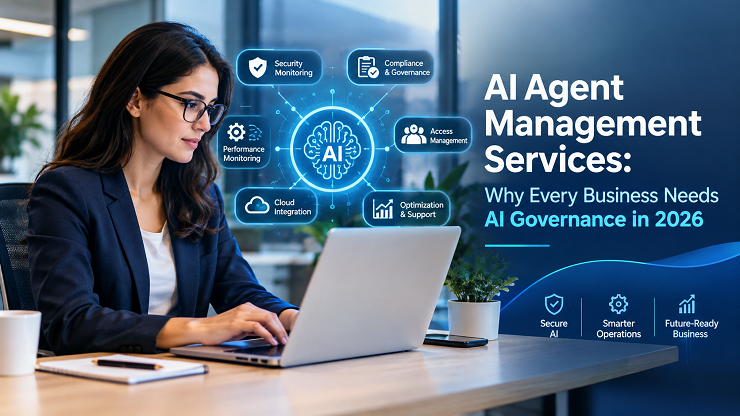
AI Agent Management Services: Why Every Business Needs AI Governance in 2026
Artificial intelligence has entered a new phase. Businesses are no longer using AI only for answering questions or generating content—they are relying on AI agents to automate customer support, analyze data, assist employees, manage workflows, and improve daily operations. As these intelligent systems become more involved in business processes, managing them has become just as important as deploying them.
Many organizations discover that AI tools require ongoing supervision to remain secure, accurate, and aligned with company policies. This growing need has given rise to AI Agent Management Services, a modern extension of managed IT support that focuses on keeping AI-powered systems reliable, compliant, and productive.
What Are AI Agent Management Services?
AI Agent Management Services involve the continuous oversight of AI-powered applications and automation tools used within an organization. Instead of treating AI as a one-time implementation, businesses maintain it through regular monitoring, security controls, performance optimization, and governance.
The objective is to ensure AI systems continue delivering value without introducing unnecessary risks.
A managed AI environment typically includes:
- Continuous performance monitoring
- Access and permission management
- Security oversight
- Policy enforcement
- Compliance monitoring
- AI workflow optimization
- Usage reporting
- Ongoing maintenance
This approach allows businesses to confidently expand AI adoption while maintaining control over their digital operations.
Why Businesses Need AI Governance
As AI becomes integrated into everyday business activities, governance becomes essential. Without clear oversight, AI systems may access sensitive information, produce inconsistent results, or operate outside company guidelines.
AI governance provides a structured framework that defines how artificial intelligence should be used across the organization.
Key governance objectives include:
- Protecting confidential business data
- Defining user permissions
- Monitoring AI activities
- Maintaining audit records
- Supporting regulatory compliance
- Ensuring responsible AI usage
A strong governance strategy helps organizations balance innovation with accountability.
The Biggest Challenges After AI Deployment
Implementing an AI solution is only the beginning. Many businesses face new operational challenges once employees begin using AI daily.
Data Security
AI systems often process business documents, customer information, financial records, and internal communications. Without proper security controls, sensitive data may become exposed.
Organizations should establish:
- Role-based access controls
- Multi-factor authentication
- Secure cloud permissions
- Data encryption
- Continuous security monitoring
These measures help reduce unnecessary exposure while protecting business information.
Permission Management
As more employees use AI tools, permission management becomes increasingly important.
Businesses need clear visibility into:
- Who can access AI systems
- Which data AI can process
- Approved AI applications
- Administrative privileges
Proper permission management reduces both security and operational risks.
Maintaining Output Quality
AI can significantly improve productivity, but output quality should still be monitored.
Businesses should regularly evaluate:
- Response accuracy
- Workflow effectiveness
- Business relevance
- Error frequency
- Performance consistency
Ongoing review helps AI remain useful as business needs change.
How Managed IT Teams Support AI Operations
Traditional IT teams already manage networks, servers, cloud platforms, and cybersecurity. AI Agent Management extends these responsibilities into intelligent business systems.
Continuous Monitoring

Continuous monitoring helps detect issues before they interrupt business operations.
Monitoring typically includes:
- AI availability
- Performance trends
- Usage patterns
- System errors
- Security alerts
- Workflow interruptions
This proactive approach improves reliability while reducing downtime.
AI Security Management
Every AI-powered business system should be protected by layered security.
Essential protections include:
- Endpoint security
- Identity verification
- Email protection
- Access management
- Threat detection
- Regular software updates
Security remains one of the most important components of successful AI adoption.
Workflow Optimization
Business requirements change over time.
Managed AI services help organizations:
- Improve automation performance
- Remove unnecessary processes
- Update AI workflows
- Increase operational efficiency
- Reduce repetitive manual work
Optimization ensures AI continues supporting business growth rather than creating additional complexity.
AI Agent Management vs Traditional IT Support
|
Traditional IT Support |
AI Agent Management |
|---|---|
|
Fixes technical issues |
Manages intelligent workflows |
|
Updates software |
Optimizes AI performance |
|
Maintains servers |
Oversees AI governance |
|
Supports users |
Monitors AI behavior |
|
Responds to incidents |
Prevents operational risks |
Rather than replacing traditional IT support, AI management expands it into a new area of business technology.
Where Businesses Are Using AI Agents

AI agents are becoming valuable across multiple departments.
Customer Support
Businesses use AI to:
- Answer routine customer questions
- Route support requests
- Assist service teams
- Improve response times
IT Help Desk
AI helps technical teams by:
- Organizing support tickets
- Suggesting troubleshooting steps
- Finding knowledge base articles
- Improving service efficiency
Human Resources
HR teams increasingly use AI for:
- Employee onboarding
- Policy assistance
- Document management
- Administrative support
Finance
Financial departments benefit from AI through:
- Report preparation
- Data analysis
- Invoice assistance
- Workflow automation
Each department creates new opportunities while increasing the importance of proper governance.
Benefits of Professional AI Management
Organizations that actively manage AI systems gain several long-term advantages.
Stronger Security
Continuous oversight helps reduce cybersecurity risks.
Better Productivity
Employees spend less time on repetitive work and more time on high-value activities.
Improved Compliance
Clear governance supports internal policies and industry requirements.
Higher System Reliability
Regular monitoring helps identify problems before they affect operations.
Scalable Growth
Businesses can expand AI adoption confidently as their technology environment grows.
Best Practices for Managing AI in Business
Organizations planning long-term AI adoption should establish practical management processes from the beginning.
Recommended practices include:
- Create clear AI usage policies.
- Limit access based on job roles.
- Monitor AI performance regularly.
- Review automated workflows.
- Maintain security updates.
- Train employees on responsible AI usage.
- Conduct periodic governance reviews.
These practices create a more sustainable foundation for business-wide AI adoption.
The Future of AI Management

Artificial intelligence is evolving from a productivity tool into a core business capability. As organizations depend more heavily on AI-powered workflows, ongoing management will become a standard part of IT operations.
Future-ready businesses will focus on:
- Secure AI adoption
- Responsible governance
- Continuous monitoring
- Business-wide optimization
- Scalable automation strategies
Organizations that combine innovation with structured management will be better positioned to maximize AI’s potential while maintaining operational control.
Frequently Asked Questions
What is AI Agent Management?
AI Agent Management is the ongoing monitoring, security, governance, and optimization of AI-powered business systems.
Why is AI governance important?
Governance helps organizations protect data, manage permissions, maintain compliance, and ensure responsible AI usage.
Can small businesses benefit from AI management?
Yes. Small businesses using AI-powered tools can improve security, productivity, and operational consistency through proper management.
Does AI replace managed IT support?
No. AI management complements managed IT services by extending IT responsibilities into intelligent business systems.
Conclusion
AI is transforming how businesses operate, but successful adoption requires more than installing new technology. It requires continuous oversight, security, governance, and optimization to ensure AI remains reliable and aligned with business objectives.
AI Agent Management Services provide that ongoing support, helping organizations confidently scale automation while protecting their data, employees, and operations. Businesses that invest in structured AI governance today will be better prepared for the increasingly AI-driven workplace of tomorrow.
Looking for professional IT management, cybersecurity, cloud support, and proactive technology solutions?
Explore OURS GLOBAL Managed IT Support Services: