Synthetic Data vs Human Data Annotation: Finding the Right Balance for AI Models in 2026
Artificial intelligence models are becoming more capable every year, but their performance still depends on one fundamental factor: high-quality training data. As organizations build computer vision systems, language models, autonomous applications, and predictive AI solutions, many are asking the same question—should they rely on synthetic data, human annotation, or a combination of both?
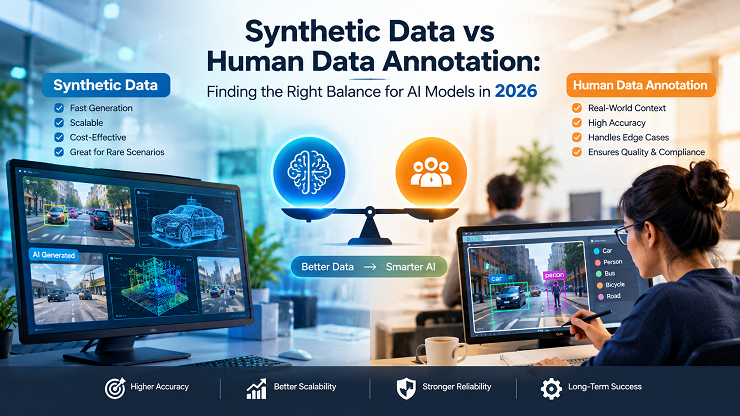
Synthetic data has gained popularity because it can generate large datasets quickly. At the same time, human data annotation remains the benchmark for creating accurate, context-aware training data that reflects real-world situations. Rather than choosing one over the other, many successful AI projects now combine both approaches to improve scalability while maintaining quality.
What Is Synthetic Data?

Synthetic data is information that is artificially generated instead of collected from real-world events. Advanced algorithms create images, videos, text, audio, or sensor data that resemble real scenarios without directly using actual user data.
Examples include:
- Computer-generated street scenes for autonomous vehicles
- Artificial medical images for research
- Simulated customer conversations
- Virtual manufacturing defects
- Digitally created satellite imagery
Synthetic datasets help organizations produce large volumes of training material when collecting real data is expensive, time-consuming, or restricted.
What Is Human Data Annotation?
Human data annotation is the process of having trained specialists label real-world data according to defined guidelines.
Depending on the project, annotators may:
- Draw bounding boxes around objects
- Create segmentation masks
- Label customer intent
- Identify named entities
- Classify documents
- Transcribe audio
- Review AI-generated outputs
Unlike automated labeling alone, human annotation captures context, ambiguity, and edge cases that machines often struggle to interpret consistently.
Why Data Quality Still Matters Most

Modern AI models can process enormous datasets, but poor-quality labels create long-term problems.
Inconsistent annotations may lead to:
- Lower model accuracy
- Incorrect predictions
- Bias in decision-making
- Poor customer experiences
- Expensive retraining cycles
Whether data is synthetic or real, quality assurance remains one of the most important stages of AI development.
Synthetic Data vs Human Annotation
|
Factor |
Synthetic Data |
Human Annotation |
|---|---|---|
|
Speed |
High |
Moderate |
|
Real-world context |
Limited |
High |
|
Edge-case understanding |
Moderate |
Strong |
|
Scalability |
Excellent |
High |
|
Quality validation |
Required |
Built into QA workflows |
|
Compliance support |
Varies |
Strong with structured review |
Both approaches serve different purposes, and combining them often produces stronger training datasets.
When Synthetic Data Works Best
Synthetic data is especially valuable when organizations need rapid dataset expansion.
Autonomous Vehicle Training

Rare driving situations are difficult to capture naturally.
Synthetic environments can generate:
- Heavy rain
- Snow conditions
- Low visibility
- Pedestrian scenarios
- Complex intersections
These simulations allow AI models to experience situations that may occur infrequently in real life.
Manufacturing Simulations
Factories can generate synthetic defect images before collecting thousands of real production samples.
This accelerates early model development while reducing data collection costs.
Robotics
Robotic systems benefit from simulated environments before operating in physical spaces.
Virtual training helps improve navigation and object recognition before real-world deployment.
Where Human Annotation Remains Essential
Despite advances in synthetic data, many AI applications still depend heavily on human expertise.
Healthcare AI

Medical imaging requires careful interpretation.
Human experts help label:
- Tumors
- Organs
- Fractures
- Tissue boundaries
- Diagnostic indicators
Clinical accuracy often depends on expert-reviewed annotations.
Legal Document Classification
Legal documents contain complex language that requires contextual understanding.
Human annotators identify:
- Contract clauses
- Obligations
- Risk categories
- Compliance requirements
This level of interpretation is difficult to replicate using automated generation alone.
Customer Support AI
Customer conversations often contain sarcasm, emotion, slang, and ambiguity.
Human reviewers help AI understand:
- Customer intent
- Sentiment
- Escalation needs
- Resolution quality
These labels improve conversational AI performance significantly.
The Rise of Hybrid AI Training

Many organizations now use a hybrid strategy.
A typical workflow looks like this:
- Generate synthetic data.
- Collect real-world examples.
- Apply human annotation.
- Validate quality.
- Train the model.
- Review performance.
- Refine difficult edge cases.
This combination improves both efficiency and real-world accuracy.
Human-in-the-Loop Quality Assurance
Human-in-the-loop workflows have become increasingly important as AI systems grow more complex.
These workflows typically include:
- Initial labeling
- Peer review
- Expert validation
- Conflict resolution
- Guideline updates
- Performance feedback
Continuous review helps maintain consistency across large annotation projects.
How Better Annotation Improves AI Performance
Well-managed annotation projects contribute to:
- Higher detection accuracy
- Better language understanding
- Stronger recommendation systems
- Improved automation reliability
- Faster deployment
- Reduced retraining costs
The return on investment often comes from preventing errors before models enter production.
Choosing the Right Strategy
Every AI project has different requirements.
|
Project Type |
Recommended Approach |
|---|---|
|
Computer Vision |
Synthetic + Human |
|
Medical AI |
Human-first |
|
Legal AI |
Human-first |
|
Autonomous Driving |
Hybrid |
|
Manufacturing |
Hybrid |
|
NLP Chatbots |
Human + QA |
|
Satellite Imaging |
Hybrid |
The best approach depends on data complexity, industry requirements, and desired model performance.
Future Trends in AI Training Data

Several trends are shaping AI training data in 2026.
Organizations are increasingly investing in:
- Human-in-the-loop workflows
- AI-assisted pre-labeling
- Multi-modal annotation
- Better quality reporting
- Domain-specialist reviewers
- Scalable annotation operations
These developments help organizations build more trustworthy AI systems while balancing speed with accuracy.
Frequently Asked Questions
Is synthetic data replacing human annotation?
No. Synthetic data expands training datasets, while human annotation remains essential for validating quality, handling edge cases, and improving real-world accuracy.
Can synthetic data improve AI models?
Yes. It helps generate additional training scenarios, especially when real-world data is difficult to collect.
Why is human-in-the-loop important?
Human reviewers help identify errors, resolve ambiguity, and maintain consistent labeling standards throughout AI development.
Which industries benefit most from hybrid data strategies?
Healthcare, autonomous vehicles, manufacturing, legal technology, robotics, and conversational AI frequently combine synthetic and human-labeled data.
Conclusion
The future of AI training isn’t about choosing between synthetic data and human annotation. It’s about combining both intelligently.
Synthetic data offers speed and scalability, while human annotation provides the accuracy, context, and quality assurance needed for reliable AI systems. Organizations that balance these approaches can build stronger models, reduce costly errors, and accelerate AI development without compromising real-world performance.
For businesses looking for professional Data Annotation & Labelling Services with scalable human-in-the-loop workflows, quality assurance, and secure AI training data preparation, visit: