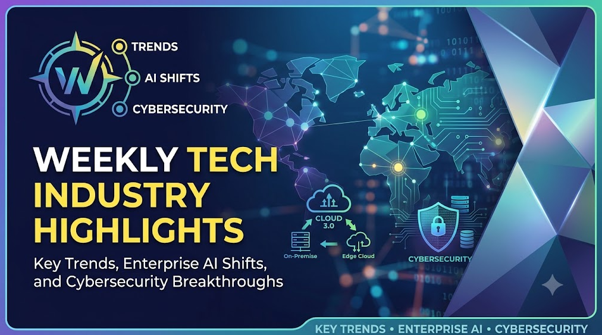
Weekly Tech Industry Highlights: Key Trends, Enterprise AI Shifts, and Cybersecurity Breakthroughs
The modern technology ecosystem moves at a relentless pace. Staying informed is no longer optional for business owners, enterprise executives, and IT leaders—it is a critical requirement for maintaining a competitive edge. Each week brings structural shifts in artificial intelligence, cloud architecture, cybersecurity defenses, and digital transformation strategy.
In this edition of Weekly Tech Industry Highlights, we break down the most impactful developments shaping the global tech landscape. From the shift toward autonomous AI agent deployment to the evolution of hybrid sovereign clouds and the rising importance of foundational operational hygiene, here is what you need to know to guide your business strategy.
1. Artificial Intelligence Moves from Hype to Operational Reality
For the past several years, corporate conversations around artificial intelligence centered primarily on proof-of-concept projects, pilot programs, and generative text capabilities. However, recent developments confirm that the experimental era is officially giving way to measurable operational impact. Enterprise leaders are demanding hard return-on-investment (ROI) metrics, shifting their focus toward practical execution and workflow integration.
The Rise of Autonomous AI Agents
One of the key Weekly Tech Industry Highlights is the rapid migration from simple prompt-and-response chatbots to fully autonomous AI agents. Unlike traditional models that wait for user queries, agentic AI systems are designed to:
-
Execute multi-step operational workflows independently.
-
Reason through complex business logic, software debugging, and compliance checks.
-
Interact with third-party software tools, APIs, and databases seamlessly.
Organizations adopting agentic architectures are seeing significant efficiency gains, particularly in back-office administration, procurement negotiation, and automated customer service orchestration.
On-Device AI and Edge Computing
Another significant trend is the shift toward local processing. Advances in neural processing units (NPUs) built directly into desktop and mobile hardware are allowing enterprises to run large-scale language and reasoning models on-device without routing data through external public cloud servers. This approach dramatically reduces latency while addressing stringent data privacy and sovereignty requirements.
2. Cloud 3.0: Hybrid and Sovereign Cloud Architectures Take Center Stage
As artificial intelligence workloads grow in scale and complexity, legacy public cloud models are facing operational bottlenecks. Enterprise cloud strategy is transitioning into what industry analysts call “Cloud 3.0″—a diversified ecosystem prioritizing hybrid deployments, local edge processing, and cloud sovereignty.
                 +------------------------------------------+
                 |            CLOUD 3.0 ECOSYSTEM            |
                 +------------------------------------------+
                                      |
       +------------------------------+------------------------------+
       |                              |                              |
+--------------+               +--------------+               +--------------+
| Public Cloud |               | On-Premises  |               | Sovereign    |
| Elasticity & |               | Security &   |               | Edge & Local |
| Scale        |               | Consistency  |               | Compliance   |
+--------------+               +--------------+               +--------------+
Why Cloud Strategies Are Shifting
While the public cloud offers unmatched scalability, high token consumption and intensive AI compute workloads have caused enterprise cloud budgets to balloon unexpectedly. Additionally, regulatory bodies worldwide are enforcing stricter data residence laws, making public cloud processing illegal or impractical for sensitive customer records and proprietary business algorithms.
To solve these challenges, IT executives are implementing a tri-part cloud framework:
-
Public Cloud: Leveraged for burst elasticity, collaborative web applications, and non-sensitive workloads.
-
On-Premises Infrastructure: Utilized for consistent baseline processing, core databases, and high-frequency inference tasks to keep operational costs predictable.
-
Sovereign Edge Cloud: Deployed locally to comply with regional data governance frameworks and ensure ultra-low latency for critical manufacturing and logistics operations.
3. Cybersecurity and the Human-Agent Defense Shift
Cybersecurity threats continue to evolve alongside technological advances. Cybercriminals are increasingly using automation and adaptive algorithms to launch targeted phishing campaigns, discover network vulnerabilities, and compromise enterprise endpoints at unprecedented speeds.
In response, cybersecurity teams are overhauling legacy security information and event management (SIEM) tools in favor of AI-native defense platforms.
Essential Security Best Practices for Businesses
To withstand automated threat vectors, enterprise security experts recommend immediate implementation of the following practices:
-
Zero-Trust Network Access (ZTNA): Eliminate implicit trust across your organization. Every user, device, and API call must be continuously verified regardless of whether it originates inside or outside the corporate network perimeter.
-
Continuous Vulnerability Scanning: Replace quarterly audit cycles with real-time automated scanning to identify and patch system vulnerabilities before they are exploited.
-
Employee Cyber-Hygiene Education: Human error remains a leading entry point for breaches. Regular, real-world simulations help employees spot sophisticated social engineering attempts.
-
Encrypted Data Backups: Maintain isolated, immutable backups of critical enterprise systems to ensure business continuity in the event of ransomware attacks.
4. Digital Transformation: Building Solid Foundations Over Hype
A recurring theme in this edition of Weekly Tech Industry Highlights is that successful digital transformation relies on organizational discipline rather than shiny tech tools alone. Many businesses rush to implement complex AI platforms or automated tools on top of fragmented, outdated business processes, only to face high project failure rates.
Why Preparation Trumps Technology
Industry experience shows that up to 40% of AI and automation initiatives fail not because the underlying software is flawed, but because companies attempt to automate broken, inefficient operational workflows.
To achieve sustainable digital transformation, business leaders must prioritize operational fundamentals:
| Operational Focus | Traditional Approach | Modernized Enterprise Approach |
| Data Management | Siloed, unstructured, unverified spreadsheets | Centralized, clean, and real-time governance engines |
| Workflow Architecture | Fragmented manual hand-offs | Streamlined, re-engineered end-to-end processes |
| System Integration | Legacy monolithic legacy platforms | Modular, API-first microservices |
| Change Management | Top-down IT mandates | Cross-functional alignment and continuous training |
Before investing in new software platforms, conduct a thorough root-cause analysis (RCA) of your existing processes. Clean up duplicate data, standardize business logic, and ensure organizational leadership is fully aligned on measurable business outcomes.
5. Emerging Trends and Practical Insights for Business Leaders
As we look toward the future, several technological trends are poised to re-shape how businesses operate, innovate, and serve customers:
1. Embodied AI and Physical Automation
Intelligence is moving off computer screens and into physical machinery. Major manufacturers, distribution hubs, and logistics providers are deploying autonomous mobile robots (AMRs) and automated handling equipment coordinated by centralized AI engines. These systems optimize warehouse routes, improve worker safety, and streamline supply chain operations.
2. Green Computing and Energy-Efficient Infrastructure
The computational demands of modern data processing have put enormous pressure on power grids globally. Data center operators are investing heavily in advanced liquid cooling systems, energy-efficient ASIC architectures, and clean power generation solutions—including geothermal energy and small modular nuclear reactors—to power next-generation computing infrastructure sustainably.
3. Intent-Driven Software Development
Software development methodologies are undergoing a fundamental shift. Rather than manually writing lines of code, developers are moving toward intent-driven engineering, where human professionals define business requirements and security parameters while AI systems assist in generating, testing, and maintaining software architectures.
Actionable Takeaways for Organizations
To successfully navigate the rapid changes highlighted in this weekly review, executives and IT decision-makers should take concrete steps:
-
Audit Your AI Projects: Evaluate existing AI initiatives to ensure they are tied directly to measurable operational KPIs or cost savings rather than speculative experimentation.
-
Review Cloud Costs: Conduct a comprehensive cloud audit to identify workload inefficiencies and evaluate whether a hybrid or edge cloud approach could lower expenses while boosting performance.
-
Strengthen Zero-Trust Defenses: Re-evaluate corporate access controls to protect sensitive assets against automated threat vectors.
-
Clean Your Data Foundations: Invest in data governance, structured data pipelines, and workflow simplification before deploying enterprise-wide automation.
Frequently Asked Questions (FAQs)
What are the main benefits of adopting autonomous AI agents?
Autonomous AI agents can execute multi-step workflows without constant human oversight, reducing operational friction, minimizing administrative error rates, and freeing employees to focus on high-value strategic decision-making.
What does “Cloud 3.0” mean for modern enterprises?
Cloud 3.0 represents a strategic shift from pure public cloud migration to a balanced hybrid architecture. It combines the elasticity of public clouds with the cost-predictability of on-premises hardware and the regulatory compliance of sovereign edge networks.
Why do many digital transformation initiatives fail to meet expectations?
Most digital transformation failures occur because organizations attempt to automate inefficient or broken processes without fixing operational fundamentals first. Success requires process redesign, data governance, and clear strategic goals.
How is zero-trust security different from traditional network security?
Traditional perimeter security assumes that everything inside a corporate network is safe. In contrast, Zero-Trust Network Access operates under the principle of “never trust, always verify,” requiring continuous authentication for every user and device attempting to access network resources.
What steps should small and medium-sized businesses take to prepare for upcoming tech trends?
Small and medium businesses should focus on consolidating their data, securing internal systems through multi-factor authentication, streamlining operational workflows, and leveraging managed enterprise solutions rather than building custom, high-maintenance tech stacks.
How does on-device AI benefit business data privacy?
By processing data locally on dedicated neural processing units (NPUs), on-device AI ensures sensitive information never leaves the local hardware, mitigating data leak risks and simplifying regulatory compliance.
Summary and Conclusion
Keeping up with these Weekly Tech Industry Highlights reinforces a vital lesson: true technological leadership is not about chasing every new headline or tool. Instead, it is about building durable operational foundations, enforcing strict security hygiene, optimizing cloud investments, and strategically deploying intelligent automation where it generates clear business value.
Whether you are refining your enterprise cloud strategy or deploying autonomous AI capabilities, prioritizing clarity, process alignment, and governance will ensure your organization remains resilient, competitive, and prepared for whatever comes next.
SEO Tags: Weekly Tech Highlights, Enterprise AI, Cloud Computing, Cybersecurity, Digital Transformation
Learn more about AI, Cloud, Cybersecurity, Digital Transformation, and Enterprise IT Solutions: