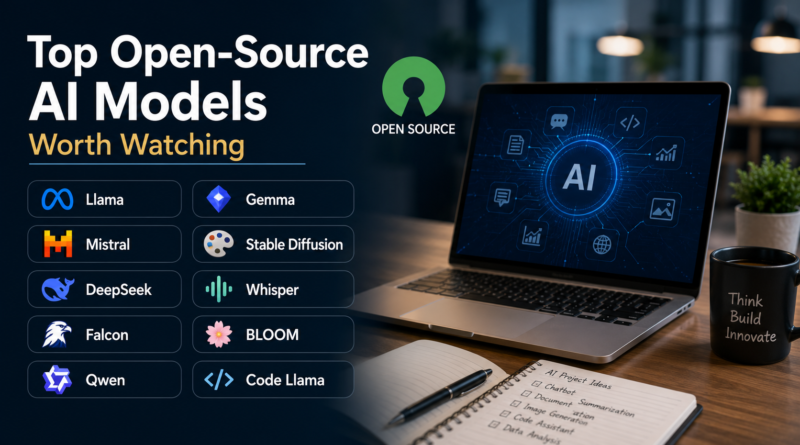
Top Open-Source AI Models Worth Watching
Introduction
Open-source Artificial Intelligence (AI) is transforming the technology landscape by making advanced AI capabilities accessible to businesses, developers, researchers, and startups around the world. Instead of relying solely on proprietary AI services, organizations can now use powerful open-source AI models to build applications, automate workflows, create intelligent assistants, analyze data, and develop innovative products while maintaining greater control over their infrastructure and data.
The rapid growth of open-source AI has accelerated innovation across industries. Technology companies, research organizations, and developer communities continuously release high-quality AI models that rival commercial alternatives in performance. These models support a wide range of tasks, including natural language processing, code generation, image understanding, reasoning, multilingual communication, and intelligent automation.
For businesses, open-source AI offers several advantages, including reduced licensing costs, greater customization, improved transparency, and the flexibility to deploy models on private infrastructure or cloud environments. As AI adoption continues to grow, understanding the leading open-source models has become essential for organizations planning long-term AI strategies.
This article explores some of the most promising open-source AI models worth watching, their strengths, practical business applications, and the factors organizations should consider before deployment.
Why Open-Source AI Is Growing Rapidly
Open-source AI has gained momentum because businesses want greater flexibility and ownership over their AI systems.
Key reasons include:
- Lower operational costs
- Faster innovation
- Transparent development
- Community-driven improvements
- Better customization
- Enhanced data privacy
- Reduced vendor dependency
- Easier integration into existing applications
Instead of building AI models entirely from scratch, developers can leverage mature open-source projects and adapt them to meet specific business needs.
Benefits of Using Open-Source AI Models
Organizations increasingly choose open-source AI because it provides both technical and business advantages.
Some of the most significant benefits include:
Greater Flexibility
Businesses can customize models according to industry requirements, company policies, and customer expectations.
Cost Efficiency
Many open-source models eliminate expensive licensing fees, making advanced AI accessible to startups and small businesses.
Data Control
Organizations can deploy models within private environments, helping protect sensitive business and customer information.
Faster Innovation
Large developer communities continuously improve model performance, documentation, and available tools.
Transparency
Open-source development allows organizations to better understand how AI systems operate and identify potential risks.
-
Llama
Llama has become one of the most influential open-source large language model families. It is designed to support conversational AI, content generation, reasoning, summarization, coding assistance, and multilingual applications.
Organizations use Llama for:
- Enterprise chatbots
- Customer support
- Knowledge management
- Document summarization
- Internal productivity tools
- AI assistants
Its growing ecosystem and strong developer community make it one of the most widely adopted open-source AI models.
-
Mistral
Mistral focuses on delivering high performance while maintaining relatively efficient resource requirements.
It performs well in:
- Text generation
- Question answering
- Programming assistance
- Business automation
- Information retrieval
- AI research
Many organizations appreciate its balance between speed, quality, and deployment flexibility.
-
DeepSeek
DeepSeek has attracted significant attention for its strong reasoning capabilities and programming performance.
Popular use cases include:
- Software development
- Code generation
- Technical documentation
- AI research
- Data analysis
- Educational applications
Developers frequently choose DeepSeek for engineering-focused AI solutions.
-
Falcon
Falcon is designed to provide enterprise-grade language capabilities while supporting commercial deployment.
Businesses use Falcon for:
- Content generation
- Customer communication
- Document analysis
- Business intelligence
- Internal knowledge assistants
Its architecture supports large-scale enterprise AI implementations.
-
Qwen
Qwen has gained popularity because of its multilingual capabilities and strong performance across various AI tasks.
Organizations leverage Qwen for:
- International customer support
- Translation
- Research
- Enterprise search
- AI assistants
- Business automation
Its language support makes it particularly valuable for global businesses.
-
Gemma
Gemma offers lightweight AI models designed for developers seeking efficient deployment without requiring extremely large computing resources.
Common applications include:
- Mobile applications
- Educational tools
- AI prototypes
- Local deployment
- Intelligent assistants
Smaller organizations often benefit from Gemma’s efficient resource requirements.
-
Stable Diffusion
While many open-source models focus on language, Stable Diffusion specializes in AI image generation.
Businesses use it to create:
- Marketing visuals
- Product concepts
- Digital artwork
- Advertising graphics
- Social media content
- Design prototypes
Creative industries continue adopting image generation technologies to accelerate design workflows.
-
Whisper
Whisper is widely recognized for speech recognition and transcription.
Business applications include:
- Meeting transcription
- Customer support analysis
- Voice assistants
- Accessibility tools
- Podcast transcription
- Video subtitles
Speech AI continues becoming increasingly important as voice interfaces expand.
-
BLOOM
BLOOM supports multilingual language processing across numerous languages.
Organizations use BLOOM for:
- Language translation
- Research
- Content creation
- Education
- International communication
Its multilingual capabilities support businesses serving diverse customer bases.
-
Code Llama
Code Llama focuses specifically on software development.
It assists developers with:
- Code completion
- Bug detection
- Documentation
- Refactoring
- Unit testing
- Programming education
Development teams use AI coding assistants to improve productivity while maintaining software quality.
Comparing Open-Source AI Models
Different AI models excel in different areas.
| AI Model | Primary Strength | Common Business Use |
| Llama | General language understanding | Chatbots and enterprise AI |
| Mistral | Efficient language processing | Automation and assistants |
| DeepSeek | Reasoning and coding | Software development |
| Falcon | Enterprise language tasks | Business applications |
| Qwen | Multilingual support | Global customer service |
| Gemma | Lightweight deployment | Mobile and local AI |
| Stable Diffusion | Image generation | Marketing and design |
| Whisper | Speech recognition | Transcription and voice AI |
| BLOOM | Multilingual NLP | Global communication |
| Code Llama | Programming assistance | Software engineering |
The best model depends on business goals, technical requirements, and available infrastructure.
Factors to Consider Before Choosing an AI Model
Selecting an AI model involves more than comparing benchmark scores.
Organizations should evaluate:
Business Objectives
Choose models aligned with actual business requirements.
Infrastructure Requirements
Some models require powerful GPUs, while others can operate efficiently on smaller systems.
Data Privacy
Businesses handling sensitive information should consider private deployment options.
Scalability
Select models capable of supporting future business growth.
Community Support
Active developer communities often provide better documentation, tools, and updates.
Licensing
Always review the model’s license to ensure it aligns with commercial usage requirements.
Business Applications of Open-Source AI
Open-source AI models support a wide variety of enterprise use cases.
Customer Support
AI assistants provide faster responses while reducing support workloads.
Marketing
Businesses generate content, analyze customer behavior, and personalize campaigns.
Healthcare
AI assists with medical documentation, research, and administrative efficiency.
Finance
Organizations automate reporting, fraud detection, and financial analysis.
Manufacturing
AI supports predictive maintenance, quality inspection, and supply chain optimization.
Education
Educational platforms create personalized learning experiences and intelligent tutoring systems.
Challenges of Open-Source AI
Although open-source AI offers significant benefits, organizations should plan for potential challenges.
These include:
- Infrastructure costs
- Security management
- Model maintenance
- Regular updates
- Compliance requirements
- AI governance
- Skilled technical resources
Successful implementations require careful planning, monitoring, and ongoing optimization.
Best Practices for Deploying Open-Source AI
Organizations can improve implementation success by following several best practices:
- Define clear business objectives before deployment.
- Choose models that match workload requirements.
- Test performance with representative datasets.
- Protect sensitive data through encryption and access controls.
- Continuously monitor model performance.
- Maintain proper version control.
- Regularly update models and dependencies.
- Establish AI governance policies.
- Train employees on responsible AI usage.
- Keep humans involved in critical decision-making processes.
These practices help ensure secure, reliable, and scalable AI deployments.
Future of Open-Source AI
The future of open-source AI looks exceptionally promising. As models continue improving in reasoning, efficiency, multimodal capabilities, and language understanding, businesses will have even greater opportunities to build intelligent applications without depending entirely on proprietary platforms.
Future trends are expected to include:
- More powerful multimodal AI models
- Improved reasoning capabilities
- Lower infrastructure requirements
- Enhanced enterprise security
- Better multilingual support
- Increased AI agent collaboration
- More industry-specific AI models
- Stronger governance and compliance features
Organizations that begin experimenting with open-source AI today will be well positioned to take advantage of these innovations.
Conclusion
Open-source AI is reshaping how organizations develop, deploy, and scale intelligent applications. Models such as Llama, Mistral, DeepSeek, Falcon, Qwen, Gemma, Stable Diffusion, Whisper, BLOOM, and Code Llama demonstrate that businesses no longer need to rely exclusively on proprietary solutions to access advanced AI capabilities.
By carefully selecting the right model, implementing strong security practices, and aligning AI initiatives with business goals, organizations can improve efficiency, reduce costs, accelerate innovation, and maintain greater control over their technology investments.
As the open-source AI ecosystem continues to mature, businesses that embrace these technologies will gain the flexibility and competitive advantage needed to thrive in the rapidly evolving digital economy.
Explore AI, cloud, cybersecurity, and digital transformation solutions for your business at: