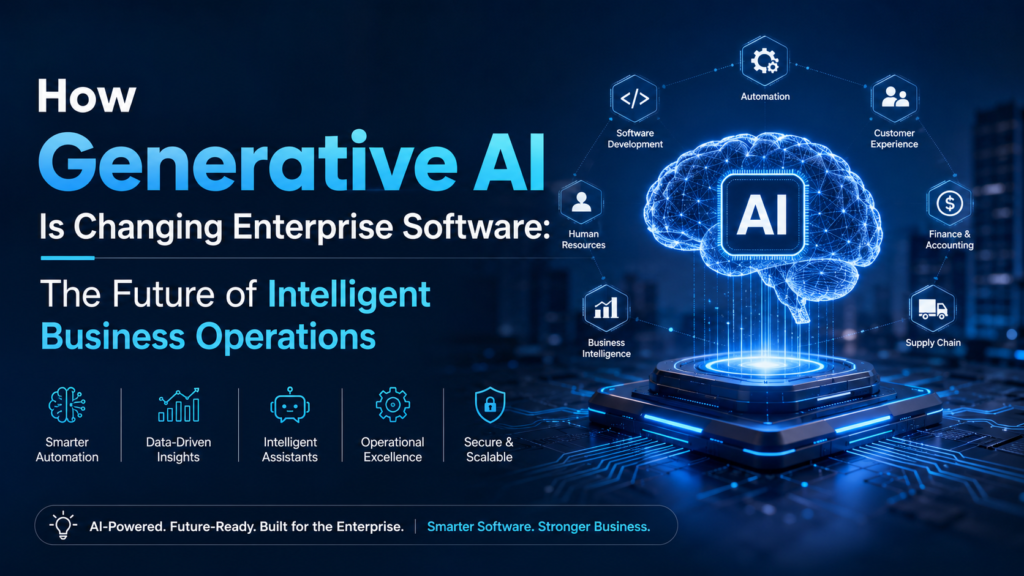
How Generative AI Is Changing Enterprise Software: The Future of Intelligent Business Operations
Artificial Intelligence has evolved from a futuristic concept into a core business technology. Among its many branches, Generative AI (GenAI) is transforming enterprise software at an unprecedented pace. Organizations are no longer using AI solely for automation—they are embedding intelligent systems into everyday business processes to improve productivity, reduce operational costs, and create better customer experiences.
Enterprise software, which traditionally focused on managing business operations such as finance, human resources, customer relationships, supply chains, and manufacturing, is entering a new era. With Generative AI, these systems are becoming smarter, more adaptive, and capable of assisting employees in real-time.
Industry analysts note that enterprise adoption is moving from experimentation to organization-wide deployment, with increasing emphasis on measurable ROI, governance, and AI-powered workflows.
What Is Generative AI?
Generative AI refers to artificial intelligence models capable of creating new content based on existing data. Unlike traditional AI, which mainly analyzes or classifies information, Generative AI can produce:
- Text
- Software code
- Images
- Reports
- Emails
- Business documentation
- Customer responses
- SQL queries
- Marketing content
- Product descriptions
Large Language Models (LLMs) such as GPT-based systems have made enterprise software significantly more intelligent by enabling natural conversations between humans and business systems.
Why Enterprise Software Needed AI
For decades, enterprise applications were designed around structured workflows.
Employees had to:
- Search through dashboards
- Learn complicated interfaces
- Generate reports manually
- Write SQL queries
- Interpret complex data
- Switch between multiple software systems
This often resulted in:
- Reduced productivity
- Higher operational costs
- Employee frustration
- Slow decision making
Generative AI removes these barriers by allowing employees to simply ask questions in natural language.
Instead of navigating ten screens, users can type:
“Show last quarter’s sales performance by region.”
Within seconds, AI generates:
- Interactive reports
- Charts
- Business insights
- Suggested actions
This dramatically changes how enterprise software is used.
Major Areas Where Generative AI Is Transforming Enterprise Software
1. Intelligent Customer Support
Customer service has become one of the biggest beneficiaries of Generative AI.
Modern enterprise platforms now include AI-powered assistants capable of:
- Answering customer questions instantly
- Understanding customer intent
- Summarizing conversations
- Creating support tickets
- Suggesting solutions
- Translating conversations into multiple languages
Instead of replacing support teams, AI enables agents to focus on complex customer issues while repetitive tasks are automated.
Benefits include:
- Faster response times
- Reduced support costs
- Higher customer satisfaction
- 24/7 availability
2. Software Development Acceleration
Developers are increasingly using AI-powered coding assistants.
Generative AI can:
- Generate code
- Detect bugs
- Explain existing code
- Write documentation
- Create unit tests
- Suggest performance improvements
Recent industry commentary highlights that AI is changing the economics of software engineering by automating routine development work while allowing engineers to focus on higher-value tasks.
3. Smarter Business Intelligence
Traditional Business Intelligence tools require analysts to create dashboards manually.
Generative AI allows executives to ask questions like:
- Why did revenue decline?
- Which customers are at risk?
- What products generated the highest profit?
- Predict next month’s sales.
The AI instantly analyzes millions of records and delivers easy-to-understand explanations instead of just charts.
This reduces dependency on technical analysts.
4. Human Resources Automation
HR departments spend significant time handling repetitive administrative work.
Generative AI now assists with:
- Resume screening
- Job description creation
- Interview scheduling
- Employee onboarding
- HR policy questions
- Performance summaries
Employees receive instant responses instead of waiting for HR representatives.
5. Finance and Accounting
Finance teams are adopting AI for:
- Invoice processing
- Expense management
- Financial forecasting
- Audit preparation
- Risk analysis
- Fraud detection
Rather than replacing accountants, AI accelerates financial workflows and improves accuracy.
6. Enterprise Knowledge Management
Large organizations often struggle with scattered documentation.
Generative AI can search across:
- PDFs
- Internal documentation
- Emails
- Contracts
- Knowledge bases
- Policies
Employees simply ask questions in natural language.
Instead of searching for hours, answers appear within seconds.
7. Supply Chain Optimization
Supply chains generate enormous amounts of operational data.
Generative AI helps organizations:
- Predict demand
- Identify supplier risks
- Recommend inventory levels
- Optimize logistics
- Analyze shipping delays
- Improve procurement
Modern AI systems combine historical data with real-time information to recommend proactive actions.
Benefits of Generative AI in Enterprise Software
Increased Productivity
Employees spend less time searching for information.
Faster Decision Making
Executives receive real-time business insights.
Lower Operational Costs
Automation reduces manual labor.
Better Customer Experience
Customers receive faster, more personalized support.
Improved Employee Experience
AI simplifies complex software systems.
Faster Innovation
Development teams build applications more quickly using AI-assisted coding.
Enhanced Data Analysis
Organizations uncover insights hidden within massive datasets.
Real-World Enterprise Use Cases
Organizations across industries are already using Generative AI.
Healthcare
- Medical documentation
- Patient support
- Insurance processing
Banking
- Fraud detection
- Customer service
- Financial recommendations
Manufacturing
- Predictive maintenance
- Inventory forecasting
- Production optimization
Retail
- Product recommendations
- Marketing content
- Customer engagement
Logistics
- Route optimization
- Shipment tracking
- Warehouse management
Education
- Personalized learning
- Administrative automation
- Student support
Challenges Businesses Must Address
Despite its advantages, Generative AI presents several challenges.
Data Privacy
Organizations must protect sensitive customer and business information.
AI Hallucinations
AI may occasionally produce incorrect or fabricated information.
Human review remains essential.
Compliance
Industries like healthcare, banking, and government require strict regulatory compliance.
Security Risks
Enterprise AI systems must prevent unauthorized access to confidential data.
Change Management
Employees need training to work effectively alongside AI systems.
Best Practices for Successful AI Adoption
Organizations should:
- Start with high-value business processes.
- Use trusted AI platforms.
- Keep humans involved in important decisions.
- Monitor AI performance regularly.
- Establish governance policies.
- Protect sensitive enterprise data.
- Train employees continuously.
- Measure business outcomes rather than AI usage alone.
The Future of Enterprise Software
Enterprise software is rapidly evolving into AI-native platforms.
Future systems are expected to include:
- AI agents capable of completing multi-step tasks
- Personalized enterprise assistants
- Autonomous workflow automation
- Predictive business planning
- Intelligent cybersecurity monitoring
- Self-improving business applications
Industry forecasts suggest that AI agents will become deeply integrated into enterprise applications over the next few years, making software more conversational, adaptive, and task-oriented.
Why Businesses Should Invest Now
Companies that adopt Generative AI today gain several competitive advantages:
- Faster operations
- Better customer experiences
- Lower operational costs
- Higher employee productivity
- Improved innovation
- Smarter decision-making
- Greater business agility
Businesses that delay AI adoption risk falling behind competitors who are already integrating intelligence into their core operations.
Conclusion
Generative AI is no longer an emerging technology—it is becoming the foundation of modern enterprise software. From customer service and finance to software development and supply chain management, AI is redefining how organizations operate.
Success, however, depends on more than adopting AI tools. Organizations need high-quality data, strong governance, employee training, and clear business objectives to realize lasting value. Companies that combine these elements with responsible AI practices will be well positioned to lead in the next generation of digital transformation.
About OURS GLOBAL
As businesses accelerate their digital transformation journeys, choosing the right technology partner is critical. OURS GLOBAL delivers end-to-end IT services, custom software development, AI-powered solutions, cloud services, business process outsourcing (BPO), digital transformation, and enterprise technology consulting to help organizations innovate and scale with confidence.
Learn more about how OURS GLOBAL can help your business harness the power of Generative AI and modern enterprise software at https://www.oursglobal.com/