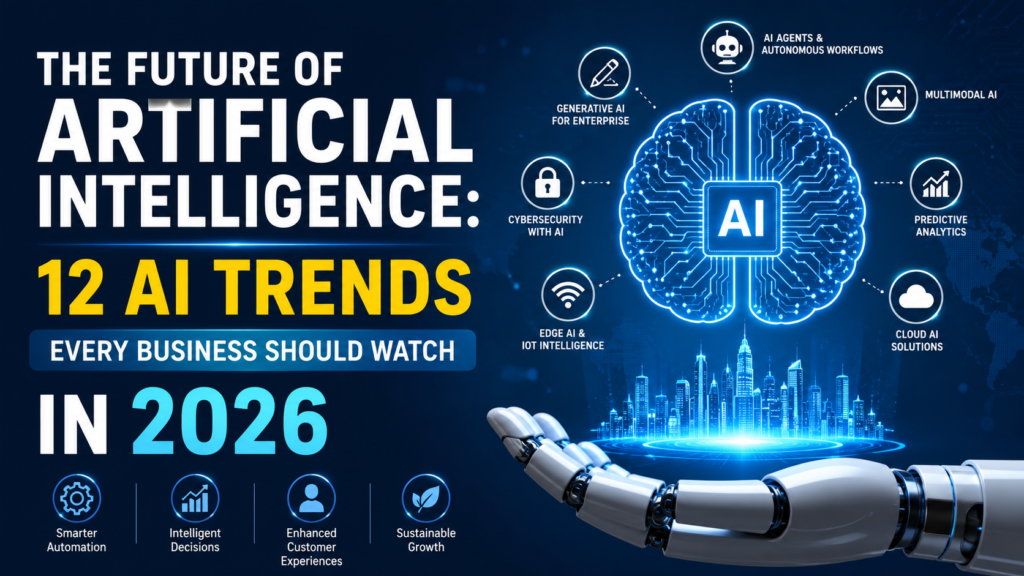
The Future of Artificial Intelligence: 12 AI Trends Every Business Should Watch in 2026
Artificial intelligence has evolved from a promising technology into a strategic business capability. Across industries, organizations are adopting AI to automate operations, improve decision-making, enhance customer experiences, and uncover new growth opportunities. In 2026, AI is no longer viewed as an experimental initiative. It is becoming a core part of business strategy, digital transformation, and long-term competitiveness.
Companies that embrace AI thoughtfully are seeing measurable improvements in productivity, operational efficiency, and innovation. At the same time, rapid technological advancements require business leaders to understand emerging trends, evaluate risks, and build responsible AI strategies that align with organizational goals.
This article explores twelve important AI trends expected to influence businesses throughout 2026 and provides practical guidance on how organizations can prepare for the future.
Why AI Matters More Than Ever in 2026
Organizations are generating more data than ever before. Customers expect personalized experiences, employees expect intelligent digital tools, and executives expect faster insights for better decision-making. Artificial intelligence helps bridge these expectations by analyzing large volumes of information, identifying patterns, and automating repetitive processes.
Beyond efficiency, AI enables businesses to develop new products, improve customer engagement, strengthen cybersecurity, and optimize supply chains. Organizations that invest in AI strategically are better positioned to respond to market changes and deliver long-term value.
1. Generative AI Becomes an Enterprise Standard
Generative AI is moving beyond chatbots and content creation. Businesses are integrating AI into software development, marketing, finance, legal operations, customer support, and knowledge management.
Enterprise AI platforms now assist employees by drafting documents, summarizing reports, writing code, generating presentations, and accelerating research. Rather than replacing human expertise, generative AI serves as an intelligent assistant that improves productivity.
Successful organizations are establishing governance policies to ensure AI-generated content remains accurate, secure, and aligned with business objectives.
2. AI Agents and Autonomous Workflows
AI agents represent one of the most significant developments in enterprise automation.
Unlike traditional automation tools that follow predefined rules, AI agents can analyze situations, make decisions, coordinate multiple tasks, and interact with different software systems.
Examples include:
- Automated customer support
- Intelligent project management
- Procurement automation
- HR onboarding
- Financial reporting
As these systems mature, businesses will automate increasingly complex workflows while allowing employees to focus on higher-value activities.
3. Multimodal AI Changes Human-Computer Interaction
Modern AI systems can understand text, images, audio, video, and structured data simultaneously.
This capability enables businesses to build applications that interpret documents, analyze product images, understand customer conversations, and generate meaningful responses from multiple information sources.
Industries such as healthcare, retail, education, manufacturing, and financial services are already exploring multimodal AI to improve operational efficiency and customer engagement.
4. Responsible AI and Governance
As AI adoption increases, organizations must establish clear governance frameworks.
Responsible AI focuses on:
- Transparency
- Fairness
- Privacy
- Security
- Human oversight
- Regulatory compliance
Businesses are creating internal AI policies to ensure that models produce reliable outputs while protecting sensitive information.
Responsible AI is becoming a competitive advantage because customers increasingly expect organizations to use artificial intelligence ethically.
5. Hyper-Personalization Across Industries
Modern consumers expect experiences tailored to their individual preferences.
AI enables businesses to personalize:
- Product recommendations
- Marketing campaigns
- Customer communications
- Learning experiences
- Healthcare treatments
- Financial services
Instead of broad customer segmentation, businesses are delivering personalized experiences at scale through real-time AI analysis.
6. AI-Powered Cybersecurity
Cyber threats continue to evolve, making AI an essential component of modern cybersecurity.
Artificial intelligence helps organizations:
- Detect unusual network activity
- Identify phishing attempts
- Monitor user behavior
- Analyze security logs
- Respond to incidents faster
Rather than replacing cybersecurity professionals, AI enables security teams to investigate threats more efficiently and reduce response times.
7. Edge AI Expands Intelligent Computing
Edge AI allows data processing closer to where information is generated instead of relying entirely on cloud infrastructure.
Benefits include:
- Faster response times
- Lower latency
- Improved privacy
- Reduced bandwidth costs
- Better reliability
Industries including manufacturing, logistics, transportation, and healthcare increasingly use Edge AI for real-time decision-making.
8. AI in Healthcare
Healthcare continues to experience significant AI innovation.
Applications include:
- Medical imaging analysis
- Clinical documentation
- Drug discovery
- Patient scheduling
- Predictive diagnostics
- Personalized treatment planning
Healthcare organizations are combining AI with clinical expertise to improve patient outcomes while reducing administrative workloads.
9. Predictive Analytics Becomes Smarter
Businesses are moving beyond historical reporting toward predictive intelligence.
AI analyzes historical and real-time data to forecast:
- Customer demand
- Equipment maintenance
- Financial performance
- Inventory requirements
- Employee retention
- Sales opportunities
These insights enable organizations to make proactive business decisions instead of reacting after problems occur.
10. AI and Cloud Computing Continue to Evolve Together
Cloud platforms provide the scalability required for enterprise AI.
Organizations increasingly deploy AI solutions using cloud infrastructure because it offers:
- Flexible computing resources
- Secure storage
- AI development tools
- Machine learning platforms
- Global accessibility
The combination of AI and cloud computing enables businesses of all sizes to adopt advanced technologies without maintaining expensive infrastructure.
11. High-Quality Data Annotation Drives Better AI Models
Artificial intelligence is only as effective as the data used to train it.
Accurate data annotation improves model performance by helping AI systems correctly identify objects, understand language, and recognize complex patterns.
Organizations developing AI applications should invest in structured, high-quality annotation processes to improve accuracy and reduce bias.
For businesses interested in scalable AI development, explore our guide on Data Annotation Architecture for Scalable AI Development available on the OursGlobal blog to understand how high-quality training data strengthens AI performance.
12. AI Transforms Customer Experience
Customer experience remains one of the strongest drivers of AI adoption.
Businesses use AI to:
- Deliver 24/7 customer support
- Provide intelligent recommendations
- Automate service requests
- Analyze customer sentiment
- Improve response times
Rather than replacing human interaction, AI enables support teams to resolve issues faster while delivering more personalized service.
How Businesses Can Prepare for the Future
Organizations looking to succeed with AI should focus on practical implementation rather than adopting every emerging technology.
Key priorities include:
- Develop an AI strategy aligned with business goals.
- Invest in data quality and governance.
- Train employees to work alongside AI systems.
- Strengthen cybersecurity practices.
- Implement responsible AI policies.
- Monitor AI performance continuously.
- Start with high-impact business use cases before expanding.
Companies that combine technology with skilled employees and strong governance are more likely to achieve sustainable AI success.
Frequently Asked Questions
Is AI replacing human jobs?
AI is primarily changing how work is performed by automating repetitive tasks and allowing employees to focus on strategic and creative responsibilities.
Which industries benefit the most from AI?
Healthcare, finance, retail, manufacturing, logistics, education, marketing, customer service, and technology are among the industries experiencing significant AI adoption.
Is AI suitable for small businesses?
Yes. Cloud-based AI platforms have made advanced capabilities accessible to organizations of all sizes without requiring substantial infrastructure investments.
Why is data quality important for AI?
High-quality data improves model accuracy, reduces bias, and enables AI systems to produce more reliable results.
What should businesses prioritize before implementing AI?
Organizations should establish clear objectives, ensure data readiness, develop governance policies, and identify business problems where AI can create measurable value.
Conclusion
Artificial intelligence is becoming a defining technology for modern business. From generative AI and autonomous agents to predictive analytics and intelligent cybersecurity, organizations have unprecedented opportunities to improve efficiency, strengthen customer relationships, and accelerate innovation.
Success will depend not only on adopting AI technologies but also on building responsible governance, investing in high-quality data, and empowering employees with the skills needed to work alongside intelligent systems.
Businesses that begin preparing today will be better positioned to adapt to future technological changes and remain competitive in an increasingly AI-driven world.
About OursGlobal
At OursGlobal, we help organizations accelerate digital transformation through advanced AI solutions, data annotation services, machine learning support, cloud technologies, and enterprise software development. Our mission is to deliver innovative, scalable, and reliable technology solutions that enable businesses to grow with confidence in the era of artificial intelligence.