
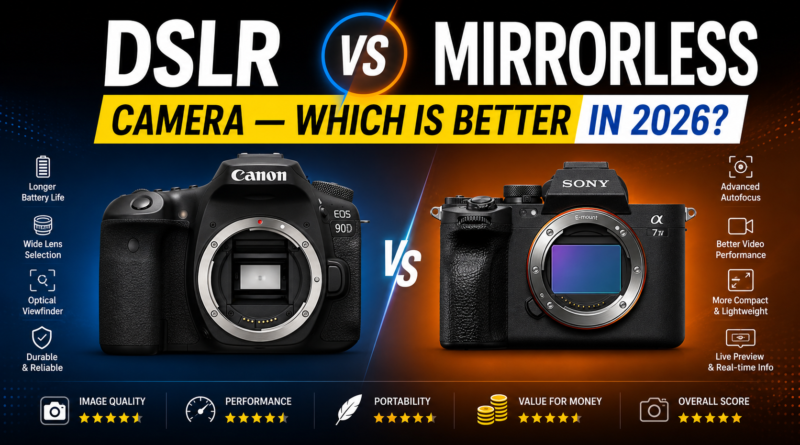
DSLR vs Mirrorless Camera — Which is Better in 2026?
Choosing between a DSLR and a mirrorless camera has become one of the biggest decisions for photographers, content creators, YouTubers, and beginners entering the photography world. Both camera systems are capable of producing stunning professional-quality images, but they work differently and offer unique advantages depending on your photography style, budget, and future goals.
In recent years, the photography industry has shifted heavily toward mirrorless technology, with major brands like Canon, Sony, Nikon, and Fujifilm focusing more on mirrorless camera development. According to industry reports, mirrorless cameras now dominate most of the interchangeable lens camera market.
However, DSLR cameras are still widely used by professional photographers, wedding studios, wildlife photographers, and photography enthusiasts around the world because of their durability, battery life, and extensive lens ecosystem.
So the real question is:
Should you buy a DSLR or a mirrorless camera in 2026?
This complete guide explains everything in detail — including technology, image quality, autofocus, video performance, battery life, lens availability, pricing, beginner recommendations, and which camera system is truly better for your needs.
What is a DSLR Camera?
DSLR stands for Digital Single-Lens Reflex camera.
A DSLR camera uses a mechanical mirror system inside the camera body. Light enters through the lens, reflects off a mirror, and travels into an optical viewfinder so you can see the scene directly through the lens. When you press the shutter button, the mirror flips upward, exposing the camera sensor to capture the image.
DSLR cameras evolved from traditional film SLR cameras and became the industry standard for professional photography for many years.
Popular DSLR camera series include:
- Canon EOS 5D Series
- Canon EOS Rebel Series
- Nikon D7500
- Nikon D850
- Pentax KF
What is a Mirrorless Camera?
Mirrorless cameras remove the mirror mechanism completely.
Instead of using an optical viewfinder, mirrorless cameras use an electronic viewfinder (EVF) or LCD screen to display a live digital preview from the sensor. Since there is no mirror box inside the camera body, mirrorless cameras are generally smaller, lighter, faster, and more technologically advanced.
Modern mirrorless cameras now dominate professional photography, filmmaking, YouTube content creation, travel photography, and hybrid shooting.
Popular mirrorless camera series include:
- Sony Alpha Series
- Canon EOS R Series
- Nikon Z Series
- Fujifilm X Series
- Panasonic Lumix Series
DSLR vs Mirrorless — Main Difference
The biggest difference is the mirror mechanism.
DSLR Workflow
Lens → Mirror → Optical Viewfinder → Sensor
Mirrorless Workflow
Lens → Sensor → Electronic Viewfinder/Screen
Because mirrorless cameras remove the mirror, they can shoot faster, focus better in video, and support advanced AI autofocus technologies.
DSLR vs Mirrorless Comparison Table
| Feature | DSLR Camera | Mirrorless Camera |
|---|---|---|
| Size & Weight | Larger & heavier | Smaller & lighter |
| Battery Life | Excellent | Moderate |
| Autofocus | Good | Advanced AI autofocus |
| Video Performance | Limited | Excellent |
| Shooting Speed | Moderate | Very fast |
| Viewfinder | Optical | Electronic |
| Lens Availability | Huge used market | Growing rapidly |
| Silent Shooting | Limited | Available |
| Beginner Friendly | Moderate | Easier live preview |
| Technology Future | Declining | Industry standard |
Image Quality — Is Mirrorless Better Than DSLR?
One of the biggest myths in photography is that mirrorless cameras automatically produce better image quality.
In reality, image quality depends more on:
- Sensor size
- Lens quality
- Lighting
- Photographer skill
- Image processing
A DSLR and a mirrorless camera with similar sensors can produce nearly identical image quality.
For example:
- A full-frame DSLR can deliver stunning professional results
- A full-frame mirrorless camera can deliver equally impressive results
The real advantage of mirrorless cameras comes from speed, autofocus, video features, and modern technology — not necessarily raw image quality alone.
Autofocus Performance
This is where mirrorless cameras dominate.
Modern mirrorless systems use advanced AI-powered autofocus systems capable of:
- Eye tracking
- Face detection
- Animal detection
- Subject tracking
- Real-time autofocus during video
Mirrorless cameras can focus across almost the entire frame, making them ideal for sports, wildlife, weddings, and video creation.
DSLR autofocus is still excellent for photography, especially professional DSLRs like the Nikon D850 or Canon 5D Mark IV, but mirrorless autofocus technology is now significantly ahead for most users.
Video Recording Performance
Mirrorless cameras are clearly better for video creators.
Most modern mirrorless cameras offer:
- 4K video
- 6K or 8K recording
- Slow motion
- Advanced stabilization
- Better autofocus during video
- Log profiles
- Lightweight rigs for filmmaking
DSLR cameras often struggle with video autofocus and modern video workflows.
If you are:
- a YouTuber
- content creator
- filmmaker
- social media creator
- vlogger
then mirrorless is usually the better investment.
Battery Life Comparison
This is one area where DSLR cameras still win.
Because DSLR cameras use optical viewfinders instead of electronic displays, they consume less battery power.
Advantages of DSLR battery life:
- Longer shooting sessions
- Better for weddings and events
- Fewer battery changes
- Reliable for travel photography
Mirrorless cameras use constant sensor and EVF power, which drains batteries faster.
Professional photographers often carry multiple batteries when using mirrorless systems.
Size and Weight
Mirrorless cameras are much smaller and lighter because they do not require a mirror mechanism.
Benefits include:
- Easier travel
- Lightweight camera bags
- Better portability
- Comfortable street photography
- Smaller video rigs
This is one reason why travel photographers and creators prefer mirrorless systems today.
Optical Viewfinder vs Electronic Viewfinder
DSLR Optical Viewfinder
Advantages:
- Natural real-world view
- No screen lag
- Better visibility in bright sunlight
- Comfortable for long photography sessions
Mirrorless Electronic Viewfinder
Advantages:
- Live exposure preview
- Real-time white balance preview
- Focus peaking
- Histogram display
- Easier learning for beginners
Many beginners find mirrorless cameras easier because they can see exposure changes live before taking the photo.
Lens Availability
DSLR cameras have been around longer, so they have huge lens ecosystems.
Advantages:
- Affordable used lenses
- Third-party lens support
- Large second-hand market
- Professional DSLR lenses available cheaply
Mirrorless lens ecosystems are rapidly growing, especially from:
- Sony
- Canon RF
- Nikon Z
- Fujifilm X
Today, mirrorless lens options are no longer a major limitation for most photographers.
DSLR vs Mirrorless for Beginners
For beginners in 2026, mirrorless cameras are generally the better choice.
Reasons include:
- Easier autofocus
- Better learning experience
- Live exposure preview
- Better video features
- Future-proof technology
- Compact size
However, DSLR cameras remain excellent budget options for beginners who mainly want photography and long battery life.
DSLR vs Mirrorless for Professional Photography
Best for Weddings
Mirrorless
Best for YouTube & Video
Mirrorless
Best for Wildlife
Mirrorless
Best for Sports
Mirrorless
Best for Studio Photography
Both
Best for Battery Life
DSLR
Best Budget Option
DSLR
Best Future Investment
Mirrorless
Why the Industry is Moving Toward Mirrorless
Most camera manufacturers now prioritize mirrorless development.
Canon, Sony, Nikon, Panasonic, and Fujifilm are investing heavily in:
- AI autofocus
- advanced video
- compact systems
- high-speed shooting
- computational photography
Industry reports show mirrorless cameras now represent around 90% of the interchangeable-lens camera market.
Very few new DSLR models are being launched today.
Are DSLR Cameras Dead?
No.
DSLR cameras are not dead.
Millions of photographers still use DSLR systems professionally because they remain:
- reliable
- durable
- affordable
- capable of amazing image quality
However, mirrorless technology is clearly the future of camera development.
Best DSLR Cameras in 2026
Popular DSLR choices:
- Nikon D7500
- Canon EOS 90D
- Nikon D850
- Canon EOS 5D Mark IV
These cameras are still excellent for photography.
Best Mirrorless Cameras in 2026
Popular mirrorless choices:
- Sony A7 Series
- Canon EOS R6 Mark II
- Nikon Z6 Series
- Fujifilm X-T Series
- Sony A6700
These models offer advanced autofocus, video performance, and compact designs.
Which Camera Should You Buy?
Choose DSLR if:
- you want maximum battery life
- you prefer optical viewfinders
- you want affordable used lenses
- your budget is limited
- you mainly shoot photography
Choose Mirrorless if:
- you shoot video
- you want advanced autofocus
- you travel frequently
- you create YouTube or social content
- you want future-proof technology
- you want compact equipment
Final Verdict — DSLR vs Mirrorless
Mirrorless cameras are the future of photography and video production. They are faster, smarter, lighter, and better suited for modern content creation.
However, DSLR cameras still offer incredible value, excellent image quality, outstanding battery life, and access to affordable lenses.
For most beginners and creators in 2026, mirrorless is the better long-term investment.
But if budget matters and your focus is mainly photography, a DSLR can still be an excellent choice.
No matter which camera you choose, editing and post-production play a major role in achieving professional-quality results.
Professional photographers and ecommerce brands often use expert retouching and image enhancement services to improve their final images. If you need professional editing support, explore our professional photo editing solutions here:
https://www.oursglobal.com/outsource-photo-editing-services
High-quality editing can dramatically improve portraits, ecommerce product photos, wedding images, and commercial photography results.
Frequently Asked Questions (FAQ)
Is mirrorless better than DSLR?
For most modern users, yes. Mirrorless cameras offer better autofocus, video features, portability, and future support.
Do professionals still use DSLR cameras?
Yes. Many professionals still use DSLR cameras for weddings, wildlife, sports, and studio work.
Is DSLR cheaper than mirrorless?
Generally yes, especially in the used market.
Which is better for beginners?
Mirrorless is usually easier for beginners due to live preview and smarter autofocus.
Which camera is better for YouTube?
Mirrorless cameras are better because of superior video autofocus and compact size.
Can mirrorless cameras replace DSLRs completely?
The industry is moving heavily toward mirrorless, but DSLRs will still remain useful for years