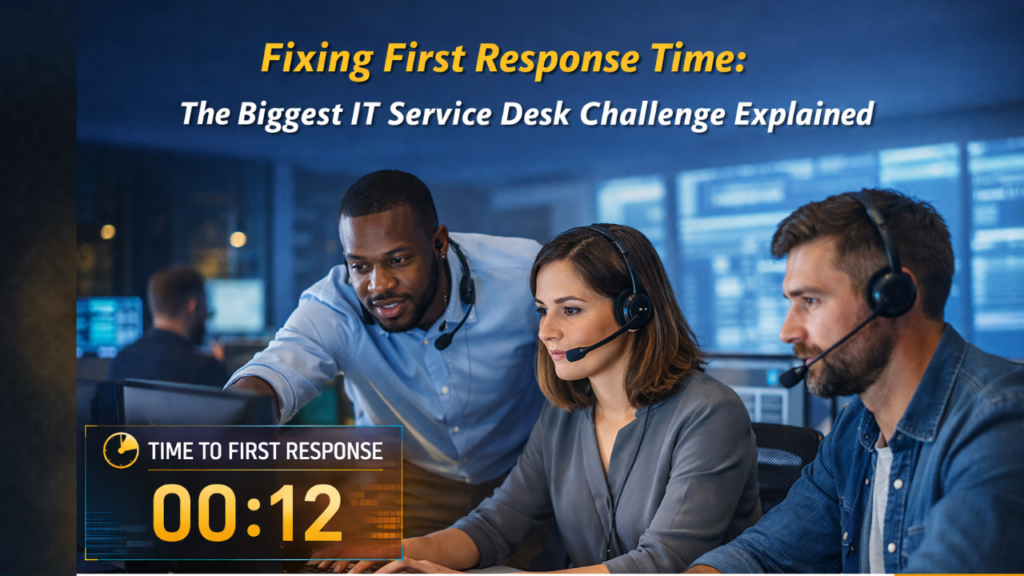
Fixing First Response Time: The Biggest IT Service Desk Challenge Explained
In a digital-first workplace, speed is everything. Employees rely on IT systems to perform even the most basic tasks, and when something breaks, they expect immediate support. But for many organizations, the IT service desk struggles to keep up-especially when it comes to First Response Time (FRT).
A slow first response doesn’t just delay issue resolution-it creates frustration, reduces productivity, and damages trust in IT. In fact, many users judge the quality of IT support not by how quickly their issue is resolved, but by how quickly someone acknowledges it.
So why is First Response Time such a persistent challenge-and more importantly, how can you fix it?
What Is First Response Time (FRT)?
First Response Time (FRT) is the time taken by the IT service desk to respond to a user’s request after a ticket is created. This response could be:
- A human acknowledgment
- An automated reply with next steps
- A request for additional information
It’s important to note that FRT is not the same as resolution time. Instead, it’s about how quickly users feel heard and supported.
Why First Response Time Is a Critical KPI
- First Impressions Matter
The first response sets the tone for the entire support experience. A quick reply reassures users that their issue is being handled.
- Direct Impact on Productivity
When employees are stuck waiting for IT, work comes to a halt. Faster responses mean quicker action and less downtime.
- Stronger SLA Performance
Most Service Level Agreements (SLAs) include strict FRT targets. Missing these can lead to penalties and dissatisfaction.
- Improved User Satisfaction (CSAT)
Studies consistently show that faster response times lead to higher satisfaction scores-even if resolution takes longer.
What Is a Good First Response Time?
The ideal FRT varies depending on the organization, but general benchmarks include:
- Critical issues: 5–15 minutes
- High priority: 15–30 minutes
- Medium priority: 1–2 hours
- Low priority: 4–8 hours
Modern organizations aiming for best-in-class IT support often target under 15 minutes for most tickets.
Top Challenges Affecting First Response Time
- Ticket Overload
As organizations grow, ticket volumes increase. Without scalable systems, service desks quickly become overwhelmed.
- Manual Processes
Manual ticket logging, categorization, and assignment slow down response times significantly.
- Lack of Skilled Resources
An understaffed or undertrained team struggles to keep up with incoming requests.
- Poor Ticket Prioritization
Without clear priority rules, critical issues may get stuck behind less urgent requests.
- Limited Support Availability
Organizations without 24/7 coverage often experience delays, especially across global teams.
- Inefficient Tools and Systems
Outdated ITSM tools can create bottlenecks instead of improving efficiency.
- Knowledge Gaps
When agents lack access to proper documentation or knowledge bases, response time increases.
How Poor First Response Time Impacts Your Business
Ignoring FRT issues can have serious consequences:
- Decreased employee productivity
- Higher operational costs
- Increased IT team stress and burnout
- Lower employee satisfaction and morale
- Negative perception of IT as a bottleneck rather than an enabler
In competitive industries, even small inefficiencies can lead to significant losses.
Proven Strategies to Improve First Response Time
-
-
Automate Ticket Management
-
Use ITSM tools to automatically log, categorize, and assign tickets. This eliminates delays caused by manual handling.
-
Implement AI and Chatbots
AI-powered chatbots can provide instant responses, resolve common issues, and escalate complex cases-reducing FRT dramatically.
-
Create a Self-Service Ecosystem
A well-maintained knowledge base allows users to resolve simple issues on their own, reducing ticket volume.
-
Define Clear SLAs and Priorities
Establish response time targets based on ticket severity and ensure teams follow them consistently.
-
Optimize Workforce Management
Ensure adequate staffing during peak hours and consider shift-based models for better coverage.
-
Enable Omnichannel Support
Allow users to reach IT through multiple channels-email, chat, phone, and portals-for faster engagement.
-
Train Your IT Team Continuously
Regular training ensures agents can respond quickly and accurately to a wide range of issues.
-
Monitor Performance Metrics
Track FRT, ticket volume, backlog, and agent performance to identify and fix bottlenecks.
The Role of 24/7 IT Support in Reducing FRT
One of the most effective ways to improve First Response Time is to ensure round-the-clock support availability.
Global businesses operate across multiple time zones, and issues don’t wait for business hours. A 24/7 service desk ensures:
- Immediate response to all tickets
- Reduced backlog
- Improved SLA compliance
- Better user experience worldwide
How Outsourcing Helps Solve First Response Time Challenges
For many organizations, improving FRT internally can be expensive and complex. Outsourcing IT service desk operations offers a practical solution.
Key Benefits of Outsourcing:
- 24/7 support without increasing internal headcount
- Access to skilled IT professionals
- Advanced tools and automation capabilities
- Scalability to handle fluctuating ticket volumes
- Improved SLA performance and faster response times
Outsourcing allows your internal IT team to focus on strategic initiatives while experts handle day-to-day support.
Real Business Outcomes of Optimized First Response Time
Organizations that successfully improve FRT often experience:
- Up to 40% reduction in ticket backlog
- Significant improvement in employee satisfaction scores
- Faster issue resolution cycles
- Reduced IT operational costs
- Stronger alignment between IT and business goals
Transform Your IT Service Desk with Ours Global
If your IT service desk is struggling with slow response times, high ticket volumes, or limited support coverage, it’s time to take a smarter approach.
At Ours Global, we provide end-to-end outsourced IT service desk solutions designed to deliver:
- Rapid First Response Times
- 24/7 global support coverage
- Skilled and certified IT professionals
- Advanced automation and ITSM tools
- Scalable support tailored to your business needs
Our goal is simple: help you deliver faster, more efficient, and user-friendly IT support.
👉 Explore how we can improve your IT service desk performance:
https://www.oursglobal.com/outsource-it-service-desk
Final Thoughts
First Response Time is more than just a metric-it’s a reflection of how responsive and reliable your IT organization is. In a world where speed defines success, improving FRT is no longer optional.
By combining the right strategies, tools, and support model, organizations can transform their IT service desk into a high-performing, user-centric function that drives productivity and business success.