Human-in-the-Loop AI: Why Data Annotation Is the Biggest AI Trend Driving Smarter Models in 2026
Artificial Intelligence is transforming almost every industry, from healthcare and finance to retail, manufacturing, and autonomous transportation. Businesses are investing billions of dollars in AI-powered solutions, expecting faster automation, better customer experiences, and smarter decision-making. However, despite rapid advances in AI models, one critical factor continues to determine whether an AI project succeeds or fails—high-quality data annotation.
The AI industry is experiencing a major shift. Instead of focusing only on building larger and more powerful models, organizations are now concentrating on creating cleaner, more accurate, and context-rich training datasets. Human experts are becoming increasingly important in reviewing, validating, and improving AI-generated labels through Human-in-the-Loop (HITL) workflows. This growing emphasis on data quality reflects a broader industry trend toward stronger AI evaluation, better governance, and greater human oversight.
For businesses developing machine learning models, this change represents an important lesson: better data creates better AI.
This comprehensive guide explains why data annotation has become the foundation of modern AI, explores the biggest industry trends, highlights emerging opportunities, and shows why outsourcing professional annotation services has become a strategic advantage.
What Is Data Annotation?
Data annotation is the process of adding meaningful labels to raw data so that artificial intelligence systems can understand patterns and make accurate predictions.
Raw data alone has very little value for machine learning. Whether it’s an image, video, text document, audio recording, or 3D sensor data, AI requires labeled examples before it can recognize objects, understand language, detect emotions, or identify patterns.
For example:
- A self-driving car learns to recognize pedestrians through thousands of labeled road images.
- A medical AI identifies tumors using accurately annotated medical scans.
- A chatbot understands customer requests through labeled text conversations.
- A voice assistant recognizes speech using carefully transcribed audio.
Without accurate annotation, even the most advanced AI model struggles to deliver reliable results.
Why Data Annotation Has Become More Important Than Ever
Several years ago, businesses believed that collecting massive amounts of data was enough to build successful AI systems.
Today, that thinking has changed.
Modern AI models already have access to enormous datasets. The real challenge is ensuring those datasets are accurate, consistent, unbiased, and representative of real-world situations.
Industry experts increasingly describe AI development as becoming data-centric, where improving data quality often produces greater performance gains than simply increasing model size.
This shift has made professional data annotation one of the most valuable investments in AI development.
The Rise of Human-in-the-Loop AI
One of the biggest trends shaping AI today is Human-in-the-Loop (HITL) annotation.
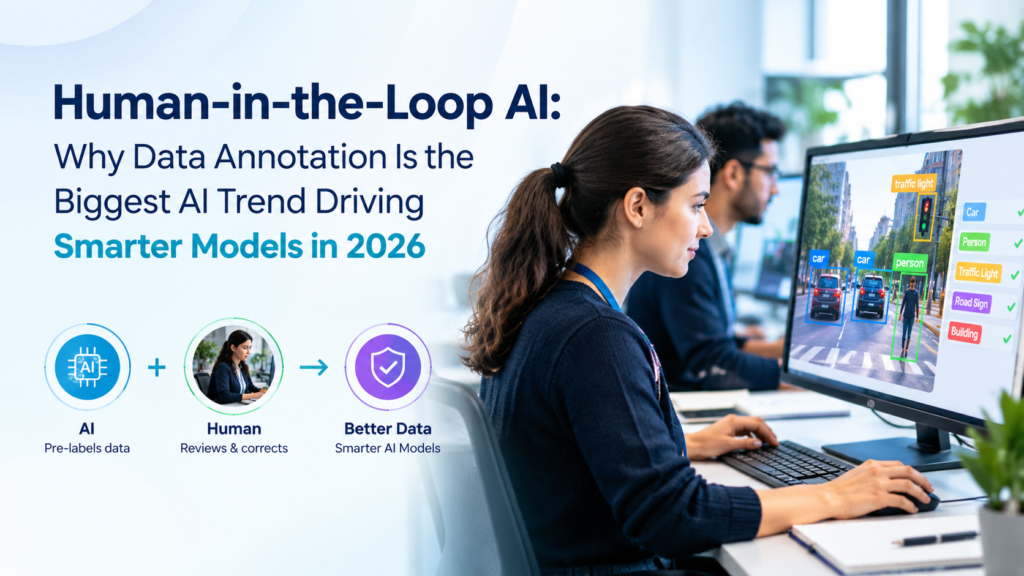
Instead of relying entirely on automation, Human-in-the-Loop combines AI efficiency with human expertise.
The workflow typically follows three stages:
- AI performs initial pre-labeling.
- Human experts review the labels.
- Quality specialists validate the final dataset.
This process delivers both speed and accuracy.
AI handles repetitive work, while experienced annotators solve difficult cases that machines often misunderstand.
Recent industry initiatives focused on AI evaluation and safety have reinforced the importance of keeping humans involved throughout AI development rather than depending solely on automated systems.
Why Human Validation Makes AI Better
AI can recognize common patterns remarkably well.
However, real-world environments contain countless exceptions.
Consider these situations:
- A partially hidden pedestrian.
- A damaged traffic sign.
- A handwritten prescription.
- Background noise during speech recognition.
- A customer using sarcasm in a review.
These situations require human judgment.
Professional annotators provide:
- Context awareness
- Edge-case identification
- Consistency
- Error correction
- Bias reduction
This human expertise significantly improves model reliability.
The Evolution of Data Annotation in 2026
The annotation industry is evolving much faster than many businesses realize.
Several important trends are shaping the future.
1. AI-Assisted Pre-Labeling
Modern annotation platforms increasingly use AI to create first-pass labels.
Instead of drawing every bounding box manually, AI suggests annotations that humans verify and refine.
Benefits include:
- Faster production
- Reduced manual effort
- Better consistency
- Continuous model improvement
The role of annotators is shifting from creating labels from scratch to validating, correcting, and improving AI-generated results.
2. Multimodal Annotation Is Becoming Standard
Earlier AI projects often focused on a single data type.
Today’s AI systems combine multiple inputs simultaneously.
Examples include:
- Images
- Videos
- Audio
- Text
- LiDAR
- Sensor data
For example, an autonomous vehicle may combine:
- Camera footage
- Driver voice commands
- Road sensors
- GPS information
Each data source must remain synchronized during annotation.
This has dramatically increased the complexity of annotation projects.
3. Domain Expertise Is Becoming Essential
General annotation is no longer enough for specialized industries.
Many projects now require experts with industry knowledge.
Examples include:
Healthcare
Medical image annotation often requires understanding complex anatomical structures.
Finance
Fraud detection datasets require financial expertise.
Legal AI
Legal document annotation demands careful interpretation of contracts and regulations.
Manufacturing
Industrial inspection datasets require knowledge of production defects.
Businesses increasingly prefer annotation partners capable of handling industry-specific requirements rather than generic labeling alone.
4. Quality Assurance Is No Longer Optional
In earlier annotation projects, quality checks often happened only after labeling was complete.
Modern workflows integrate quality assurance throughout the process.
Common QA practices include:
- Double review
- Gold standard datasets
- Expert arbitration
- Consistency audits
- Inter-annotator agreement measurement
These methods help maintain high-quality training data across large projects.
Types of Data Annotation
Different AI applications require different annotation techniques.
Image Annotation
Image annotation remains one of the largest segments of AI training.
Common techniques include:
Bounding Box Annotation
Objects are enclosed inside rectangular boxes.
Applications:
- Object detection
- Retail inventory
- Autonomous vehicles
Polygon Annotation
Complex objects receive detailed outlines.
Applications:
- Medical imaging
- Agriculture
- Construction
Semantic Segmentation
Every pixel receives a category label.
Applications:
- Self-driving cars
- Satellite imagery
- Robotics
Instance Segmentation
Each individual object receives its own mask.
Applications:
- Manufacturing
- Crowd analysis
- Quality inspection
Keypoint Annotation
Specific body or object points are labeled.
Applications:
- Human pose estimation
- Sports analytics
- Healthcare
Video Annotation
Video annotation helps AI understand movement across time.
Common tasks include:
- Object tracking
- Action recognition
- Lane detection
- Traffic monitoring
- Security surveillance
Video projects require frame-by-frame consistency, making experienced annotation teams especially valuable.
Text Annotation
Natural Language Processing depends heavily on text labeling.
Common methods include:
- Sentiment analysis
- Named entity recognition
- Intent classification
- Topic categorization
- Question-answer labeling
These annotations power:
- Chatbots
- Search engines
- Virtual assistants
- Customer support automation
Audio Annotation
Audio annotation improves speech-based AI.
Tasks include:
- Speech transcription
- Speaker identification
- Emotion recognition
- Background sound labeling
- Language identification
Voice assistants and call center analytics rely heavily on accurate audio datasets.
3D and LiDAR Annotation
Advanced AI systems increasingly use 3D sensor data.
Applications include:
- Autonomous vehicles
- Robotics
- Smart cities
- Warehouse automation
LiDAR annotation requires specialized expertise because every point cloud represents real-world spatial information.
Industries Driving Data Annotation Demand
The demand for professional annotation services continues growing across nearly every industry.
Healthcare
Healthcare AI depends on highly accurate datasets.
Annotation supports:
- X-rays
- MRI scans
- CT scans
- Pathology slides
- Ultrasound imaging
Small labeling mistakes can significantly affect diagnostic performance.
Automotive
Self-driving technology depends on millions of annotated road scenes.
Required annotations include:
- Vehicles
- Pedestrians
- Traffic lights
- Lane markings
- Road signs
Human reviewers remain essential for difficult driving scenarios.
Retail and E-commerce
Retail businesses use annotation for:
- Product recognition
- Visual search
- Inventory management
- Customer behavior analysis
- Recommendation systems
High-quality labels improve shopping experiences while reducing operational costs.
Financial Services
Banks increasingly use AI for:
- Fraud detection
- Document verification
- Risk assessment
- Customer onboarding
Accurate text annotation improves these systems considerably.
Manufacturing
Factories rely on computer vision for:
- Defect detection
- Assembly verification
- Safety monitoring
- Quality inspection
Well-labeled datasets reduce false detections and improve automation accuracy.
Agriculture
Agricultural AI uses annotation for:
- Crop monitoring
- Weed detection
- Disease identification
- Yield prediction
- Drone imagery analysis
These systems help farmers make faster and more informed decisions.
Common Challenges in Data Annotation
Many businesses underestimate the complexity of annotation projects.
Common challenges include:
Maintaining Consistency
Different annotators may interpret guidelines differently.
Clear instructions and quality checks help solve this problem.
Handling Large Volumes
AI projects often require millions of labeled examples.
Scaling internal teams becomes expensive and time-consuming.
Managing Edge Cases
Rare situations require experienced reviewers.
Examples include:
- Poor lighting
- Motion blur
- Occlusions
- Unusual objects
These cases often determine real-world AI performance.
Tight Deadlines
Businesses need rapid delivery without sacrificing quality.
Professional annotation teams provide flexible scaling to meet changing demands.
Why Outsourcing Data Annotation Makes Business Sense
Many organizations eventually discover that building an internal annotation team creates unnecessary operational complexity.
Outsourcing offers several advantages.
Faster Project Delivery
Dedicated annotation teams accelerate production.
Projects scale quickly without lengthy hiring processes.
Lower Operational Costs
Businesses reduce expenses related to:
- Recruitment
- Training
- Infrastructure
- Management
Access to Experienced Professionals
Professional annotators understand:
- Quality standards
- Annotation guidelines
- Edge-case handling
- Industry best practices
Flexible Scaling
Annotation needs constantly change.
Outsourcing allows businesses to increase or decrease capacity as projects evolve.
Better Quality Assurance
Professional providers typically include multiple review stages, improving overall dataset reliability.
How to Choose the Right Data Annotation Partner
Selecting the right partner can significantly affect AI performance.
Look for providers offering:
- Human-in-the-Loop workflows
- Multi-level quality assurance
- Image annotation expertise
- Video annotation capabilities
- Text annotation services
- Audio labeling support
- Secure data handling
- Scalable teams
- Flexible project management
- Customized annotation guidelines
A strong annotation partner becomes an extension of your AI development team rather than simply a vendor.
The Future of Data Annotation
The future of AI will not depend only on larger models.
Instead, success will increasingly depend on:
- Better datasets
- Human oversight
- Smarter quality control
- Domain expertise
- Ethical annotation practices
- Scalable workflows
Industry developments show that organizations are investing more heavily in evaluation systems, human validation, and trustworthy AI pipelines. This makes high-quality data annotation one of the most valuable long-term investments for businesses building AI products.
As AI becomes part of everyday business operations, the companies with the highest-quality training data will gain the strongest competitive advantage.
Why Choose OURS Global for Data Annotation & Labeling Services
At OURS Global, we help businesses transform raw data into accurate, AI-ready training datasets that power high-performing machine learning and artificial intelligence solutions.
Our experienced annotation professionals combine advanced tools with careful human review to deliver consistent, scalable, and high-quality labeling across every project.
Our Data Annotation Services Include:
- Image Annotation
- Video Annotation
- Text Annotation
- Audio Transcription & Labeling
- Bounding Box Annotation
- Polygon Annotation
- Semantic Segmentation
- Instance Segmentation
- Keypoint Annotation
- LiDAR & 3D Annotation
- AI-Assisted Human Validation
- Custom Data Labeling Solutions
Why Businesses Choose OURS Global
- Experienced annotation specialists
- Human-in-the-Loop quality assurance
- Scalable teams for projects of any size
- Fast turnaround times
- Secure and confidential workflows
- Industry-specific annotation expertise
- Consistent quality across large datasets
Whether you’re building a computer vision application, training a natural language processing model, improving speech recognition, or preparing multimodal AI datasets, OURS Global provides reliable Data Annotation & Labeling Services designed to help your AI achieve greater accuracy, better performance, and real-world success.