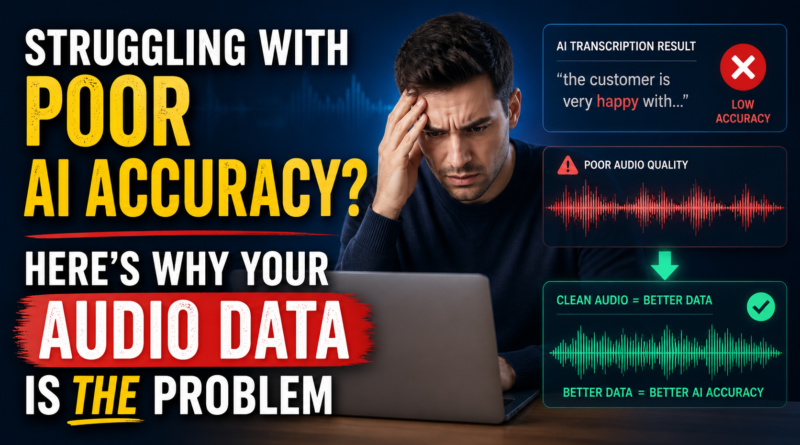
Struggling with Poor AI Accuracy? Here’s Why Your Audio Data Is the Problem
Introduction
Artificial Intelligence is only as powerful as the data it learns from. Yet despite investing heavily in AI systems—especially those built for speech recognition, voice assistants, and call analytics—many companies face the same frustrating reality: poor accuracy and inconsistent performance.
If your AI model is underperforming, producing unreliable results, or making critical mistakes in production, you might be looking in the wrong place for solutions.
The truth? The problem often isn’t your algorithm or your development team. More often than not, the real culprit lies in your audio data quality.
This comprehensive guide explores why audio data matters so much, common pitfalls companies face, and how outsourcing audio annotation can transform your AI performance.
Understanding the Root Cause: Why AI Models Fail
The Common Misconception
Most businesses assume improving AI performance requires:
- Upgrading to newer models (GPT variants, transformer architectures)
- Investing in advanced ML frameworks (TensorFlow, PyTorch)
- Hiring experienced developers (ML engineers, data scientists)
While these steps matter, they won’t fix a fundamental problem: garbage in, garbage out.
Even the most sophisticated AI systems fail catastrophically when trained on poorly annotated, low-quality, or inconsistent audio data.
The Real Issue: Low-Quality Audio Data
Most organizations struggle with one or more of these common audio data problems:
-
Background Noise & Recording Quality Issues
- Inconsistent audio levels across different recordings
- Heavy background noise (traffic, machinery, interference)
- Low-fidelity or compressed audio formats
- Unclear or muffled speech
-
Incorrect or Inconsistent Labeling
- Transcription errors and typos
- Inconsistent annotation standards across teams
- Missing metadata or context
- Conflicting labels for similar audio segments
-
Lack of Linguistic Diversity
- Limited accents and dialects represented
- Insufficient multilingual samples
- Regional language variations not captured
- Underrepresentation of minority languages
-
Insufficient Context in Conversations
- Missing speaker identification
- No background on conversation participants
- Lack of industry-specific terminology
- Missing emotional tone or sentiment annotations
-
Poor Transcription Quality
- Inaccurate speech-to-text conversions
- Untrained annotators without domain expertise
- No quality assurance or review process
- Inconsistent formatting and punctuation
The Direct Impact on Model Performance
These issues directly affect how your AI system learns, leading to:
- Misinterpreted voice commands → Frustrated users
- Incorrect analytics insights → Wrong business decisions
- Poor customer experience → Lost revenue
- Failed AI deployments → Wasted investments
The Critical Role of Audio Annotation in AI Success
Audio annotation—sometimes called audio labeling—is the process of systematically tagging and labeling sound data so AI models can understand and interpret it correctly.
What Does Quality Audio Annotation Include?
Speech-to-Text Transcription
- Accurate conversion of spoken words to written text
- Proper handling of accents, regional dialects, and slang
- Correct punctuation and capitalization
Speaker Identification
- Recognizing and tagging different speakers in conversations
- Tracking speaker turns and interactions
- Identifying speaker demographics when relevant
Emotion & Sentiment Detection
- Labeling emotional tone (happy, angry, frustrated, neutral)
- Sentiment classification (positive, negative, mixed)
- Stress and urgency indicators
Sound & Acoustic Classification
- Identifying background sounds (music, traffic, silence)
- Categorizing audio types (phone call, podcast, interview)
- Detecting audio anomalies or quality issues
Specialized Annotations
- Industry-specific terminology (medical, legal, technical)
- Named entity recognition (names, places, organizations)
- Intent classification (for conversational AI)
Why Precision Matters
Without meticulous annotation, your AI system is essentially learning from confusing, contradictory, or misleading information. The consequences ripple across your entire operation:
- AI voice assistants misunderstand natural language queries
- Speech recognition systems produce garbled transcripts
- Sentiment analysis tools misinterpret customer feedback
- Call analytics platforms generate unreliable insights
The bottom line: High-quality annotation is the foundation of accurate, reliable AI systems.
Why In-House Audio Annotation Fails (And Why It Costs More Than You Think)
Common In-House Challenges
Many organizations attempt to handle audio annotation internally—hoping to reduce costs and maintain control. However, most quickly discover significant obstacles:
-
Scalability Constraints
- Handling thousands of hours of audio data requires substantial team expansion
- Infrastructure costs for storage, processing, and quality management
- Difficulty ramping up or down annotation capacity
- Bottlenecks during peak project periods
-
Prohibitive Costs
- Hiring and onboarding annotators is expensive and time-consuming
- Training costs (domain expertise, tool proficiency, quality standards)
- Management overhead (supervision, quality checks, revisions)
- Benefits, equipment, and workspace expenses
- Hidden cost: Turnover and knowledge loss
-
Inconsistent Quality
- Without standardized processes, annotation quality varies dramatically
- Different annotators interpret guidelines differently
- No consistent quality assurance framework
- Variable performance across team members
- Result: Model performance suffers unpredictably
-
Expertise Gaps
- Audio annotation requires specialized domain knowledge
- Multilingual annotation needs native speakers
- Industry-specific terminology requires subject matter expertise
- Limited access to specialized tools and technologies
- Difficulty keeping up with evolving annotation standards
The Hidden Cost of In-House Annotation
When you account for salaries, training, infrastructure, quality control, and opportunity cost, in-house annotation typically costs 2-3x more than professional outsourcing—with worse quality results.
The Strategic Solution: Professional Audio Annotation Services
Why Leading Companies Are Outsourcing
Forward-thinking organizations are increasingly partnering with specialized audio annotation service providers to overcome these challenges.
Key Benefits of Outsourcing Audio Annotation
-
Rapid Scalability
- Scale from hundreds to millions of audio samples instantly
- No need to hire, train, or manage large annotation teams
- Flexible capacity that adjusts to your project needs
- Fast turnaround times without quality compromise
-
Guaranteed Quality & Consistency
- Standardized annotation processes and guidelines
- Professional annotators with domain expertise
- Rigorous quality assurance and multi-level review
- Consistent output that meets enterprise standards
-
Access to Specialized Expertise
- Multilingual annotators (native speakers for 100+ languages)
- Domain experts (healthcare, finance, legal, automotive, etc.)
- Advanced annotation tools and technology platforms
- Industry best practices and methodologies
-
Significant Cost Reduction
- 40-60% lower costs compared to in-house teams
- Predictable, transparent pricing models
- No infrastructure or overhead expenses
- Faster project completion = reduced time-to-market
-
Focus on Core Business
- Free your team from tedious annotation work
- Allow engineers to focus on model development
- Product managers can prioritize feature development
- Faster AI development cycles overall
Finding the Right Annotation Partner
When selecting a professional audio annotation service, look for:
- Proven experience with your industry and use case
- Certified annotators with relevant expertise
- Transparent quality metrics and SLAs
- Data security and compliance certifications (ISO 27001, GDPR, etc.)
- Flexible engagement models (project-based, dedicated team, hybrid)
For high-quality audio annotation services, professional providers like Outsource Global offer specialized teams experienced in speech recognition, voice analytics, and multilingual projects.
What Better Audio Data Transforms AI Accuracy
Measurable Impact on AI Performance
When your audio data is properly annotated and cleaned, the results are immediate and quantifiable:
✅ Improved Model Performance & Accuracy
- Before: Models trained on poor data achieve 70-80% accuracy
- After: Quality data drives accuracy to 95%+ in production
- Faster model convergence during training
- More stable, predictable model behavior
- Reduced need for retraining and fine-tuning
✅ Superior User Experience
- Voice assistants and chatbots respond more naturally
- Speech recognition systems produce fewer errors
- Sentiment analysis delivers accurate customer insights
- Call analytics tools generate reliable, actionable intelligence
- Users experience fewer frustrations and errors
✅ Accelerated Time-to-Market
- High-quality data reduces retraining cycles dramatically
- Fewer debugging and re-annotation cycles
- Faster model deployment and validation
- Quicker iterations on new features
- Result: Competitive advantage through speed
✅ Stronger Business Outcomes
- Better insights from customer interactions
- More reliable automated decision-making systems
- Improved customer satisfaction and retention
- Reduced operational costs through better automation
- Higher ROI on AI investments
Real-World Applications: Industries Dependent on High-Quality Audio Data
Poor audio data doesn’t just affect tech startups—it impacts multiple enterprise sectors where accuracy is literally non-negotiable:
Healthcare & Medical Services
- Voice-based clinical documentation (doctors dictating notes)
- Patient diagnosis support systems
- Accessibility tools for disabled patients
- Telemedicine platforms requiring high-quality audio
- Regulatory requirement: HIPAA compliance for patient data
Customer Support & Call Centers
- Call center analytics and quality assurance
- Customer sentiment analysis for satisfaction tracking
- Complaint categorization and routing
- Quality monitoring and agent performance tracking
- Chatbot training from conversation data
Financial Services & Banking
- Voice authentication systems for security
- Fraud detection based on conversation patterns
- Regulatory compliance (call recording and review)
- Customer service quality monitoring
- Loan applications and credit assessment
Automotive Industry
- Voice-controlled infotainment systems
- Hands-free calling and messaging
- Vehicle diagnostics via voice commands
- Driver safety features (distraction detection)
- Emergency call systems (eCall technology)
E-Commerce & Retail
- AI-powered chatbots and virtual assistants
- Voice search optimization (Alexa, Google Home integration)
- Customer service automation
- Feedback and review analysis
- Personalized shopping experiences
In all these sectors, accuracy is not optional—it’s a business-critical requirement.
The Smarter Solution: Outsourcing Audio Annotation
To overcome these internal challenges, forward-thinking businesses are increasingly turning to specialized audio annotation service providers. Outsourcing allows companies to:
- Scale quickly without hiring and managing large internal teams
- Ensure high-quality, consistent annotations through standardized processes
- Access trained experts and advanced annotation tools
- Reduce operational costs and overhead
- Accelerate AI development and time-to-market
If you’re looking for a reliable, professional solution, explore Ours Global’s Audio Annotation Services. They specialize in delivering high-quality, scalable audio annotation tailored to your AI project’s needs.
Common Questions: Addressing Your Concerns
Q: How long does audio annotation take?
A: Timeline depends on project scope:
- Small projects (100-500 hours): 1-2 weeks
- Medium projects (500-2,000 hours): 2-4 weeks
- Large projects (2,000+ hours): 4-12 weeks
- Professional services typically operate faster than in-house teams
Q: What’s the cost per hour of audio annotation?
A: Costs vary by:
- Annotation complexity ($0.50-$2.00 per hour for basic transcription)
- Language and dialect ($1.50-$4.00+ for specialized languages)
- Industry expertise required ($2.00-$5.00+ for domain-specific work)
- Quality assurance level included
- Result: 40-60% savings vs. in-house annotation
Q: How do you ensure annotation consistency across large teams?
A: Professional provider’s use:
- Detailed annotation guidelines and standards
- Continuous training and quality monitoring
- Blind quality assurance reviews
- Multiple annotator comparison and resolution
- Statistical quality metrics tracking
Q: Is my data secure with an outsourced partner?
A: Reputable providers maintain:
- ISO 27001 information security certifications
- GDPR and CCPA compliance
- Signed NDAs and data protection agreements
- Secure infrastructure and encrypted storage
- Regular security audits and compliance reporting
Taking Action: Your Path to Better AI Performance
Step-by-Step Implementation Plan
Phase 1: Assess Your Current Situation (Week 1)
- Audit your existing audio dataset quality
- Identify specific annotation gaps and pain points
- Calculate current annotation costs (in-house or semi-manual)
- Define your AI accuracy targets
Phase 2: Define Requirements (Week 2)
- Document annotation guidelines and standards
- Identify languages and dialects required
- Specify industry-specific terminology and needs
- Determine quality assurance requirements
Phase 3: Select & Partner (Week 3)
- Evaluate annotation service providers
- Request pilot projects or samples
- Negotiate SLAs and pricing
- Establish communication protocols
Phase 4: Launch & Scale (Weeks 4+)
- Start with pilot project (100-500 hours)
- Monitor quality and iterate on guidelines
- Scale to full project volume
- Integrate into your ongoing AI development pipeline
Conclusion: Your AI Is Only As Good As Your Data
If your AI model isn’t delivering the results you expected, it’s time to look beyond algorithms and frameworks.
The uncomfortable truth is simple and universal: Your AI is only as good as your data.
For companies serious about AI accuracy, reliability, and performance:
- Invest in high-quality audio annotation
- Prioritize data quality over model complexity
- Partner with specialized, experienced providers
- Make data quality a strategic competitive advantage
Investing in professional audio annotation is not just a technical upgrade—it’s a strategic decision that directly impacts:
- Model accuracy and reliability
- Time-to-market for AI products
- Operational costs and efficiency
- Customer satisfaction and retention
- Long-term business competitiveness
Instead of struggling with poor results and missed opportunities, focus on fixing the root cause: your data.
The companies winning with AI aren’t those with the fanciest algorithms—they’re the ones with the cleanest, most carefully annotated data.
Start improving your AI accuracy today.
Additional Resources